Free Trees & Forestry tool
 Free Trees & Forestry tool
Tree Leaves Calculator
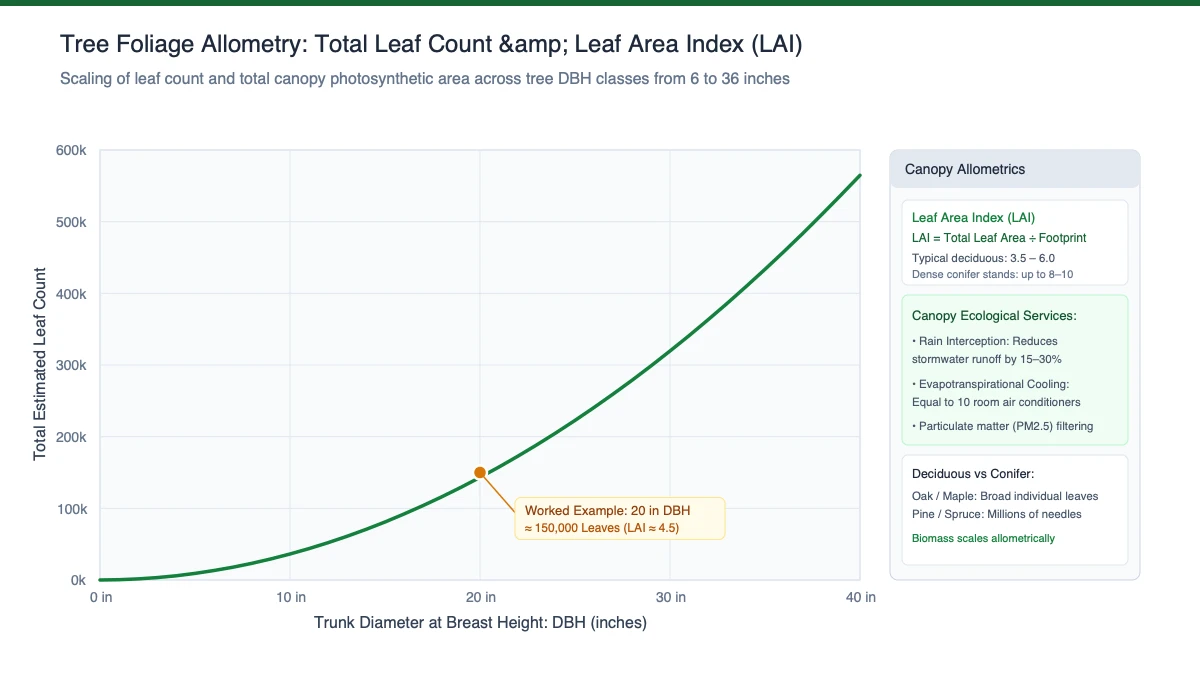
The Tree Leaves Calculator estimates total leaf count and cumulative foliar surface area ($m^2$) from tree crown volume and leaf area index (LAI). A tree's entire economy runs through its leaves: every millimetre of blade is a solar panel trading water for carbon. This calculator scales from one leaf to the whole canopy: enter blade length and width to get a single leaf's area, multiply out to total canopy leaf area, and divide by the ground it shades to get leaf area index, the number ecologists use to compare canopies.
Tree Leaves Calculator: result
At a glance
- What it does: Estimates one leaf's area from blade length and width, then scales to canopy total and leaf area index.
- Who it is for: For students, researchers and growers who need foliage area without a leaf-area meter on hand.
- Typical result: Returns cm² per leaf, m² of leaf for the tree, and an LAI read against open and closed ranges.
How to use the tree leaves calculator
- Pick the shape model: the ellipse for most simple leaves, the Montgomery 0.75 factor when you want the field-empirical estimate that hedges the blunt tips and narrow bases real blades have. prefill →
- Measure one representative, fully expanded leaf (length from tip to petiole insertion, width at the widest point) in centimetres. prefill →
- Estimate the leaf count with the branch method: count leaves on two or three representative branches, average, and multiply by the number of branches (foliage loads the outer crown shell, so inner twigs matter less).
- Enter the ground area the canopy shades (the crown footprint for a single-tree LAI, a plot area for stand work) and read LAI; leave it at 0 for per-leaf and total areas only.
- Sanity-check the LAI against what you can see: below 2 you should be finding ground between crowns, above 4 the canopy should be closing over most of the plot.
Tree Leaves: the formula & its source
One leaf's area depends on the model you trust for blade shape:
Aleaf = π × (L ÷ 2) × (W ÷ 2) = π × L × W ÷ 4 (ellipse)
Aleaf = 0.75 × L × W (Montgomery empirical factor)
Scale to the tree, then to the ground it occupies:
Atotal = Aleaf × number of leaves
LAI = Atotal ÷ ground area (m²)
The ellipse gives about 0.785 × L × W; the Montgomery factor of 0.75 sits slightly lower because real blades taper at both ends. Both are one-sided projected areas: the convention that makes LAI comparable between studies.
| Symbol | Meaning | Unit | Typical range |
|---|---|---|---|
L | blade length from tip to the petiole insertion | cm | 1–60 cm |
W | widest span across the blade | cm | 0.5–30 cm |
A_leaf | projected area of a single leaf | cm² | 1–500 cm² |
N | leaves counted on the whole tree | count | 100–100,000 |
G | ground area the canopy shades | m² | 1–10,000 (0 skips LAI) |
LAI | one-sided leaf area per unit of ground | ratio | 0–8 |
Tree Leaves: worked example
Worked example: a 12 × 6 cm leaf, 25,000 leaves, 45 m² of ground. Ellipse area = π × 12 × 6 ÷ 4 = π × 18 = 56.55 cm² per leaf. Total = 56.55 × 25,000 = 1,413,717 cm² = 141.37 m² of leaf. LAI = 141.37 ÷ 45 = 3.14: a mid-range canopy that should read as mostly closed with occasional gaps. Switch to the Montgomery model and the same leaf gives 0.75 × 72 = 54.00 cm², total 135.00 m², LAI 3.00, a 4 % difference from shape assumption alone, far smaller than the error in counting 25,000 leaves.
Example B: no ground area
Example B: ground area left at zero. A smaller 8 × 4 cm blade under the ellipse model gives π × 8 × 4 ÷ 4 = 25.13 cm². Twelve thousand leaves total 301,593 cm², which is 30.16 m² after dividing by 10,000. Enter 0 in the ground field and the tool reports both areas while skipping the LAI row, exactly what you want when only a single crown's foliage mass is being estimated. Re-enter the crown footprint (say 20 m²) and LAI appears at 1.51, an open canopy you would expect to see ground through.
Field method
Choose one representative, fully expanded leaf from the sunlit outer crown, lay a ruler from tip to the point where the blade meets the petiole, and note the widest span across it. Those two lengths decide the per-leaf area. Growing the answer to a whole tree runs through the branch method: count leaves on two or three typical branches, average them, and multiply by the number of branches you paced off. The ground term closes the chain: a crown footprint for one tree, a plot outline for a stand. Date the field notes, because the same canopy in June and again in September is a different measurement.
Counting leaves you cannot count
A mature broadleaf may carry tens of thousands of blades, so the count is a sampling problem rather than a tally. Work from the outer shell of the crown, where the foliage actually hangs, and treat sheltered inner twigs as leftovers rather than a second population. Compound species demand a decision before the first leaf is picked: ash or locust leaflets must be counted as leaflets if the blade dimensions were taken leaflet by leaflet, and mixing the two conventions shifts totals by factors rather than percent. Sample branches of middling vigour, not the long shoot nearest your hand, and the extrapolation holds.Record the branch sample as counts per branch rather than one grand total, because re-running that arithmetic later is the only way to notice a limb that was tallied twice or skipped entirely.
Instrument error
A ruler pressed against a curling blade contributes the first wobble, and the ellipse model contributes the second: real leaves taper at both ends, which is precisely what the Montgomery 0.75 factor absorbs. Both pale next to the count. Branch sampling that misses by a third moves total leaf area by a third, while a millimetre of error on a 12 cm blade shifts the result under two percent. The ground area is the quiet term: a crown footprint a single-tree LAI and a plot outline gives a stand figure, and the two ratios are not comparable even when the arithmetic looks identical.
Common blunders
Centimetres squared must be divided by 10,000 before they meet a ground area in square metres; skipping that step inflates LAI by the conversion itself rather than by anything biological. Counting leaflets while measuring whole leaves, or the reverse, distorts the total beyond any sensible rounding. Quoting LAI with neither the season nor the denominator attached makes the number impossible to compare with anything. Leaving the ground field at 0 is correct when only areas are wanted, yet reading a blank LAI row as a zero canopy happens often enough to be worth checking before the figure travels.
Worked field example
A 12 × 6 cm blade under the ellipse model gives π × 12 × 6 ÷ 4 = 56.55 cm². Twenty-five thousand of them come to 1,413,717 cm², or 141.37 m² once square metres are restored by dividing by 10,000. Spread across 45 m² of ground, LAI reads 3.14, a canopy you would expect mostly closed with gaps still showing. Swap in the Montgomery factor and the same blade gives 54.00 cm², the total falls to 135.00 m², and LAI settles at 3.00. Shape assumption costs 4 %; the branch count behind N can easily cost ten times that.
Unit systems
Blade dimensions belong in centimetres and totals in square metres, with a flat 10,000 cm² per m² between them, and that single division is where hand calculations usually break. Ground area is entered directly in m² whether it came from a crown footprint or a plot tape, so nothing else converts. Readers working in inches must translate the blade first, since the model offers no imperial path. Keep leaf area in m² and LAI as a bare ratio: leaf area index carries no unit, and attaching one to it is the fastest way to tell a reader that the denominator changed mid-report.
What your tree leaves result means
LAI is the exchange rate of the canopy: it governs how much light is intercepted, how much rain is caught and evaporated before reaching soil, and how much carbon the tree can fix per square metre of land. Two stands with identical stem counts can differ twofold in LAI if one carries double the foliage, which is why growth models and remote-sensing products work in leaf area rather than tree count.
The scaling chain also shows where uncertainty lives: leaf dimensions are easy and exact, the leaf count is the soft step (branch sampling can easily miss by 30 %), and the ground-area choice decides whether you are reporting a single crown's density or a whole plot's.
How to read the output:| Result range | What it means | What to do next |
|---|---|---|
| LAI below 2 | open or young canopy | Ground should be plainly visible between crowns |
| LAI 3–6 | closed broadleaf canopy | Most of the plot shades over at midday |
| LAI above 6 | very dense foliage | Re-check the count; light may be limiting growth |
| cm² per leaf | single blade result | Compare blades before any scaling is done |
| Total in m² | whole-tree foliage area | Feeds gas-exchange and biomass comparisons |
| LAI row blank | ground area entered as 0 | Expected: enter a footprint to compute it |
Model whole-canopy carbon assimilation across millions of leaves using our forest canopy photosynthesis calculator.
Common mistakes with the tree leaves
- Dividing the totals by the wrong factor: Square centimetres become square metres over 10,000, so do that division before dividing by the m² ground area or LAI lands 10,000 times high.
- Counting leaflets while measuring whole leaves: Match the count to the blade you measured: an ash frond is one leaf and dozens of leaflets, and mixing them shifts totals by factors.
- Treating the leaf count as a precise input: Branch sampling can miss by a third, so round N to two figures and quote LAI to one or two decimals rather than three.
- Quoting LAI without a denominator or a date: State whether the ground term was a crown footprint or a plot, and name the month, since deciduous canopies swing from near zero to peak.
- Expecting shaded inner leaves to photosynthesise like sun leaves: The formula treats every blade as live and well lit, so trim the interpretation when the crown is dense or heavily browsed.
Limits of the tree leaves calculator
Compound leaves break naive measurement: an ash frond is one leaf but dozens of leaflets, and mixing leaflet-sized areas with whole-leaf counts (or vice versa) shifts totals by factors, not percent. Measure a single leaflet only if the counts were made leaflet by leaflet.
Deciduous canopies are seasonal: the same tree swings from near 0 in winter to its peak in midsummer, so a leaf-area figure without a date is uninterpretable. Damage, herbivory, and interior shading mean not every leaf counts equally: the estimate treats all foliage as live and well lit, which overstates photosynthesis for shaded inner leaves. And one crown footprint is not the same statistic as plot LAI where crowns overlap.
Forestry note from Dr. Dinesh A. Nagegowda, PhD: Estimating total leaf area index (LAI) and foliar leaf count in mature forest trees couples allometric sapwood cross-sectional area with crown volume. In our physiological studies, leaf mass per area (LMA) varies significantly between upper sun leaves (thick, high chlorophyll density) and lower shade leaves (thin, broad surface area), directly influencing total photosynthetic carbon assimilation.
Understand how annual leaf production fuels woody carbon storage in our tree biomass and carbon storage guide.
Sources
- American Forests, Tree Measuring Guidelines (used for: length-and-width measurement practice for tree parts applied here to a leaf blade)
- US Forest Service, nationwide forest inventory field guide (used for: plot area and stem tally conventions behind the ground term in LAI)
- Oregon State Extension EM 9058, Measuring Your Trees (used for: crown and canopy measurement practice when scaling from one leaf to a whole tree)
Cite This Calculator
For laboratory course reports, academic papers, or institutional protocols (APA format):
Tree Leaves: frequently asked questions
How do you measure leaf area without a machine?
Trace or flatten the leaf, measure length and width, and apply pi/4 x L x W (or the 0.75 Montgomery factor). Photograph the leaf against a ruler and measure in image software for quick work; the dimensional formulas agree with planimeter readings within a few percent for most simple shapes.
What is a good LAI for my tree or stand?
Closed broadleaf canopies commonly run about 3–6, open or young stands below 2, and dense plantations can exceed 6. Compare like with like: crown-based LAI (this tool with a crown footprint) and plot-based LAI in a closed stand use different denominators.
Does LAI count both sides of the leaf?
No. One-sided (projected) area is the standard convention and this calculator follows it. Some older agricultural papers use a double-sided convention for low crops like clover; check which convention a quoted figure uses before comparing.
Found a number that does not match its source? Report a mistake. Corrections are published in place and the page date is updated.
Does a figure on this page disagree with the source behind it? Let us know.

Dr. Dinesh A. Nagegowda, PhD: Plant & Molecular Biology Editor
Dinesh is a plant molecular biologist and Chief Scientist at CSIR-CIMAP whose research runs through functional genomics, transcriptomics, metabolomics, and biosynthetic pathways in plants. He writes and…