Guide · Trees & Forestry
How Much Carbon Does One Tree Actually Store?
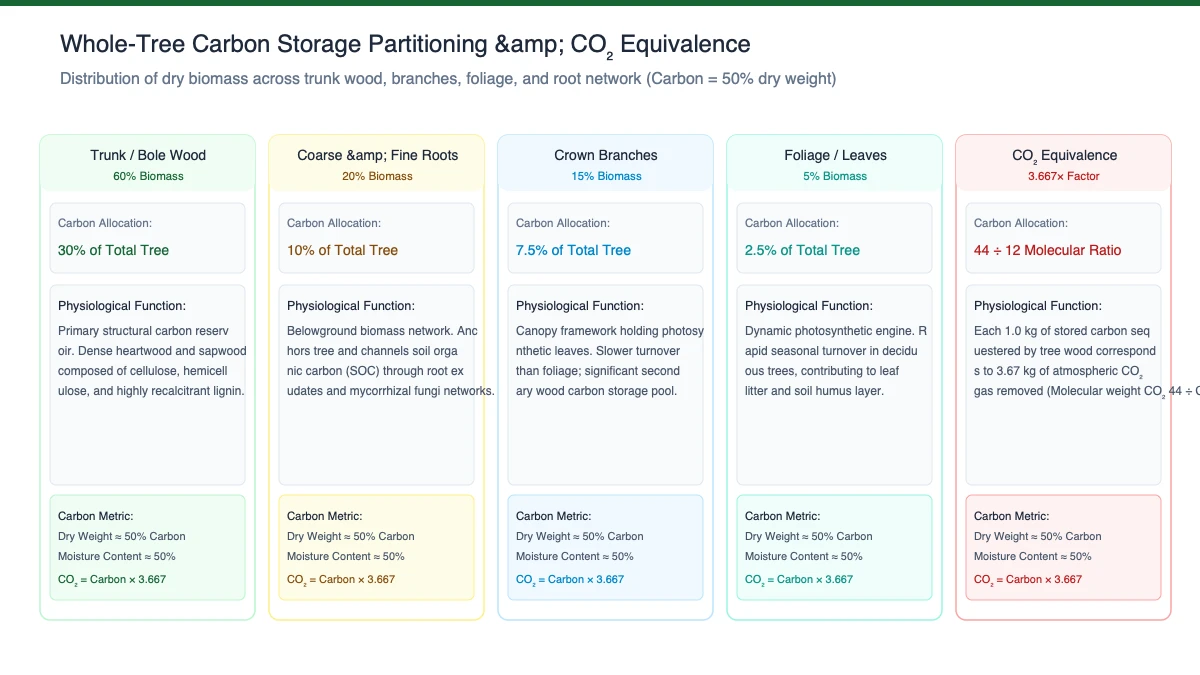
Arboreal carbon sequestration modeling calculates tree biomass from wood density coefficients and DBH measurements, converting total dry weight into sequestered elemental carbon ($50\%$) and carbon dioxide equivalent ($ ext{CO}_2e = ext{Biomass} imes 0.5 imes 3.67$). Computing allometric carbon storage quantifies forest ecosystem contribution to atmospheric carbon mitigation.
Key takeaways
- Carbon is 0.47 of dry biomass by mass, and carbon becomes CO2 by multiplying by 44/12 = 3.67.
- A standing tree cannot be weighed, so foresters scale diameter, height and wood density through a published allometry.
- Stock and rate are different figures: kilograms held today, and kilograms added this year.
- Single-tree allometries carry roughly 20 to 35 percent error, so a named method plus a band beats false precision.
- Roots, soil, litter and harvested products sit outside every one of these equations.
Interactive Calculator: Calculate carbon storage and annual CO2 absorption for any tree species with our tree carbon sequestration calculator.
Biomass first, carbon second, CO₂ third
Wood mass is not carbon mass, and carbon mass is not CO₂ mass. The chain runs through two published constants. The 2006 IPCC Guidelines for National Greenhouse Gas Inventories set the default carbon fraction of aboveground forest biomass at 0.47 tonnes of carbon per tonne of dry matter (Volume 4, Chapter 4, Table 4.3): under half of every kilogram of wood is carbon. Then chemistry: CO₂ is 44 parts mass to carbon's 12, so carbon becomes CO₂ by multiplying by 44/12 = 3.67.
carbon (kg) = biomass × 0.47
CO₂ (kg) = carbon × 44/12 = carbon × 3.67
Work it end to end on a mid-sized hardwood: 582 kg of dry biomass becomes 273 kg of carbon, which becomes 1,003 kg (about a tonne) of CO₂. The most common reporting error in this field is labelling the middle number as the last one: calling 273 kg 'carbon dioxide stored' understates the climate claim by nearly three-quarters. Say which of the three you mean, every time.
Getting biomass without a scale
You cannot weigh a standing tree, so foresters scale it from measurements through an allometry, a regression fitted to felled, weighed trees. The modern default for tropical work is Chave and colleagues' pantropic model (Global Change Biology, 2014, Equation 4), which combines diameter, height and wood density in a single term:
AGB = 0.0673 × (ρ × D² × H)0.976 (D in cm, H in m, ρ in g/cm³, AGB in kg)
A 30 cm, 20 m tree at 0.60 g/cm³ returns about 582 kg of aboveground dry biomass. For quick screens there is the diameter-only route: Jenkins and co-authors' national US estimators (Forest Science 2003, 49(1):12–35) fit species-group equations of the form AGB = exp(β₀ + β₁·ln D), and the same 30 cm trunk lands near 390 kg. Different continents, different tree populations, same tree, which is the point of the next sentence: Jenkins et al. found about 80% of their reference data fell within 20–35% of the fitted equations, and single-tree figures should be quoted with that band attached.
Stock is not a rate
The tonnage above is what the tree holds today, a stock. Sequestration is a flux: kilograms added per year. The clean way to estimate it is to re-run the same allometry one diameter increment into the future. If the 30 cm hardwood above adds 0.6 cm of DBH annually, the Chave equation returns 604.5 kg next year, a 22.9 kg biomass gain, or about 40 kg CO₂ sequestered in the year.
Read that figure against the headlines. Forty kilograms is a slow accumulator: worth compounding over decades of growth and worth planting for canopy, cooling and habitat co-benefits, but not an offset you can sell this year. Rates also decay: as a tree approaches its maximum size, ring widths narrow and annual sequestration falls toward zero while the stock stays in the trunk.
What the estimate leaves out
Every one of these equations counts aboveground dry wood and sometimes foliage. Roots are excluded (typically a meaningful fraction of total tree mass), as are soil organic carbon, litter, dead wood and the products a harvested tree becomes. A claim about what a tree 'stores' that sweeps in soil carbon is mixing pools with different measurement methods and different turnover.
Permanence is the other omission. Carbon stays sequestered only until fire, windthrow, harvest, insect kill or decay returns it to the atmosphere, so every credible figure carries a time horizon: 'held for 30 years' rather than 'stored'. The IPCC framework exists precisely to keep national accounts honest about exactly these distinctions.
Mistakes that wreck carbon claims
- Swapping carbon and CO₂. Multiply by 3.67, once, and label the unit.
- Quoting point estimates. Allometries carry ±20–35% single-tree error; a rounded figure with the method named beats a false-precision kilogram.
- Ignoring wood density. It enters the Chave equation directly. Look the species up rather than defaulting to 0.60 g/cm³.
- Mixing equations across the same claim. A Chave number and a Jenkins number for one tree differ by a third; pick one method and say which.
- Treating stock as perpetual. Add a horizon, or the claim assumes no fire, no harvest and no decay, ever.
Why two equations disagree about the same tree
Run one 30 cm trunk through both published routes and the answers land a third apart: about 582 kg from Chave's pantropic model and about 390 kg from the Jenkins national US estimators. Nothing is broken. Chave's equation takes diameter, height and wood density together, so a tall, dense tree is priced as one; the Jenkins species-group equations take diameter alone, fitted to felled sample trees from a different set of forests. The gap is what different tree populations and site conditions look like once they are compressed into a single regression, and it is the reason a carbon claim should name its equation.
Pick one route for a whole inventory, keep every tree on it, and state which one you used. Mixing a Chave number and a Jenkins number inside a single total produces a figure that describes no method at all, and a reader who recognises the mismatch will trust neither half. If the answer will be quoted, carry the inputs with it: diameter, height where the equation needs it, the density you looked up, and the equation itself.
Look up wood density before you trust the tonnage
Wood density is the one input you can get wrong without ever touching the tree. It sits inside the same base term as diameter squared and height, and because the exponent is 0.976 the output tracks it almost step for step, so a density guessed rather than looked up imports its full error straight into the tonnage. The 0.60 g/cm3 used in the worked example is a convenience for a mid-sized hardwood, not a value that holds for every species.
Diameter-only equations avoid the choice by folding density into the fitted species group, which is part of why their answers sit where they do; the cost of that convenience is that the species group is doing the deciding for you. Whichever route you take, the estimate still carries the limits already named: aboveground dry wood only, a single-tree band of roughly 20 to 35 percent, and a stock that stays sequestered only while the tree does. Record the inputs with the output and the figure remains checkable a decade from now.
Worked example: How Much Carbon Does One Tree Actually Store?
A 30 cm, 20 m hardwood at 0.60 g/cm3 returns about 582 kg of aboveground dry biomass from the Chave equation. Multiply by 0.47 for 273 kg of carbon, then by 44/12 for roughly 1,003 kg of CO2, about a tonne. Re-run the same equation one diameter increment ahead: 0.6 cm of growth a year gives 604.5 kg next year, a 22.9 kg gain, which is about 40 kg of CO2 sequestered in the year. Say which of the three numbers you mean. Run the 30 cm hardwood in the tree carbon calculator →
Put it to work: How Much Carbon Does One Tree Actually Store?
The calculators below apply exactly what this guide explains: same formula, no mental arithmetic.
How Much Carbon Does One Tree Actually Store?: frequently asked questions
How much CO₂ does one tree store?
There is no single answer. It scales with size, species and age. A roughly 30 cm, 20 m hardwood computes to about a tonne of CO₂ in aboveground wood via the Chave 2014 equation, with ±20–35% allometric error. Small urban trees hold tens of kilograms; old-growth giants hold tonnes.
Is carbon the same as CO₂?
No. Carbon is 0.47 of dry biomass by mass; converting carbon to CO₂ multiplies by 44/12 = 3.67. A tonne of CO₂ contains only about 270 kg of carbon.
How fast does one tree sequester carbon?
For a mid-sized hardwood adding 0.6 cm of diameter a year, the same allometry gives roughly 40 kg CO₂ per year, and the rate declines as the tree ages and rings narrow.
Does the carbon stay stored?
Only while the tree does. Fire, storm, harvest and decay release it, so credible sequestration claims state a time horizon and usually a risk buffer.
Sources & further reading
Found a number that does not match its source? Report a mistake. Corrections are published in place and the page date is updated.

Dr. Dinesh A. Nagegowda, PhD: Plant & Molecular Biology Editor
Dinesh is a plant molecular biologist and Chief Scientist at CSIR-CIMAP whose research runs through functional genomics, transcriptomics, metabolomics, and biosynthetic pathways in plants. He writes and…