Free Animal Pregnancy tool
 Free Animal Pregnancy tool
Rabbit Pregnancy Calculator
The Rabbit Pregnancy Calculator calculates the doe kindling date and nest-box placement timeline based on a 31-day rabbit gestation average. Rabbits have one of the shortest pregnancies in livestock (about 31 days), with kindling anywhere from day 28 to 33. Enter the breeding date for the due date, gestational day, and the nest-box timeline: box in by day 28–29, fur pulled 12–24 hours before kindling, and kits born blind and hairless, opening their eyes around day 10.
Rabbit Pregnancy Calculator: result
At a glance
- What it does: Adds 31 days to a breeding date and prints the kindling date, gestational day, and the 28–33 day window.
- Who it is for: Made for breeders timing the nest box, watching for false pregnancy, and planning the kindling check.
- Typical result: Returns the expected date, her stage today, and the milestones that fall in the last few days of the window.
How to use the rabbit pregnancy calculator
- Enter the date the doe was put with the buck. Ovulation is induced by mating (10–13 hours after), so a single successful exposure dates the whole pregnancy. prefill →
- Leave the check date as today for her gestational day, or set any date to plan the nest box and kindling watch. prefill →
- Watch the milestones: palpable beads from day 12, false-pregnancy confusion through day 17, nest box in by day 28–29.
- Expect kindling inside the 28–33 day window and do not peek during or right after it: quietly add hay if the nest looks thin.
- Use the overdue warning if day 33 passes: veterinary help after day 32 is normal practice, not an overreaction.
Rabbit Pregnancy: the formula & its source
Rabbit gestation averages 31 days, with a normal window of days 28–33 (Merck lists 31–33; extension guidance commonly uses 28–33). Because ovulation is induced by mating itself (10–13 hours after service), the breeding date is an unusually accurate anchor for rabbits.
Stages: days 0–11 (fertilization and free-floating embryos), days 12–27 (palpable from day 12; a 17-day false pregnancy can imitate early pregnancy), and days 28–31 (nesting, kindling, and the window itself).
due date = breeding date + 31 days
gestational day = (check date − breeding date) in days
| Symbol | Meaning | Unit | Typical range |
|---|---|---|---|
breed_date | Date the doe was put with the buck | date | any date within the last 40 days |
ref_date | Date her status is read for, left blank for today | date | the breeding date through day 33 |
D | Gestational day counted from the breeding date | days | 0 to 31 |
due | Expected kindling date, computed as D plus 31 | date | 28 to 33 days after breeding |
Rabbit Pregnancy: worked example
Worked example: bred September 5. Kindling date: September 5 + 31 = October 6. Kindling window: October 3 – October 8, so the nest box goes in October 3 (day 28). Checking on September 19 puts her at day 14 of ~31 (45% of term) with 17 days left: beads already palpable if you know the technique, and the false-pregnancy period (day 17) two days away.
Example B: false pregnancy nesting at day 17
Example B: nesting on day 17 with no kits to follow. A doe bred on 3 April begins pulling fur and arranging hay around 20 April, which is the date a real pregnancy would show late behaviour and the point a pseudogestation of roughly 17 days peaks as well. Palpation from day 12 would have settled the question a week earlier, and without it the calendar keeps both possibilities open until day 28 passes with nothing. Keep the nest box out of reach until day 28, and confirm by feel or by a heat check rather than by the nesting.
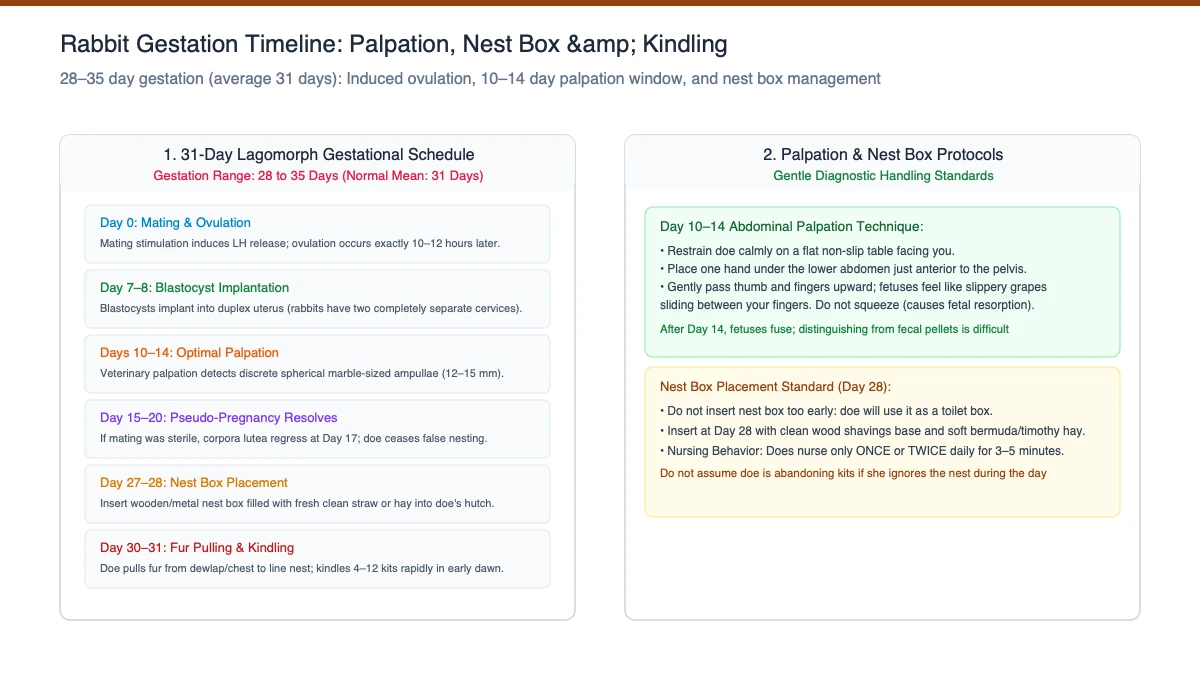
Average and range in days
Rabbit pregnancy averages 31 days, with normal kindling between day 28 and day 33. Some references give 31 to 33 while extension guidance commonly works with 28 to 33, and the difference comes down to breed and body weight: smaller breeds tend to kindle earlier, heavier ones later. Five days of spread is ordinary, and within it the computed date is a planning marker rather than a promise.
The anchor for this species is unusually reliable. Ovulation is induced by mating itself, occurring 10 to 13 hours after service, so a single successful exposure dates the entire pregnancy with a precision that timed breeds and recorded heats cannot match. The practical consequence is that a well-kept breeding date gives a kindling window you can act on, with the nest box going in at day 28 to 29 regardless of which end of the band the computed date happens to sit on.
Predict kit phenotype distributions and recessive color allele frequencies with our rabbit coat color genetics calculator.
Early signs and timeline
Fertilisation and early embryonic development run through days 0 to 11 with nothing to observe. From about day 12 the embryos are palpable as firm beads along the uterine horns, which is the earliest point at which a pregnancy can be confirmed by feel, and experienced breeders use it precisely because the next two weeks contain a trap.
That trap is pseudogestation, a false pregnancy of roughly 17 days that is hormonally real and carries no embryos. A doe experiencing one may nest, act territorial, and behave exactly like a pregnant animal, so palpation from day 12 or a confirmed return to heat is what separates the two. From day 28 the practical work begins: nest box in by day 28 to 29, fur pulled and arranged 12 to 24 hours before kindling, and kits born blind, hairless and entirely dependent, opening their eyes around day 10 and starting solids near day 18 to 21.
When to see a vet
Day 33 is the practical deadline for a doe that appears ready to kindle. Veterinary help after day 32 is normal practice in most breeding programmes rather than an overreaction, and a doe that passes day 33 with no kits, especially one showing nesting behaviour, should be examined rather than given another day.
The other reason to call is a litter that seems to vanish. Stress-induced resorption in the first two weeks can remove a pregnancy entirely, and the doe's condition and behaviour may not make that obvious. A doe who strains without delivering, who delivers part of a litter and stops, or who shows discharge or lethargy around kindling needs attention at once. None of these situations improves with time, and the window in which intervention helps is measured in hours.
How accurate is the estimate
Because ovulation follows mating by only 10 to 13 hours, the input date carries more weight here than in almost any other species on this site. Two days of normal variation remains inside the 28 to 33 day window, and most of that variation tracks breed size rather than uncertainty about when conception occurred.
Confirmation is available early. Palpation from day 12 identifies beads and rules out pseudogestation at the same time, and a return to heat check around day 17 to 18 gives an alternative when handling is undesirable. Neither method narrows the kindling date further, since the range is already narrow to begin with. Use the calculator to fix the nest box date and the watch period, then let palpation handle the question of whether the doe is pregnant at all.
Record the pairing rather than the observation. A doe put with a buck on a known date, for a known duration, gives a start point that induced ovulation then fixes within half a day, and that precision is why this page can promise a five-day band where most species offer far more. Does left with a buck permanently are a different matter, since multiple exposures produce competing dates and the earliest one governs. Body weight adds the remaining variation, with smaller breeds tending toward the early side of the window and heavier ones toward the late side. Neither effect moves the nest box date, which stays fixed at day 28 to 29 whatever the breed.
What your rabbit pregnancy result means
With a five-day window and a 31-day average, the gestational day is what you actually work from: before day 28 nothing needs doing, and the box-in date is fixed at day 28–29 regardless of the due date.
False pregnancy is the trap of this species: a 17-day pseudogestation produces a nesting, territorial doe that looks bred. Only palpation from day 12, or a confirmed return to heat, separates the two.
How to read the output:| Result range | What it means | What to do next |
|---|---|---|
| Days 0–11 | fertilisation and free-floating embryos | Keep records and avoid unnecessary handling |
| Day 12 | embryos palpable along the uterine horns | Confirm by palpation and rule out a false pregnancy |
| Day 17 | false pregnancy period peaks around here | Check for a return to heat if nesting has started |
| Days 28–29 | nest box goes in ahead of kindling | Place the box with bedding and leave the doe to settle |
| Days 28–33 | normal kindling window around the computed date | Watch quietly for fur pull and delivery |
| Day 33 onward | past the window with no kits | Contact a vet, as help after day 32 is routine |
Common mistakes with the rabbit pregnancy
- Adding the nest box on the computed due date: Fit it at day 28 to 29 instead, since kindling can start early and the doe needs the box in place beforehand.
- Reading nesting behaviour as proof of pregnancy: Confirm by palpation from day 12 or a heat check, because a 17-day false pregnancy produces identical nesting behaviour.
- Disturbing the nest on day 30 or 31: Leave the nest alone during kindling, and quietly add hay rather than handling the doe or the kits.
- Rebreeding the doe the day after kindling: Give her 35 to 42 days of rest, skipping a litter, so body condition recovers before the next pregnancy.
Limits of the rabbit pregnancy calculator
Stress-induced resorption is a real cause of a 'missing' litter in the first two weeks, and a doe bred across multiple exposures can be harder to date. Treat ±2 days as normal variation inside the 28–33 window.
A doe can conceive again within 24 hours of kindling: useful if intended, a surprise if not. Most advisors recommend letting her rest 35–42 days (skipping a litter) before re-breeding so she recovers body condition. Never disturb a nest on day 30–31.
Clinical note from Dr. Chyrle Bonk, DVM: Rabbit gestation averages 31 to 32 days. In our lagomorph consults, does must be provided with a nesting box and clean straw on day 28; providing it too early leads to soiling, while late provision risks kits being kindled on cold wire floors. Pseudopregnancy is common if an unbred doe is mounted by another female, lasting roughly 16 to 18 days with intense nest-building and fur-plucking that resolves spontaneously.
Sources
- Merck Veterinary Manual, Breeding and reproduction of rabbits (used for: 31-day gestation average and induced ovulation 10–13 hours after mating)
- USU Extension, Rabbit breeding and management: a guide for producers (used for: 28–33 day kindling window, nest box timing, and re-breeding intervals)
- USU Extension, Basic rabbit selection and breeding considerations (used for: palpable pregnancy from day 12, false pregnancy, and kit development milestones)
Cite This Calculator
For laboratory course reports, academic papers, or institutional protocols (APA format):
Rabbit Pregnancy: frequently asked questions
How long is a rabbit pregnant?
About 31 days on average, with normal kindling between day 28 and 33 from the mating date.
What is a false pregnancy?
A pseudogestation of about 17 days, hormonally real but containing no embryos. The doe may nest and act territorial; palpation from day 12 or a heat check settles it.
When should the nest box go in?
Day 28–29: a day or two before kindling. Fur pull and active nesting begin 12–24 hours before the kits arrive.
How soon can the doe be bred again?
She can be bred within 24 hours of kindling, but a rest of 35–42 days (skipping one litter) is better for her condition and future litters.
Found a number that does not match its source? Report a mistake. Corrections are published in place and the page date is updated.
Something on this page not matching its cited source? Report it.

Dr. Chyrle Bonk, DVM: Veterinary Editor
Chyrle is a mixed-animal veterinarian in rural Idaho who has practised since 2010, with a particular emphasis on food-animal medicine and cattle alongside her companion-animal caseload. She reviews the…