Guide · Animal Pregnancy
How Accurate Are Gestation Calculators, Really?
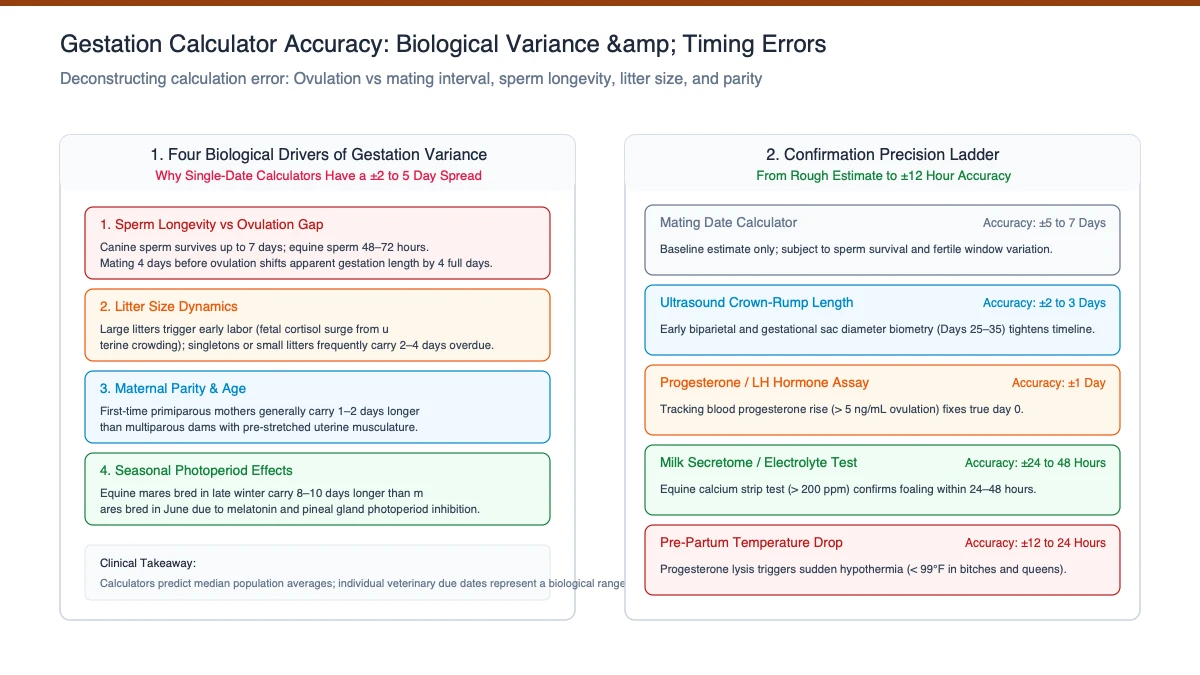
Animal gestation calculators predict parturition dates by projecting mean species-specific embryonic development timelines from observed breeding timestamps. When supplied with confirmed ovulation dates, mathematical estimates achieve clinical precision within two to four days; unobserved breeding intervals introduce biological variance that veterinarians resolve through progesterone assays and ultrasonography.
Key takeaways
- A calculator adds one species mean to the date you typed, so the date sets the ceiling.
- One bitch pregnancy reads 56–58, 64–66 or 58–72 days depending on which clock starts.
- Ultrasound ages to about ±3 days in a bitch and ±2 in a queen; radiographs do better near term.
- Treat every due date as a span: prepare at the early edge, escalate past the late edge.
Interactive Calculator: Need an accurate whelping estimate for your dam? Enter breeding dates into our canine pregnancy due date tool for week-by-week developmental milestones.
What the calculator actually knows
Under the hood there is only one operation: breeding date plus species mean gestation. The software knows the calendar and the mean; it does not know when ovulation occurred, when fertilization happened, or how this particular animal compares with the average. That limitation is not a software flaw. It is veterinary consensus. The Merck Veterinary Manual's whelping guidance (Merck Veterinary Manual, Whelping and Queening) states it plainly: breeding dates and conception dates do not correlate closely enough to permit accurate prediction of whelping dates. The calculator is faithfully computing the best estimate available from the one input you gave it, and the honest question is how good that input usually is.
One animal, three clocks
Dog gestation is the clearest demonstration that even experts date from different reference points. The same pregnancy, per Merck's guidance, reads 56 to 58 days counted from the onset of diestrus, 64 to 66 days from the progesterone rise above 2 ng/mL or the luteinizing hormone surge, and 58 to 72 days counted from the first permitted breeding. Three clocks, one pregnancy, and a spread of more than two weeks depending on which one starts the count. Queens are similar: about 64 to 66 days from the LH surge, while dating from the mating date the calculator uses averages 65 with a 61–69 window. The number is precise only once you fix the origin, and breeders fixing it by mating date inherit every day of uncertainty between mating and ovulation.
How large is the error in practice
Breeding-date error is the dominant term. Semen remains viable several days after mating, ovulation timing varies relative to the visible heat, and animals bred across multiple days can conceive over a stretch: the site's own dog calculator cautions that multi-day matings and ovulation timing shift due dates by about ±3 days, which is why it presents a 58–68 day window alongside the single date. Imaging error, for comparison, is smaller: Merck's pregnancy-determination table (Merck Veterinary Manual, Pregnancy Determination in Bitches and Queens) puts ultrasound gestational age at roughly ±3 days in the bitch and ±2 days in the queen. Independent veterinary work reaches the same verdict on the other side of the comparison: Lopate's theriogenology review (Lopate, Theriogenology, 2008) reports that use of breeding dates alone does not provide due dates with adequate accuracy, and recommends imaging-based aging instead when the date matters clinically.
The methods, ranked by error
When precision changes a decision (scheduling a C-section, planning induction, staffing a barn), these are the tools in order of tightening accuracy:
| Method | Typical accuracy | What it tells you |
|---|---|---|
| Breeding date + mean gestation | ±3–5 days or worse | Window only; best available without records |
| Progesterone / LH timing | ±1 day of ovulation | Retroactive gold standard: fixes the clock's origin |
| Ultrasound | ±2–3 days | Confirms pregnancy early; ages it by measurements |
| Radiograph | ±1–2 days near term | Skeletal calcification from ~day 45; counts puppies |
| Relaxin test | yes/no, not a date | Presence of pregnancy after ~day 22–27 |
Note what the ranking rewards: knowledge of ovulation beats inference from behavior, and imaging beats both for counting. In cattle, where service dates are recorded to the day and breed means are well characterized (dairy near 279, beef near 287), the calculator's window is genuinely tight; in a free-mated flock dated by raddle marks redrawn every 14 to 17 days, the same arithmetic starts several days fuzzy by design.
Working well inside a ±3-day world
Treat every due date as a span. Prepare for the earliest edge of the window (day 58 for a bitch, day 61 for a queen), and treat the late edge as the escalation line: past day 68 with no labor, or day 70 without whelping, contact your veterinarian rather than waiting another night. The red-flag list does not move with the estimate: hard straining without delivery, green discharge, bleeding, or lethargy mean call immediately whenever they appear. Within that frame the calculator does exactly what it should: it tells you when to be present, when to be ready, and when the calendar has run out and imaging should take over. Precision beyond that comes from hormones and X-rays, not from a finer algorithm on the same date.
Why the origin date dominates the error
The calculator's arithmetic is exact; every uncertain day sits upstream of it. Three biological facts stand between the date in your record and the moment a pregnancy actually begins. Ovulation does not announce itself in step with visible heat, so the day you observed mating and the day the egg was ready can disagree by a day or two. Fertilisation stays possible for several days after a single mating, because semen remains viable, so conception can fall anywhere across that stretch rather than on the recorded night. Animals bred on more than one day inherit the full span of those matings on top of everything else. None of this changes the number you type, and because the software adds one fixed mean to it, each uncertain day passes straight through to the due date. That is the ceiling worth remembering: not the formula, but everything the formula is standing on.
Building a record the calculator can trust
Each method in the ranking fixes a different origin, and a good record captures each one the moment it becomes known. Log the date of the mating itself, never the day heat was noticed. When progesterone was tracked, write the date it rose past 2 ng/mL; when an LH surge was sampled, write that date instead, because either one pins ovulation to about a day and becomes the true start of the clock. Note every repeated mating, since the earliest permitted breeding sets your readiness date and the latest sets the escalation line. Keep imaging reports with their measurements: an ultrasound age read from fetal structures is evidence that never passed through a calculator at all. With those entries on the page, the arithmetic stops being a guess with a date attached. It becomes one input among several, each carrying a stated error you can hand to a veterinarian. Records like these are also auditable later: when a due date and a litter disagree, the page shows which origin produced the number and how far that origin could reasonably be wrong.
Worked example: How Accurate Are Gestation Calculators, Really?
Suppose a single mating was recorded on 1 June and nothing else is known. Adding the bitch's 63-day mean gives 3 August, but the honest answer is the window: prepare from day 58 (29 July) and escalate past day 68 (8 August) if whelping has not started. Now shift the record by three days (a multi-day mating or a breeding nobody watched) and the whole window slides with it, because the calculator only ever adds a mean to the date you gave it. Nothing in the arithmetic failed; the input moved. Open the prefilled whelping example →
Common mistakes: How Accurate Are Gestation Calculators, Really?
- Entering the day heat was noticed instead of the day of mating: anchor the count on the breeding record, because the calculator adds its mean to exactly what you type.
- Collapsing a multi-day mating into one date: use the earliest permitted breeding as the readiness date and the latest as the escalation line.
- Treating the output as a single day: prepare for the early edge of the window and call the veterinarian once the late edge passes with no labour.
- Reading a relaxin result as a date: it answers yes or no after about day 22 to 27 and contributes no timing information at all.
- Chasing precision with a better algorithm: the remaining error sits in the record, so progesterone or LH timing and imaging are what tighten it.
Put it to work: How Accurate Are Gestation Calculators, Really?
The calculators below apply exactly what this guide explains: same formula, no mental arithmetic.
How Accurate Are Gestation Calculators, Really?: frequently asked questions
Can a due date be off by a week?
Yes, when the breeding date itself is uncertain: multi-day matings, unobserved breedings, or dating from a heat rather than ovulation can each contribute several days. With a confirmed single breeding, ±3 days is the normal expectation.
Is ultrasound or radiograph more accurate?
Ultrasound confirms earliest and ages to about ±2–3 days; radiographs are more precise near term (±1–2 days once skeletons calcify around day 45) and are the only method that counts puppies reliably. Progesterone timing, where available, pins ovulation itself to about a day.
Why did my dog whelp three days before her due date?
Because the due date is a mean and ovulation preceded the mating by a day or two: whelping inside the 58–68 day window, on either side of day 63, is normal variation, not an error.
Do calculators work the same way for cows and cats?
The arithmetic is identical (breeding date plus mean), but the inputs differ in quality. Recorded cattle service dates and tight breed means make the result more reliable than free-mated sheep, while an induced-ovulation queen bred over several days can span a wider conception range than her single mating date suggests.
Sources & further reading
- Merck Veterinary Manual, Whelping and Queening in Bitches and Queens
- Merck Veterinary Manual, Pregnancy Determination in Bitches and Queens
- Lopate (2008), estimation of gestational age and canine fetal maturation
Cite This Calculator
For laboratory course reports, academic papers, or institutional protocols (APA format):
Found a number that does not match its source? Report a mistake. Corrections are published in place and the page date is updated.

Dr. Chyrle Bonk, DVM: Veterinary Editor
Chyrle is a mixed-animal veterinarian in rural Idaho who has practised since 2010, with a particular emphasis on food-animal medicine and cattle alongside her companion-animal caseload. She reviews the…