Free Animal Pregnancy tool
 Free Animal Pregnancy tool
Dog Pregnancy Calculator
The Dog Pregnancy Calculator estimates the canine whelping window (58–68 days), gestational week, and developmental milestones from the breeding date. Canine gestation runs about 63 days from ovulation, with a normal whelping window of 58–68 days. Enter the breeding date (or suspected mating date) to get the due date, how far along the pregnancy is today, and which developmental milestones have already passed, plus the dates that should have you calling your veterinarian.
Dog Pregnancy Calculator: result
At a glance
- What it does: Adds 63 days to a breeding date and prints the whelping date, the gestational day, and the 58–68 day window.
- Who it is for: Made for owners and breeders timing a whelping box, a pregnancy check, or a radiograph before day 45.
- Typical result: Returns the expected date, how far along she is today, and the milestones and red flags that fall near it.
How to use the dog pregnancy calculator
- Enter the date of the mating. If breeding happened on multiple days, use the first successful mating. Puppies can be conceived across a 2-day window but dating runs from ovulation/mating. prefill →
- Leave the check date as today, or set any date to see how far along the pregnancy was or will be then. prefill →
- Read the gestational day and week: whelping is expected around day 63, with a safe window of days 58–68.
- Use the milestone list to know what should already be confirmable (ultrasound day 25–30, radiograph day 45) and what comes next.
- Note the red-flag conditions at the bottom of the result panel and keep your vet's after-hours number handy near day 58.
Dog Pregnancy: the formula & its source
Canine gestation is dated from ovulation (or the mating that followed it), and averages 63 days, commonly quoted as a 58–68 day range because ovulation timing relative to mating varies by a few days and bitches frequently breed across two cycles of matings.
due date = breeding date + 63 days
gestational day = (check date − breeding date) in days
Radiographic dating is the clinical gold standard once skeletons calcify at ~day 45: counting fetal skulls or spine ossification centres confirms term within ±1–2 days.
| Symbol | Meaning | Unit | Typical range |
|---|---|---|---|
breed_date | Date of the mating that started the pregnancy | date | any date within the last 70 days |
ref_date | Date her status is read for, left blank for today | date | the mating date through day 70 |
D | Gestational day counted from the mating | days | 0 to 63 |
due | Expected whelping date, computed as D plus 63 | date | 58 to 68 days after the mating |
When adjusting prophylactic medications or calculating fluid allowances during canine pregnancy, determine surface area via our canine metabolic surface area calculator.
Dog Pregnancy: worked example
Worked example: bred March 1. Due date: March 1 + 63 = May 3. Whelping window: April 28 – May 8. Checking on April 10 (day 40): second trimester, day 40 of ~63, 23 days remaining; ultrasound confirmation and palpation are already behind you, radiograph dating is coming up around April 15 (day 45).
Example B: day 68 with no labor yet
Example B: day 68 with no labor yet. A bitch served on 9 November reaches day 68 on 16 January, the outer edge of the window. Nothing is automatically wrong on that date, but it stops being a formality: watch her closely, keep the after-hours number within reach, and treat day 70 without labor as a call rather than a wait. A litter conceived across two separate days of matings can also arrive at the far end of the window while the recorded date sits near the early edge.
Average and range in days
Canine whelping is dated from ovulation, not from the day a bitch first tolerated a stud, and the average from that anchor is 63 days. Because mating follows ovulation by a day or two, breeders work with a window of 58 to 68 days rather than a single calendar date. Record the first successful mating if she was served on more than one day, since puppies in one litter can be conceived days apart and the earliest conception governs when labor may begin.
Three days either side of the computed date is ordinary variation. Ovulation timing relative to mating shifts the true due date, and a long, well-nourished bitch carries no special allowance here: the calculator adds 63 days to whatever date you enter and draws the 58–68 day band around it. Treat the middle of that band as the expected day and the two ends as the dates you are actually watching, because whelping clusters inside the window rather than on the midpoint.
Early signs and timeline
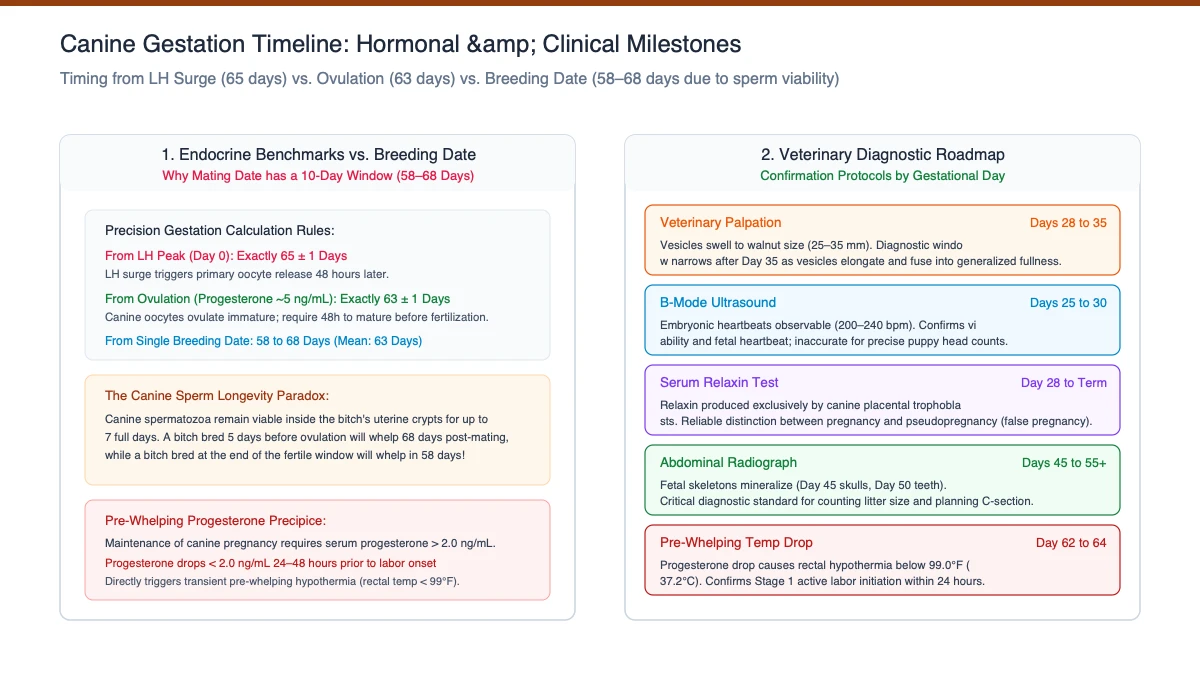
The first three weeks pass with nothing to see or feel. Implantation and organ formation are underway while the abdomen still looks and behaves normally, so a breeding date is doing all the work during this stretch. Ultrasound from about day 25 is the first point at which pregnancy can be confirmed, and an experienced hand may pick up changes palpably a few days before that.
Day 45 is the milestone that changes planning, because fetal skeletons have calcified enough to show on a radiograph. From that date a film both confirms the pregnancy and counts puppies accurately, which is why the pre-whelping radiograph is normally scheduled in the days just after it. Between day 45 and term the outward signs accumulate gradually: mammary development, a nest built in a quiet corner, and a drop in activity. Owners recording a rectal temperature through the final week often see a short dip shortly before labor starts, but the computed window remains the simpler guide for timing.
When to see a vet
Call rather than watch when any of three things happens. Strong, productive contractions with no puppy delivered for 20 minutes mean the labor has stalled and needs help. Green discharge appearing before day 58 signals that the placenta is separating far too early, and it needs to be assessed the same day it appears.
The third signal is simple absence: no labor at all by day 70. Past day 68 the risk of placental failure and dystocia climbs steadily, so a bitch who reaches day 70 still quiet is a patient, not a wait-and-see. Keep the after-hours number posted near the whelping area from day 58 onward, along with the mating record and this calculator's window, so whoever is on hand can answer the vet's first question, which day she is on, without hunting for paperwork.
Prepare before the window opens rather than during it. A stocked whelping area, the mating record, and a clinic that already knows the bitch remove the two things that slow a late-night decision, which are finding information and explaining history. Owners taking a rectal temperature through the final week gain a few hours of notice, but nobody should hold a call while waiting for a number to fall. A bitch with a previous difficult delivery deserves an earlier call than the general guidance suggests, because past trouble is the best predictor available.
How accurate is the estimate
Treat the output as a midpoint with a built-in tolerance of about three days in either direction. Ovulation can precede the recorded mating by up to two days, and puppies conceived days apart stretch the tail of the litter beyond the first conception, so both the early and late edges of the window are real possibilities rather than error.
Precision comes from imaging, not from arithmetic. Ultrasound confirms the pregnancy around day 25 to 30 but does not refine the date much on its own. Once skeletons are calcified at day 45, counting fetal skulls or ossification centres on a radiograph settles term to within a day or two, and it gives a litter count at the same time. If a litter count or a scheduling decision depends on being exact, book the film after day 45 and let the calculator handle the planning in the meantime.
Dam energy intake should increase by roughly 10% weekly starting in week 6 of gestation; determine exact caloric needs with our canine daily feeding calculator.
What your dog pregnancy result means
The number that matters clinically is the gestational day, not the calendar week. Before day 45 nothing about the pregnancy is externally obvious; after day 45 the dating becomes verifiable, which is exactly when you should schedule the pre-whelping radiograph if you want a reliable puppy count.
Past day 68, the risk of placental failure and dystocia rises steadily. Day 70 without labor is a vet call, not a wait-and-see.
How to read the output:| Result range | What it means | What to do next |
|---|---|---|
| Days 0–20 | pregnancy confirmed by nothing you can observe yet | Trust the date record and plan checks ahead |
| Days 25–30 | first window for ultrasound confirmation | Book a confirmation scan if the mating date is uncertain |
| Day 45 | skeletons calcify and radiographs date the pregnancy | Schedule the film for a puppy count and firm due date |
| Days 58–68 | normal whelping window around the computed date | Have the whelping area and vet contact ready |
| Past day 70 | pregnancy running beyond the window | Contact the vet instead of recalculating |
Common mistakes with the dog pregnancy
- Dating from the last mating of a multi-day heat: Use the first successful mating, since the earliest conception sets the whelping window even when later matings also occurred.
- Reading the computed date as a fixed appointment: Plan for the whole 58–68 day band, because ovulation timing and conception dates routinely shift the result by a few days.
- Waiting past day 45 to count puppies: Book the radiograph soon after day 45, when ossification is reliable enough to give an accurate litter count.
- Treating day 70 without labor as patience: Call the vet once day 70 passes, since placental failure and dystocia risk climb after the window closes.
Limits of the dog pregnancy calculator
This calculator dates from a mating date, but ovulation can precede mating by up to two days, shifting the true due date. Puppies in the same litter can also be conceived days apart. Treat ±3 days as normal variation, and confirm with ultrasound or radiograph when precision matters.
Clinical note from Dr. Chyrle Bonk, DVM: In our canine breeding management, counting gestation from breeding dates produces wide apparent variances (58 to 68 days) because canine sperm remains viable in the female tract for up to 5 days, while eggs take 48 hours to mature after ovulation. Counting from the post-ovulatory serum progesterone surge (5 ng/ml) reliably narrows delivery to 63 ± 1 days. Radiographs after day 45 provide definitive puppy counts to identify singleton litters or fetal macrosomia.
Sources
- Merck Veterinary Manual, Whelping and queening in bitches and queens (used for: 63-day average, whelping stages, and labor warning signs)
- Merck Veterinary Manual, Pregnancy determination in bitches and queens (used for: ultrasound from day 25–30 and radiograph dating after day 45)
- American Kennel Club, Understanding the canine reproductive cycle (used for: ovulation timing relative to mating and the reasoning behind the 58–68 day window)
- Lopate (2008), Ultrasound for fetal ageing in the bitch, Theriogenology (used for: ossification-based fetal dating accuracy once day 45 passes)
Cite This Calculator
For laboratory course reports, academic papers, or institutional protocols (APA format):
Dog Pregnancy: frequently asked questions
How long is a dog pregnant?
About 63 days from ovulation, with a normal whelping window of 58–68 days from mating.
How can I tell how many puppies my dog will have?
Only imaging can count reliably: ultrasound from day 25 confirms pregnancy, and radiographs from day 45 count calcified skeletons accurately. Abdominal size is a poor predictor.
When should I worry that whelping is late?
Strong contractions with no puppy for 20 minutes, green discharge before day 58, or no labor at all by day 70 warrant immediate veterinary contact.
Can a dog's due date be wrong?
Yes. Multi-day matings and ovulation timing can shift it by up to ±3 days, which is why clinicians work with a 58–68 day window rather than a single date.
Found a number that does not match its source? Report a mistake. Corrections are published in place and the page date is updated.
See a value here that won’t reconcile with its cited source? Report a mistake.

Dr. Chyrle Bonk, DVM: Veterinary Editor
Chyrle is a mixed-animal veterinarian in rural Idaho who has practised since 2010, with a particular emphasis on food-animal medicine and cattle alongside her companion-animal caseload. She reviews the…