Free Animal Pregnancy tool
 Free Animal Pregnancy tool
Ferret Gestation Calculator
The Ferret Gestation Calculator calculates the expected jill delivery date and gestational milestones from the mating date based on a 42-day gestation period. A jill's pregnancy is short (about 42 days). Because ferrets are induced ovulators, the clock starts at mating during her 24-hour heat. Enter the mating date for the due date, gestational day, and the milestones that separate a real pregnancy from the 40–42 day pseudopregnancy that looks identical from the outside.
Ferret Gestation Calculator: result
At a glance
- What it does: Adds 42 days to a mating date and prints the kitting date, gestational day, and the 38–44 day window.
- Who it is for: Made for owners separating a real pregnancy from the pseudopregnancy that runs almost as long.
- Typical result: Returns the expected date, her stage today, and the imaging dates that settle what the calendar cannot.
How to use the ferret gestation calculator
- Enter the date of mating. Ferrets are induced ovulators (ovulation occurs 30–40 hours after copulation), so a successful heat, not the calendar, starts the 42-day count. prefill →
- Leave the check date as today for the gestational day, or set any date to plan diagnosis or kitting preparation. prefill →
- Confirm early if it matters: ultrasound from about day 12–14, palpation from day 14–16, radiograph from day 30 for a kit count.
- Prepare the nest box before day 38 (dark, quiet, and undisturbed) and plan not to handle newborns.
- Watch the overdue warning: pseudopregnancy runs 40–42 days as well, so day 44+ without kits means a vet visit either way.
Ferret Gestation: the formula & its source
Ferret gestation averages 42 days with a normal window of days 38–44. Because ovulation is induced by mating (30–40 hours after copulation), a jill bred in a proper standing heat dates reliably; one bred outside heat may not ovulate at all.
Stages: days 0–12 (free blastocyst), days 13–29 (implantation days 12–13, ultrasound and palpation confirmation, the pseudopregnancy trap), and days 30–42 (radiograph kit count, mammary rings, nesting and delivery).
due date = mating date + 42 days
gestational day = (check date − mating date) in days
| Symbol | Meaning | Unit | Typical range |
|---|---|---|---|
breed_date | Date of mating during a standing heat | date | any date within the last 50 days |
ref_date | Date her status is read for, left blank for today | date | the mating date through day 44 |
D | Gestational day counted from the mating date | days | 0 to 42 |
due | Expected kitting date, computed as D plus 42 | date | 38 to 44 days after mating |
Compare ferret reproduction against fellow induced ovulators on our feline induced ovulator pregnancy calculator.
Ferret Gestation: worked example
Worked example: mated September 10. Kitting date: September 10 + 42 = October 22. Kitting window: October 18 – October 24. Checking on October 10 puts her at day 30 of ~42 (71% of term) with 12 days left: implantation done (September 22, day 12), radiograph kit count now possible, and mammary rings expected around October 12 (day ~32).
Example B: day 42 with no kits
Example B: day 42 passes with no kits. Mated on 10 September, she reaches day 42 on 22 October, and a pseudopregnancy would end right about then too, which is the difficulty in one sentence. The calendar cannot tell the two apart at any point in the final week. Palpation from day 14 to 16 or an ultrasound from day 12 onward could have, weeks earlier, and by day 44 the practical choice is a veterinary visit either way rather than another day of waiting.
Average and range in days
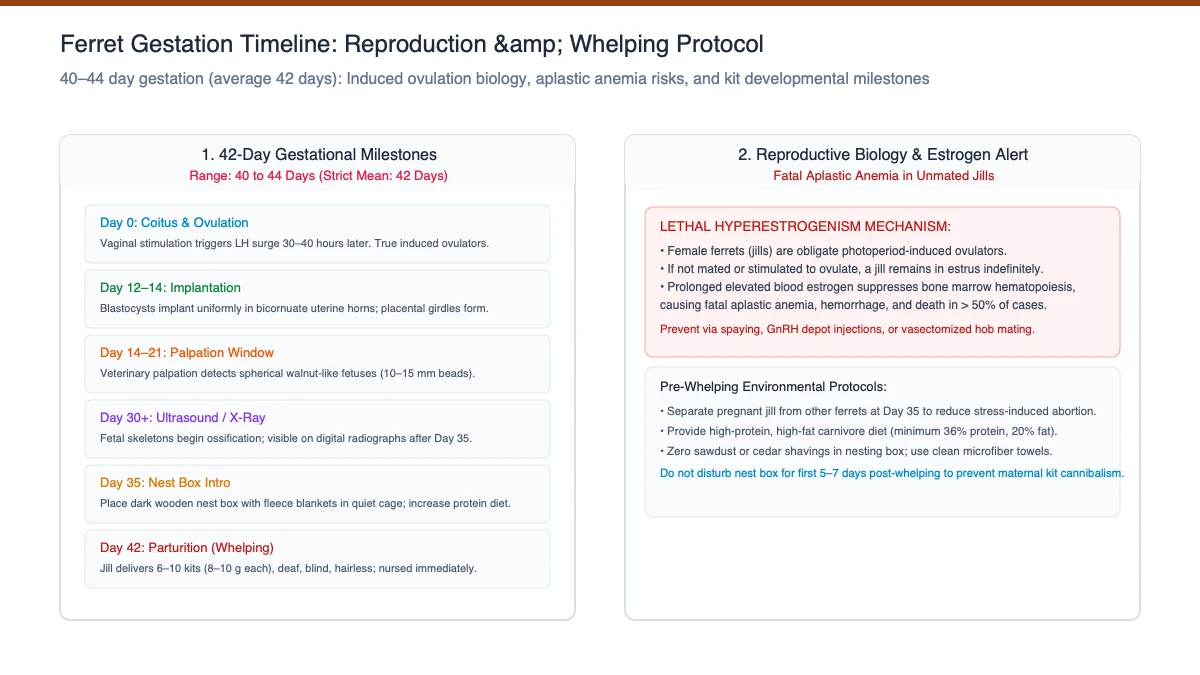
Ferret pregnancy averages 42 days, with a normal window from day 38 to day 44. The clock starts at mating rather than at a calendar cycle, because ferrets are induced ovulators and ovulation occurs 30 to 40 hours after copulation. A jill bred during a proper standing heat therefore dates reliably, while one paired outside heat may never ovulate, in which case the recorded mating describes an event rather than a pregnancy.
Four days of spread either side of the average is ordinary. What makes this species awkward is not the width of the window but what runs alongside it: pseudogestation lasts 40 to 42 days, close enough to real gestation that the two cannot be separated by observation or arithmetic. The number the calculator prints tells you when a real pregnancy would end and when a false one would too, which is exactly why imaging sits in the middle of every sensible plan for a jill in this window.
Early signs and timeline
The opening twelve days are free-living. The blastocyst floats without attaching until implantation around days 12 to 13, which is the first point at which the pregnancy becomes detectable by any method. Ultrasound works from about day 12 to 14, and rectal palpation from day 14 to 16, so the question of pregnant or pseudopregnant can be settled in the second week rather than at the end.
Confirmation then has three more weeks to run. Radiographs from about day 30 give a kit count, since the skeletons are mineralised by then. Late signs are modest: hairless rings appear around the teats roughly a week and a half before term, nesting and restlessness build through the final days, and delivery itself, once started, typically lasts only two to three hours. Kits are born hairless, blind and deaf at roughly 6 to 12 grams each, in litters ranging anywhere from 1 to 18 with about 8 being common.
Household management matters as much as the date. Keep a pregnant jill away from intact males for the whole window, since a postpartum heat can follow delivery within days and a male present during kitting is a risk to the kits. Prepare the box early, keep noise and handling down, and plan the household around three or four quiet weeks rather than around the computed date alone. Note the mating date and the condition of the heat she was in, because that record decides whether the 42-day count applies in the first place.
When to see a vet
Day 44 without kits is a veterinary visit regardless of which outcome turns out to be true, because pseudogestation and pregnancy have both run their course by then and neither resolves itself further. Owners who confirm early by ultrasound or palpation have a head start on this decision; those relying on the calendar arrive at it with no information.
Prepare the nest box before day 38, dark, quiet and undisturbed, and plan not to handle newborns, since disturbance around kits risks the mother abandoning or consuming them. An intact jill left in prolonged heat faces a separate and serious problem: hyperestrogenism can suppress bone marrow and become life-threatening, so breeding, implantation and spaying decisions belong with a veterinarian rather than with a wait-and-see approach. A jill who strains without delivering, or who delivers part of a litter and stops, needs help immediately.
How accurate is the estimate
Reliability depends on knowing that ovulation actually occurred. A mating recorded during a standing heat is a good anchor, since induced ovulation follows 30 to 40 hours later; a pairing outside heat may produce no ovulation at all, and the 42-day count then describes a pregnancy that never started. Given a valid mating date, four days of normal variation covers the window comfortably.
Imaging, not the calendar, resolves the ambiguity that defines this species. Ultrasound from day 12 to 14 or palpation from day 14 to 16 tells a real pregnancy from a false one while there is still time to plan, and a radiograph from day 30 adds a kit count. Late signs such as mammary rings and nesting behave similarly in both outcomes, which is why they carry little diagnostic weight. Confirm early where the answer matters, and use the computed date to schedule the nest box and the watch rather than to draw conclusions.
What your ferret gestation result means
The narrow six-day window is useful precisely because the two outcomes (pregnant or pseudopregnant) run almost the same length. The calendar tells you when to decide; only imaging tells you which it is.
Mammary rings and nesting behavior are late-stage signs at best, and a pseudopregnant jill can show similar restlessness. That is why diagnosis sits at days 12–16 rather than at day 40.
How to read the output:| Result range | What it means | What to do next |
|---|---|---|
| Days 0–11 | free blastocyst, not yet attached | Record the mating and avoid handling decisions |
| Days 12–16 | implantation and the confirmation window | Confirm by ultrasound or palpation now |
| Day 30 onward | radiograph can count kits | Book a film if a kit count matters to you |
| About 10 days pre-term | hairless rings appear around the teats | Prepare the nest box and quiet the housing |
| Days 38–44 | normal kitting window around the computed date | Watch for nesting and delivery of two to three hours |
| Day 44 onward | pregnancy and pseudogestation have both ended | Call the vet rather than extending the estimate |
Common mistakes with the ferret gestation
- Assuming the calendar can separate pregnancy from pseudopregnancy: Confirm by ultrasound from day 12 or palpation from day 14, since both outcomes run about the same length.
- Dating a pairing outside standing heat: Check that the jill was in heat, as an induced ovulator paired outside heat may not ovulate and the count never applies.
- Handling newborn kits to inspect them: Leave the nest undisturbed for the first days, since handling risks the mother abandoning or consuming the litter.
- Leaving an intact jill in prolonged heat: Speak to a vet about breeding, implantation or spaying, because prolonged heat can cause hyperestrogenism with serious consequences.
Limits of the ferret gestation calculator
A jill outside standing heat may not ovulate, so a mating date can overstate the clock. Pseudopregnancy is hormonally real and lasts 40–42 days, close enough to real gestation that guessing is unsafe.
An intact jill left in prolonged heat can develop hyperestrogenism and life-threatening aplastic anemia; breeding, implantation, or spaying decisions belong with your vet. Disturbance around newborn kits risks rejection and cannibalism, so hands off the nest for the first days.
Clinical note from Dr. Chyrle Bonk, DVM: Ferrets are seasonally polyestrous induced ovulators with a 41 to 42 day gestation period. In our exotic clinic, we monitor jills closely because uninterrupted estrus without breeding or hormonal termination can lead to hyperestrogenism, bone marrow hypoplasia, and fatal aplastic anemia. Pseudopregnancy is common and lasts the same duration as true gestation; abdominal palpation after day 14 provides early confirmation.
Compare ferret developmental durations with other domestic mammals in our mammalian gestation length reference chart.
Sources
- Merck Veterinary Manual, Breeding and reproduction of ferrets (used for: 42-day gestation, induced ovulation 30–40 hours after mating, and pseudopregnancy length)
- Merck Veterinary Manual, The reproductive system in animals (used for: induced ovulation and cycle timing across ferret reproduction)
- Merck Veterinary Manual, Approximate gestation periods table (used for: ferret gestation average used as the calculation baseline)
Cite This Calculator
For laboratory course reports, academic papers, or institutional protocols (APA format):
Ferret Gestation: frequently asked questions
How long is a ferret pregnant?
About 42 days on average, with a normal window of 38–44 days from mating.
How is pseudopregnancy different?
Almost not at all from outside. It also runs 40–42 days. Ultrasound or palpation (from day 14–16) is the only way to tell a real pregnancy from a false one.
How many kits are normal?
Anywhere from 1 to 18, most commonly around 8. Kits are born hairless, blind, and deaf at roughly 6–12 g each.
What are the signs labor is close?
Hairless rings around the teats about 1.5 weeks before, nesting and restlessness in the last day or two, and delivery that typically lasts only 2–3 hours once it starts.
Found a number that does not match its source? Report a mistake. Corrections are published in place and the page date is updated.
Found a number on this page that doesn’t match its source? Email the correction →.

Dr. Chyrle Bonk, DVM: Veterinary Editor
Chyrle is a mixed-animal veterinarian in rural Idaho who has practised since 2010, with a particular emphasis on food-animal medicine and cattle alongside her companion-animal caseload. She reviews the…