Free Other Animals tool
 Free Other Animals tool
Rabbit Color Calculator
The Rabbit Color Calculator determines kit coat color probabilities and genotype combinations across the agouti, black, color, dilute, and extension loci. Seven known genes, one coat. Set the most-penetrant allele at each locus (pattern, base colour, pattern colour, density, extension and spotting), and this calculator composes the phenotype the way the genes actually interact: complete dominance first, then the epistatic overrides that can erase everything underneath.
Rabbit Color Calculator: result
At a glance
- What it does: Predicts the visible coat from six known loci: pattern, base, colour series, density, extension, spotting.
- Who it is for: Made for breeders and owners who want the phenotype before a litter arrives, not a cross ratio.
- Typical result: Returns the predicted coat plus per-locus rows showing what each gene contributed and what was masked.
How to use the rabbit color calculator
- Work out each locus from the rabbit in front of you or a breeding plan: start with pattern (banded, tan, or solid), then base colour, then density. prefill →
- Set the C locus only after pattern. Chinchilla banding only shows on an agouti rabbit, and albino overrides everything you picked below it. prefill →
- Pick the extension allele: normal for most pets, harlequin for the patchwork patterns, fawn for ee, steel only if the hairs have silver or gold tips.
- Set spotting last. It sits on top of whatever colour pattern the other six loci produced.
- Read the Predicted coat row, then use the per-locus rows to see which gene contributed what (and which ones the epistatic overrides hid).
Rabbit Color: the formula & its source
This is a rule engine rather than a single equation. Phenotype is composed in the order the loci act:
coat = spotting ( over ( extension ( pattern-colour ( pattern ( base ) ) ) )
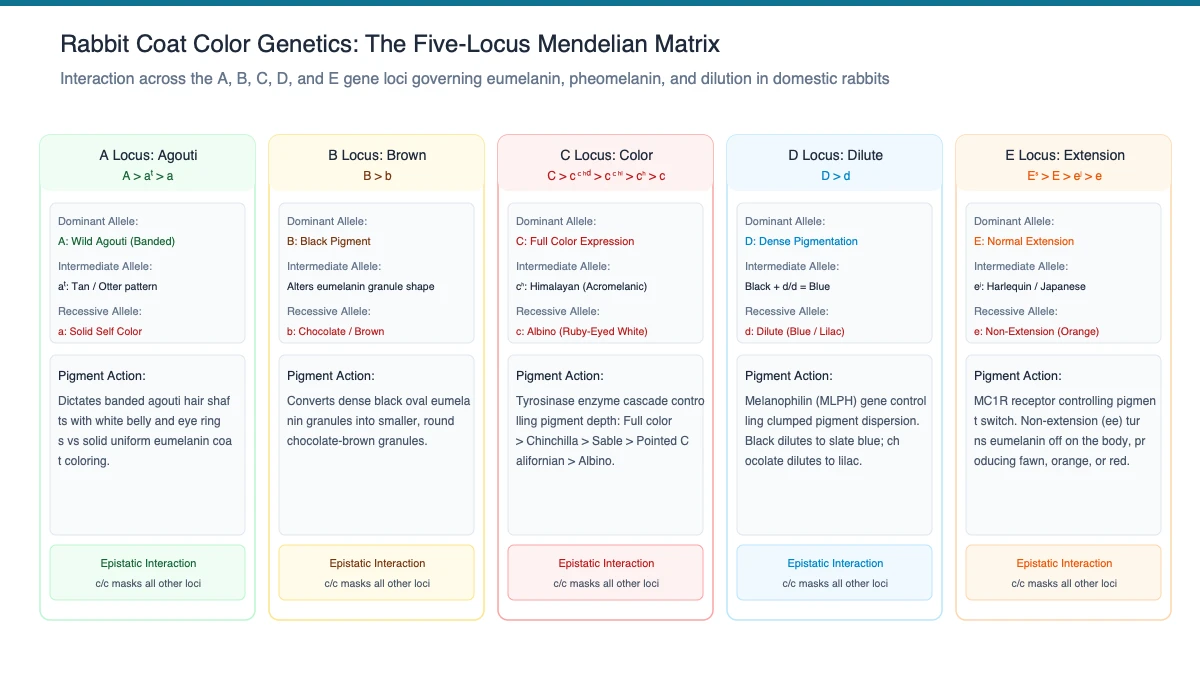
Base colour is the 2 × 2 table of B and D: B_D_ black, B_dd blue, bbD_ chocolate, bbdd lilac. Pattern comes from A in descending dominance (A > at > a). The C series recolors the pattern (C > cchd > cchl > ch > c), with cc epistatic to every other locus. Extension runs Ed > Es > E > ej > e: Ed forces the B/D colour regardless of A and C, Es adds steel tips but only on an agouti (A_) coat, ej gives harlequin patchwork, and ee is epistatic to B, fawn/orange/red whatever the base colour says. Spotting (En > en) is applied last: Enen typical broken, EnEn nearly white, enen none. Each dropdown states the most-penetrant allele present, so A_ means AA or Aa. The second allele is implied, not forgotten.
| Symbol | Meaning | Unit | Typical range |
|---|---|---|---|
aL | A locus: agouti, tan or self pattern | select code | A, at, a |
cL | C locus: pattern colour series | select code | C, cchd, cchl, ch, cc |
eL | E locus: extension, the epistatic switch | select code | Ed, Es, E, ej, ee |
spot | KIT spotting, applied on top of everything | select code | enen, Enen, EnEn |
Rabbit Color: worked example
Worked example 1: A_ B_ C_ D_ E_ with Enen. Black dense base under an agouti pattern, full colour, normal extension, typical spotting → Broken chestnut (wild-type agouti), exactly what the tool prints. Every locus at its wild-type allele gives the chestnut the source calls the wild-type phenotype; Enen adds the white patches.
Worked example 2: aa bb dd cc. Self pattern, chocolate base, dilute, albino: you might expect lilac, but cc is epistatic. The predicted coat reads albino: no visible colour (cc masks every other locus), and the B, D and A genotypes underneath cannot be read from the coat at all.
Example B: cc masks a lilac self
Example B: aa bb dd with cc. Self pattern, chocolate base and dilute would compose as lilac: the base row reads lilac, and the pattern row reads Self. Then the C locus does its work: cc is epistatic to every other locus, so the predicted coat prints albino, no visible colour while the rows beneath still record lilac and self as masked genotypes. The genes did not vanish; they are simply invisible from the outside, which is exactly why an albino rabbit can never be genotyped by eye.
The formula behind this
This is a rule engine rather than a single equation, because a coat colour is composed in the order the loci act: base colour, then pattern, then pattern colour, then extension, then spotting on top. Base colour is the two-by-two table of B and D: black, blue, chocolate or lilac. Pattern comes from A in descending dominance, agouti over tan over self. The C series recolours whatever pattern sits underneath it, running C over cchd over cchl over ch over c.
Each dropdown states the most-penetrant allele present rather than a literal genotype, so choosing A means A_: AA or Aa, the second allele implied rather than forgotten. Extension runs Ed over Es over E over ej over e, and spotting runs En over en as the final layer. The wild-type reference the form starts from is a chestnut with a white belly, which is what every locus at its default allele produces, and every other prediction on the page is that reference rewritten by whichever loci differ from it.
How the loci stack
Two overrides dominate the rest of the engine. cc erases all colour regardless of every other locus, so an albino prediction arrives even when pattern, base and density are fully specified beneath it. ee removes black and brown pigment entirely, which is why a black-based rabbit can throw fawn: no extension means no dark pigment for the B locus to act on. Ed works in the opposite direction, forcing the solid base colour and ignoring pattern and the C series altogether.
Smaller interactions matter too. Steel adds silver or gold hair tips only where an agouti pattern exists, and the calculator says so when a different A allele is hiding the effect rather than inventing tips that would not show. Harlequin splits the base into patchwork. Spotting sits last, so Enen gives the typical broken coat with white patches, EnEn gives the nearly white extreme, and enen adds no white at all. Read the rows top to bottom: whatever sits highest in that order is what you will actually see, and whatever a row says was masked is still there in the genotype even though no one can see it from outside.
Assumptions
The engine assumes each dropdown reflects the animal in front of you, and that is the hard part. Recessive alleles are invisible in the animals that carry them, so two visually identical rabbits can differ at B, D or A in ways only test breeding or DNA testing will expose. Fitting a genotype to a observed phenotype works in one direction: it shows the genotype consistent with the coat, not the genotype proven.
It also assumes the published locus descriptions are complete, which they are not. The sable allele is noted in the source as speculated about rather than confirmed by DNA evidence, full extension is rare, and silvering and fur type are separate traits this model does not touch at all. Every row is a prediction built from a peer-reviewed extension table, not a laboratory result, and the calculator stays silent where the genetics do not. Where the table itself flags uncertainty, the per-locus rows carry that uncertainty forward instead of resolving it into a tidier answer than the evidence supports.
Biological limits
Genotype bounds what a coat can look like, and several real-world effects push an individual away from the printed prediction. Age changes shaded coats over the first weeks, sun-bleaching lightens tips independently of any allele, and diet and health shift pigment intensity without altering the genotype underneath. Show-standard names such as steel tan go beyond what the locus descriptions themselves guarantee.
The limits run in the other direction as well. An albino rabbit tells you nothing about the six loci it carries, which is the clearest case of a phenotype that stops being evidence. Where an outcome depends on effects this model does not carry (silvering, rex or angora fur, environmental bleaching), the table simply composes what it can and leaves the rest to the per-locus rows. Breeding decisions belong with a documented pedigree and a veterinarian, alongside the arithmetic rather than behind it, and a predicted coat should never be the only reason two rabbits are paired.
What your rabbit color result means
Colour genetics is predictive bookkeeping: two apparently solid black rabbits can carry hidden chocolate, dilute and tan alleles, and this calculator makes the hiding visible. Set B_ to see the black phenotype, then flip to bb and watch the base change even though the rabbit looks identical if it also carries the recessive in disguise.
For breeders, the value is working backwards: decide the target coat, find the locus combination that produces it, and check which matings can actually deliver it. The epistatic rows explain the classic surprises: two patterned parents producing albino kits, or a black rabbit throwing fawn.
How to read the output:| Result range | What it means | What to do next |
|---|---|---|
| Predicted coat | the composed phenotype | Read this row first, then work downwards |
| Base colour (B × D) | the two-by-two under the pattern | Dilute dd shifts black to blue |
| Masked row | another locus overrode it | The genotype still stands for breeding |
| Spotting last | enen, Enen or EnEn | White sits on top of every colour |
Schedule breeding dates and kit birth timelines using our companion rabbit breeding due date calculator.
Common mistakes with the rabbit color
- Reading the prediction as a genotype read-out: Work from the per-locus rows instead, because recessive alleles hiding in a visually normal rabbit still need test breeding or DNA testing to confirm.
- Expecting steel tips on a non-agouti coat: Steel only shows on an agouti pattern, so the calculator reports when the A locus is hiding the effect rather than inventing silver or gold tips.
- Assuming a white rabbit reveals its genes: cc masks everything beneath it, so an albino output says nothing about pattern, base or spotting; those loci are still there, just invisible.
- Using the coat alone for breeding decisions: Pair the output with a documented pedigree and a veterinarian before planning any mating, since the engine composes phenotypes rather than proving parentage.
Limits of the rabbit color calculator
The model reproduces the extension publication's locus descriptions, but real coats are also touched by silvering (Si, gene unknown), fur type (rex, angora), age, and sun-bleaching of the tips. The sable allele (cchl) is noted in the source as speculated rather than confirmed by DNA evidence, and Ed is rare. A solid dark rabbit is far more often aa with normal extension. Show-standard naming (fancy terms like 'steel tan') goes beyond what these locus descriptions guarantee.
Clinical note from Dr. Chyrle Bonk, DVM: Rabbit coat color genetics involves complex epistatic interactions across five primary loci: Agouti (A), Black (B), Color (C), Dilution (D), and Extension (E). In breeding genetics, understanding that recessive alleles (like dilution dd converting black to blue, or non-extension ee producing tort or fawn) can remain hidden for multiple generations allows breeders to predict genotype frequencies accurately and prevent undesirable phenotypic surprises.
Sources
- Oregon State University Extension, rabbit coat color genetics summary table (EM 9708) (used for: the dominance orders and locus descriptions this calculator composes)
- Oregon State University Extension, understanding the genetics behind rabbit coat colors (EM 9707) (used for: recessive-carrier and epistasis behaviour behind the masked rows)
- PubMed, MC1R mutations associated with coat colours in the domestic rabbit (PMID 16978179) (used for: published gene nomenclature behind the extension-locus allele codes)
Cite This Calculator
For laboratory course reports, academic papers, or institutional protocols (APA format):
Rabbit Color: frequently asked questions
Why does my black rabbit produce fawn babies?
Because fawn comes from ee, and the ee genotype is epistatic to the B locus. No extension means no black or brown pigment, whatever the base-colour genes say. Both parents must have contributed an e allele for it to show.
What does the calculator mean by 'Enen' instead of 'broken'?
Enen is the genotype: the heterozygote at the KIT spotting gene produces the typical broken coat with white patches. Homozygous EnEn is almost all white (the 'Charlie' extreme) and enen has no white spotting at all.
Is the sable allele real?
It is published but unconfirmed: the source notes that cchl and its sable phenotype have been speculated about without DNA evidence. Treat sable output as the extension article describes it: a phenotype hypothesis, not a sequenced marker.
Can the calculator tell me what my rabbit is genetically, from its looks?
Only partially, and never for an albino. cc masks everything beneath it. For the others, the per-locus rows show the genotype that fits the observed phenotype, but recessive alleles hiding in a visually normal rabbit cannot be detected without test breeding or DNA testing.
Found a number that does not match its source? Report a mistake. Corrections are published in place and the page date is updated.
A value here that won’t reconcile with its reference? Report a mistake.

Dr. Chyrle Bonk, DVM: Veterinary Editor
Chyrle is a mixed-animal veterinarian in rural Idaho who has practised since 2010, with a particular emphasis on food-animal medicine and cattle alongside her companion-animal caseload. She reviews the…