Free Trees & Forestry tool
 Free Trees & Forestry tool
Tree Spacing Calculator
The Tree Spacing Calculator calculates stems per acre (trees/acre) and inter-tree planting distance under square, rectangular, and equilateral triangular grid patterns. Spacing decides everything downstream: how fast crowns close, what equipment fits between rows, and how many trees you pay for at the nursery. Enter row and in-row distances to get stocking per acre and hectare, or flip the problem around and give it a target density to solve for the in-row gap.
Tree Spacing Calculator: result
At a glance
- What it does: Converts row and in-row spacing into trees per acre and hectare, or solves an in-row gap from a target.
- Who it is for: For growers, planters and students laying out an orchard, shelterbelt or plantation before ordering stock.
- Typical result: Returns stocking, the square-equivalent gap, and the reverse calculation when a density is already fixed.
How to use the tree spacing calculator
- Set the method: density mode when you know the planting distances, target mode when you have a trees-per-acre goal from a silvics or orchard guide. prefill →
- Enter row spacing (centre to centre, the direction the equipment travels) and in-row spacing for density mode, in feet or metres; the unit toggle converts everything for you. prefill →
- Read trees per acre and per hectare as the same stocking on two scales, plus the square-equivalent gap if a square or staggered pattern is on the table.
- In target mode, give the target density in trees per acre and the row width you are locked into; the tool returns the in-row gap and confirms the density it produces.
- Cross-check against published planting tables for your species before ordering stock. Nursery runs and replant allowances typically add 5–10 % over the calculated count.
Tree Spacing: the formula & its source
Planting density is the land area divided into the area one tree occupies:
trees per acre = 43,560 ÷ (row spacing × in-row spacing)
trees per hectare = 10,000 ÷ spacing area in m² = trees per acre × 2.471
The square-equivalent gap is the side of the square with the same area per tree:
s = √(43,560 ÷ trees per acre)
Inverting for a density target:
in-row spacing = 43,560 ÷ (target trees per acre × row spacing)
Imperial-to-metric: 1 ft² = 0.092903 m², 1 acre = 0.4047 ha, and a staggered triangular pattern at nearest-neighbour distance s holds each tree in (√3 ÷ 2) × s² ≈ 0.866 s², about 15 % more stems than a square of side s.
| Symbol | Meaning | Unit | Typical range |
|---|---|---|---|
r | row spacing, centre to centre | ft or m | 3–40 ft / 1–12 m |
s | spacing between trees inside a row | ft or m | 2–40 ft / 0.5–12 m |
43,560 | square feet in one acre, the constant behind imperial density | ft²/ac | fixed value |
N | trees per acre produced by the spacing | trees/ac | 20–50,000 |
N_ha | the same stocking per hectare | trees/ha | 50–100,000 |
T | target density the layout should reach | trees/ac | 1–10,000 |
Tree Spacing: worked example
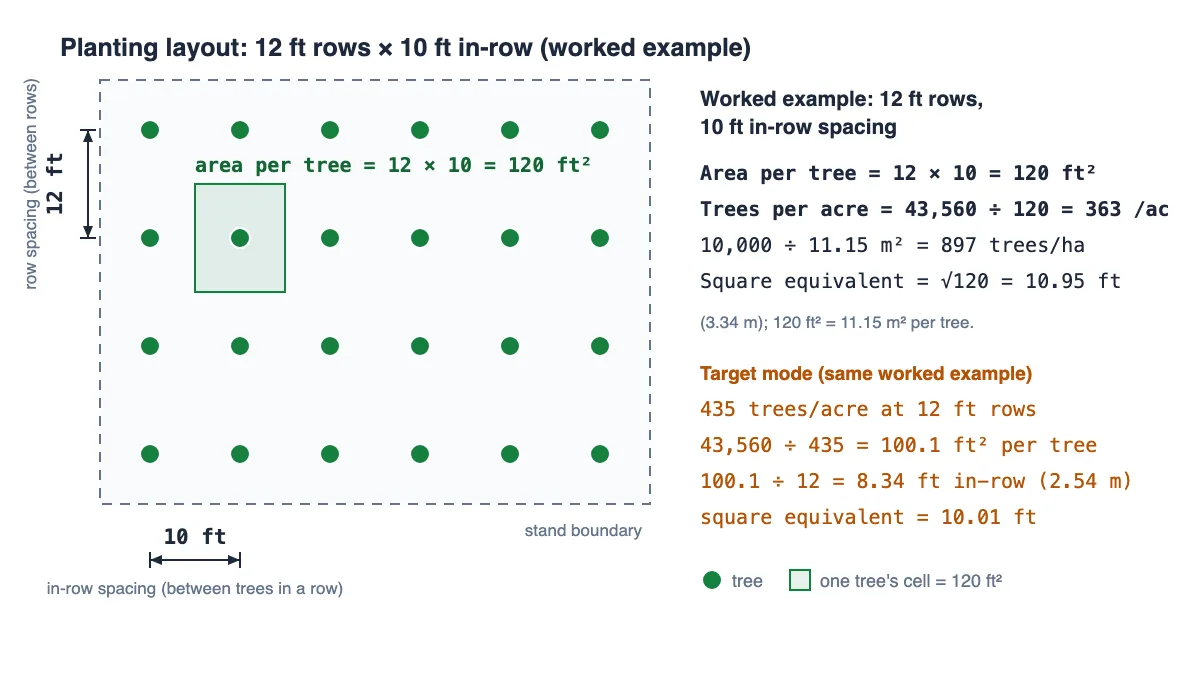
Worked example: 12 ft rows, 10 ft in-row. Area per tree = 12 × 10 = 120 ft². Trees per acre = 43,560 ÷ 120 = 363 /ac; the same stand is 120 ft² × 0.092903 = 11.15 m², so 10,000 ÷ 11.15 = 897 /ha (363 × 2.471 = 897, both routes agree). The square equivalent is √120 = 10.95 ft (3.34 m). Target mode: 435 trees/acre at a 12-ft row needs 43,560 ÷ 435 = 100.1 ft² per tree, so the in-row gap is 100.1 ÷ 12 = 8.34 ft (2.54 m): square equivalent 10.01 ft, confirming the density round trip.
Example B: metric staggered rows
Example B: metric rows. Set the unit to metres and enter 4 m between rows with 3 m in-row: area per tree is 12 m², so 10,000 ÷ 12 = 833 trees per hectare, which is 833 ÷ 2.471 = 337 per acre. The square equivalent is √12 = 3.46 m. A staggered plan at the same nearest-neighbour distance holds each tree in 0.866 × 12 = 10.4 m², lifting the count to about 962 per hectare, roughly 15 % more stems on the same ground, which is exactly why shelterbelts are often planted on the offset.
Field method
Set the direction the tractor travels before anything else, because that axis fixes the row spacing (usually the machine's working width), while the in-row gap follows from species and the crown you expect. Measure both centre to centre rather than trunk to trunk, and enter them in feet or metres exactly as the tape reads. When the planting plan arrives as a trees-per-acre figure instead, flip to target mode: the row width you are already committed to stays put, and the tool returns the in-row gap that satisfies the density. Check that result against published planting tables for your species before the nursery order goes out.
What the pattern decides later
Spacing is the cheapest decision on the plan and the most expensive to revisit, because it fixes how soon crowns close, how long individual trees grow before competition bites, and how many stems you buy, plant and eventually thin out. The same 120 ft² per tree reads as a fast-closing timber crop in one planting and a machinery-friendly nut orchard in another. Rectangular grids also favour row-oriented crown growth: a 12 × 10 ft rectangle hands each tree a long open axis and a tight one, which can shade in-row neighbours before the row gap suggests. Staggered rows pack about 15 % more stems at the same nearest-neighbour distance.Stake the first row and the corner before anyone plants ahead of you, because a layout error found three rows deep costs an afternoon of lifting and replanting.
Instrument error
The arithmetic assumes a perfect grid and real planting rarely supplies one. Skips, doubles and terrain that shoves rows around leave measured density below the calculated figure, which is why replant allowances run 5–10 % over the worked number. Slope stretches the along-slope distance, so a row laid across a hillside occupies more ground than its horizontal reading implies. Conversion drift is the quieter error: alternating between × 2.471 and ÷ 0.4047 rounds differently on each pass. Take the row and in-row measures at several points along the planting, since one pace at the headland rarely represents the field behind it.Walk the finished planting before calling it done and count stems inside a fixed sub-plot, so measured density can be set against the arithmetic on the same patch of ground.
Common blunders
Entering feet while the unit selector still reads metres gives an area per tree roughly forty times too large and a stocking figure far too thin. Using the edge-to-edge gap instead of centre-to-centre shrinks the product and inflates the count. Pointing target mode at the wrong field flips the solve so the tool returns a value you already had. Ordering exactly the calculated number guarantees a bald patch at the end of the run. And mixing a per-hectare target with the per-acre field plants two different densities on the same ground.Rounding the row gap to a convenient number while laying it out quietly changes the stocking you ordered the nursery rows for.
Worked field example
Rows at 12 ft with 10 ft in-row gives 120 ft² per tree, so 43,560 ÷ 120 = 363 trees per acre. The same 120 ft² equals 11.15 m², so 10,000 ÷ 11.15 = 897 per hectare, and 363 × 2.471 returns the same 897, so both routes agree. Square equivalent: √120 = 10.95 ft. Reverse the problem for a 435-tree target against a 12 ft row: 43,560 ÷ 435 = 100.1 ft² per tree, so the in-row gap is 100.1 ÷ 12 = 8.34 ft, whose square equivalent of 10.01 ft confirms the round trip.
Unit systems
Imperial spacing multiplies square feet by 43,560; metric spacing multiplies square metres by 10,000. The unit toggle moves both inputs together, so trees per acre and per hectare always describe one stocking on two scales. Keep a single conversion route rather than alternating: 1 acre = 0.4047 ha, 1 ft² = 0.092903 m², and acres reach hectares by × 0.4047 while hectares return by × 2.471. Staggered layouts change the count, not the system: the 0.866 packing factor applies to the nearest-neighbour distance in whatever unit you measured it.
What your tree spacing result means
Spacing is the one decision that cannot be undone cheaply: it fixes how quickly crowns close, how much individual trees grow before competition sets in, and how many trees you buy, plant, and later thin out. The same 120 ft² per tree behaves as a timber crop (fast closure, early self-thinning) or a nut orchard (machinery access, decades of individual-crown growth) depending on species and intent.
Area per tree is the quiet unit behind it all: it converts directly to crown space, and once a canopy-cover target is set (see the canopy calculator), it tells you how long until the crowns meet.
How to read the output:| Result range | What it means | What to do next |
|---|---|---|
| 363 trees/acre | 12 × 10 ft rectangular grid | Cross-check against published planting tables |
| 545 trees/acre | 8 × 10 ft, denser row | Common shelterbelt and nursery arrangement |
| Square equivalent | side of a square with equal area | Compares rectangular layouts at a glance |
| Target mode result | in-row gap from a density goal | Confirm the row width entered is already fixed |
| Per-hectare figure | metric form of the same stand | × 2.471 from acres, ÷ 0.4047 going back |
| About 15 % higher count | staggered rows, same neighbour distance | Faster canopy closure, harder to cultivate |
Plan plantation spacing to maximize high-grade sawlog recovery detailed in our timber scaling log rules reference.
Common mistakes with the tree spacing
- Typing feet while the unit sits on metres: Switch the toggle first: 12 read as metres gives forty times the area per tree and a stocking figure far too sparse.
- Measuring edge to edge instead of centre to centre: The formula divides land by the area one tree occupies, so pace trunk centre to trunk centre along both axes.
- Ordering exactly the calculated count: Add 5–10 % for skips, doubles and rough ground; measured density on a real site always runs a little under the arithmetic.
- Alternating between the two hectare conversions: Choose × 2.471 or ÷ 0.4047 and stay with it, since swapping routes drifts the per-hectare figure with every pass.
- Feeding a per-hectare target into the acre field: Convert before entry by multiplying by 0.4047, or solve in one system and read the equivalent row the tool prints.
Limits of the tree spacing calculator
The formulas assume perfect grid geometry. Real planting has skips, doubles, and terrain that shoves rows around, so order 5–10 % over the calculated count and expect measured density on the ground to run a little low. Slope matters too: on steep rows the along-slope distance stretches effective spacing.
Rectangular grids read differently for light than square ones: a 12 × 10 ft rectangle gives each tree a long unobstructed axis and a tight one, which favours row-oriented crown growth and can shade in-row neighbours before the row spacing suggests. And keep one conversion route (× 2.471 or ÷ 0.4047) rather than mixing them, or rounding drift creeps into the per-hectare figure.
Forestry note from Dr. Dinesh A. Nagegowda, PhD: Designing tree plantation spacing requires balancing early canopy closure against future thinning intervals. For commercial timber production (e.g. Pinus or Populus stands), tight 8x8 ft or 10x10 ft spacing encourages straight, self-pruning stems with minimal lateral branch knotting. For agroforestry or urban windbreaks, wider 15x15 ft staggered triangular layouts maximize crown development and wind interception.
For fruit orchards and windbreak spacing comparisons, consult our orchard and crop spacing calculator.
Sources
- USDA NRCS Conservation Practice Standard documentation for tree and shrub establishment (used for: density = 43,560 divided by the area one tree occupies)
- Alabama Cooperative Extension FOR-2082, Forest Inventory Basics (used for: stocking and plot arithmetic used to cross-check a planting count)
- Oregon State Extension EC 1129, Tools for Measuring Your Forest (used for: measuring row and in-row distances on the ground)
Cite This Calculator
For laboratory course reports, academic papers, or institutional protocols (APA format):
Tree Spacing: frequently asked questions
How many trees per acre is my spacing?
Divide 43,560 by the product of row and in-row spacing in feet. 12 × 10 ft gives 363/acre, 8 × 10 ft gives 545/acre, 10 × 12 ft gives 363/acre. The tool also reports the per-hectare figure.
What is the difference between row and in-row spacing?
Row spacing is the gap between rows, usually set by equipment width; in-row spacing is tree-to-tree within a row, usually set by species and target crown size. The calculator needs both because stocking depends on their product.
Square planting or staggered rows?
Staggered (triangular) planting packs about 15 % more trees at the same nearest-neighbour distance and closes canopy faster; square grids are easier to cultivate and harvest. Orchards often use squares for machinery, timber plantations often stagger for early closure.
Found a number that does not match its source? Report a mistake. Corrections are published in place and the page date is updated.
See a value here that won’t reconcile with its cited source? Report a mistake.

Dr. Dinesh A. Nagegowda, PhD: Plant & Molecular Biology Editor
Dinesh is a plant molecular biologist and Chief Scientist at CSIR-CIMAP whose research runs through functional genomics, transcriptomics, metabolomics, and biosynthetic pathways in plants. He writes and…