Free Trees & Forestry tool
 Free Trees & Forestry tool
Basal Area Calculator
The Basal Area Calculator determines cross-sectional stem area ($ft^2/acre$ or $m^2/ha$) from diameter at breast height (DBH) and tree counts to measure stand density. Basal area is the cross-sectional area of tree stems at breast height, summed over a unit of land, the standard way foresters express stand density. Enter diameter at breast height (DBH) to get per-tree basal area, then add a tree count to get the stand total in ft²/acre or m²/ha.
Basal Area Calculator: result
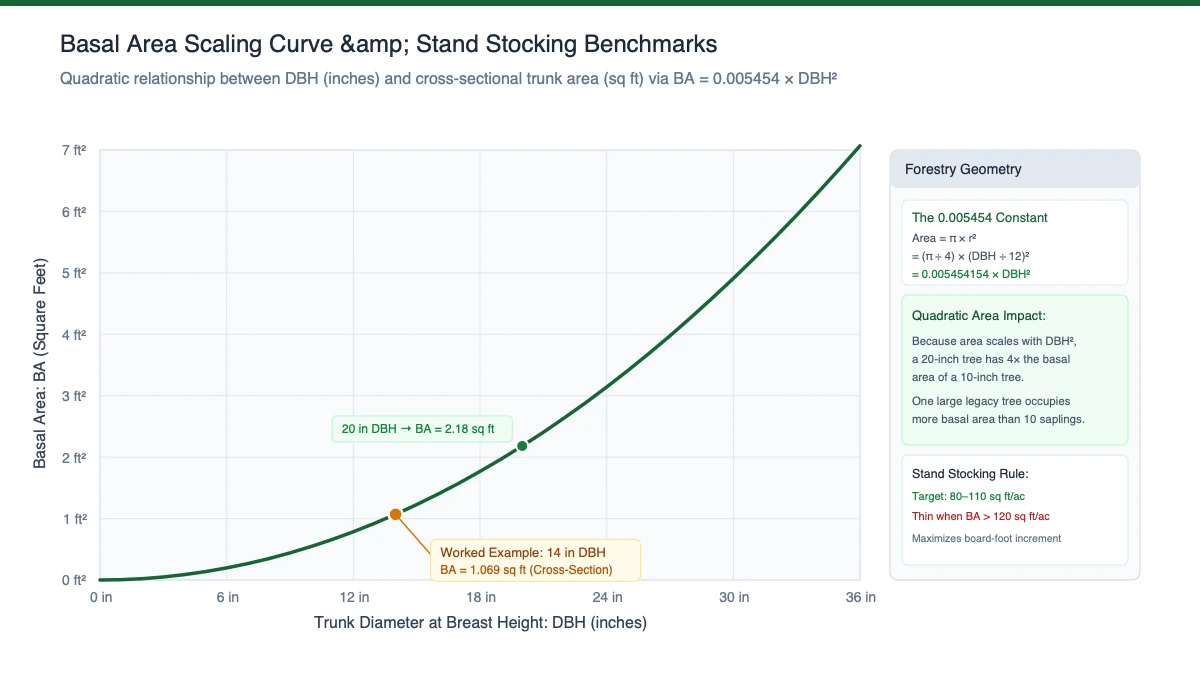
Imperial basis: BA = 0.005454 × DBH², where DBH is in inches and BA is in square feet: 0.005454 = π/4 ÷ 144, converting a diameter circle to square feet.
At a glance
- What it does: Converts diameter at breast height into per-tree basal area and scales a plot tally to ft²/ac or m²/ha.
- Who it is for: Made for foresters and landowners checking stand density against thinning targets and cruise benchmarks.
- Typical result: Returns a size-weighted stocking figure that reads more honestly than a bare stem count in mixed stands.
How to use the basal area calculator
- Measure DBH at 4.5 feet (1.37 m) above ground on the uphill side, on the north face if bark is irregular. prefill →
- Enter diameter in inches or centimetres. The formula switches constants accordingly. prefill →
- For stand basal area, enter the number of trees your count represents and the plot area (a 1/10-acre plot with 8 trees → count 8, area 0.1).
- Compare to site targets: many eastern US hardwood stands are managed around 60–100 ft²/ac; intensively stocked plantations run higher.
- Use BA change over time to decide thinning: BA rising to the site's carrying capacity signals a thin is due.
Basal Area: the formula & its source
Basal area is the area of the stem cross-section at breast height. For a single tree with diameter d:
BA = 0.005454 × d² (d in inches → BA in ft²/acre basis per tree)
The constant is π/4 ÷ 144: π/4 converts diameter to area (square inches), and 144 converts square inches to square feet. Stand basal area is per-tree BA scaled by stem density:
stand BA = (trees ÷ plot area) × per-tree BA
In metric, BA = π × (d/200)² gives m² per tree with d in cm, and stand BA is reported in m²/ha. Conversion: 1 m²/ha = 4.356 ft²/ac.
| Symbol | Meaning | Unit | Typical range |
|---|---|---|---|
d | diameter at breast height of one stem | in or cm | 0.1–60 in / 0.25–150 cm |
BA | cross-sectional stem area at 4.5 ft above ground | ft² or m² | 0.001–5 ft² per tree |
0.005454 | constant π/4 ÷ 144 that folds square inches into square feet | constant | fixed value |
n | stems represented by your tally | count | 1–500 per plot |
A | ground area the tally covers | ac or ha | 0.01–10 |
stand BA | stem area summed and scaled to a whole unit of land | ft²/ac or m²/ha | 20–200 |
Basal Area: worked example
Worked example: 12-inch DBH, 80 trees/acre. Per-tree BA = 0.005454 × 12² = 0.005454 × 144 = 0.785 ft². Stand BA = 80 × 0.785 = 62.8 ft²/ac, a mid-density hardwood stand, right in the typical thinning-sensitive zone of 60–100 ft²/ac.
Example B: centimetre plot
Example B: metric plot, 30 cm DBH. Switch the unit to centimetres and enter 30: per-tree basal area = π × (30 ÷ 200)² = 0.0707 m². A tally of 30 stems on 0.1 ha scales to 300 per hectare, so stand basal area reaches 21.2 m²/ha. Convert before comparing with an American thinning target: 21.2 × 4.356 = 92.4 ft²/ac, inside the 60–100 band where hardwood stands start needing attention. Leaving the unit on inches while typing centimetres inflates the answer roughly sixfold.
Field method
Stake the plot, set the tape at 4.5 feet on the uphill side, and read every stem with a diameter tape. Each reading yields a per-tree basal area on its own, so a stand of mixed sizes is summed stem by stem instead of averaged. The stand figure needs two extra entries: how many trees the tally held and how much ground it covered. A 1/10-acre plot with eight stems is typed as count 8 against area 0.1, and the result scales to a full acre or hectare. Write the plot pair down even if you arrived caring about one tree only, because it costs a line of notebook and saves a return trip.
Stumps, not stems
Picture the acre sawn flat at breast height: the total surface of the stumps left standing is that acre's basal area, and one tree's contribution is its own stump circle. That image explains the number's temperament. A 20-inch stem carries more than twice the basal area of a 12-inch neighbour, so a few large trees dominate the total while a stem count treats every entry alike. Two stands can therefore show similar occupancy yet behave differently, and reporting basal area alongside stem count and quadratic mean diameter keeps that structure visible. Size weighting is the whole reason foresters reach for this metric rather than a head count.
Instrument error
Where the plot sits outweighs how carefully it was measured. Skid roads, sheltered hollows and property edges collect trees of unusual size, and a plot chosen on a whim reproduces that bias at full strength while the tape itself reads true. Slope adds a smaller repeatable effect: a band wound around a leaning or buttressed stem reads long, and the square law doubles the damage. Standard DBH includes bark, so heavy-barked pine gains a few tenths that the formula happily squares. When a thinning decision hangs on the figure, run a second plot on the opposite aspect and treat the spread between the two as the honest error.Plot shape deserves the same care as plot size: a fixed-radius plot walked off with a pacing wheel and flagged at both ends is far easier to revisit next season than an eyeballed square, and noting the radius on the sheet lets a later reader recompute the area instead of trusting a remembered number.
Common blunders
Breast height drifts as the ground falls away: measured on the downhill side, the 4.5-foot mark sits lower on the stem and the reading comes out fat. Tallies that quietly mix saplings with crop trees, or live stems with snags you never intended to count, shift the stand total without any visible change of method. Plot area is the other trap: entering 1 when the tally came from a tenth of an acre inflates density tenfold. Squaring a mean diameter instead of each stem is the subtlest version of the same failure, because it discards the very property that made basal area worth collecting.
Worked field example
Eight stems stand on a 0.1-acre plot, the largest reading 14 inches and the smallest 6. Individual areas run 0.005454 × 14² = 1.07 ft² at the top down to 0.005454 × 6² = 0.196 ft² at the bottom, and summing all eight gives 4.60 ft² of stem surface. Scaling up: 4.60 ÷ 0.1 = 46 ft² per acre. Now take the shortcut the blunder list warns about: a mean diameter near 10 inches gives 0.545 × 8 = 4.36, about 5 % low. In a two-tier stand with one emergent pine among poles, that gap widens well past 5 %.
Unit systems
Inches drive the imperial route: the 0.005454 constant already contains π/4 and the 144 square-inches-per-square-foot conversion, so the stand answer lands in ft²/ac without further arithmetic. Centimetres switch the mathematics to π × (d ÷ 200)², giving m² per stem and m²/ha for the stand. Translate between the systems with 1 m²/ha = 4.356 ft²/ac, which makes 25 m²/ha read about 109 ft²/ac. Keep the unit toggle and the plot units in the same system: a plot laid out in acres with a diameter entered in centimetres produces a number that no conversion factor can rescue afterwards.
What your basal area result means
Basal area approximates leaf area and growing space: it correlates with crown volume, volume growth, and site occupancy better than tree count alone, because it weights each stem by size. A stand of 40 big trees and 200 saplings can hold the same BA but behave very differently, which is why foresters report BA alongside QMD (quadratic mean diameter) and stem count.
Relative BA (stand BA ÷ maximum BA for the site) is the common thinning trigger: as it approaches 1.0, self-thinning and stagnation begin.
How to read the output:| Result range | What it means | What to do next |
|---|---|---|
| 60–100 ft²/ac | typical eastern hardwood stocking | Compare with your site target before thinning |
| 120–160 ft²/ac | intensively stocked conifer plantation | Expect crowding; plan a cut before stagnation |
| Below your target | growing space still unused | Let the stand accrete; no thin is due yet |
| Near the site ceiling | relative basal area approaching 1.0 | Self-thinning starts; schedule the thin now |
| m²/ha on screen | metric stand figure | Multiply by 4.356 to read it as ft²/ac |
| One tree, no tally | per-tree area only | Useful for inventory math, not for stocking |
Convert stand basal area and merchantable log height into timber volume on our standing timber stumpage value tool.
Common mistakes with the basal area
- Squaring a mean diameter instead of each stem: Add the per-tree areas one at a time: area scales with d², so a mean quietly shortchanges the large stems that carry the stand.
- Entering the raw plot tally as a stand total: Divide the count by plot area first: eight trees on a tenth of an acre is 80 per acre, not 8 per acre.
- Comparing a per-tree reading with a stocking target: Targets such as 60–100 ft²/ac describe whole stands, so supply the count and area and read the stand-level row instead.
- Mixing a centimetre diameter with an acre plot: Set the DBH unit and the plot units together: inches return ft²/ac, centimetres return m²/ha, and crossing them garbles the result.
- Reading one plot as the whole property: Plot placement error beats measurement error, so repeat on a second aspect and report the range between plots alongside the point.
Limits of the basal area calculator
BA measured on one plot assumes the plot represents the stand: plot placement error dominates measurement error. The uniform-stand note is literal: mixed-size stands need per-tree summation (Σ 0.005454 dᵢ²), not mean-diameter math, because area scales with the square of diameter and a few big stems dominate.
Forestry note from Dr. Dinesh A. Nagegowda, PhD: In silviculture and forest mensuration, stand basal area (square feet per acre) measures forest density and competition. When conducting timber cruises using an angle gauge or optical wedge prism, calibrating the Basal Area Factor (BAF 10 or 20) against slope gradient is mandatory; failure to apply slope corrections on steep terrain leads to systematic overcounting of "borderline" trees and inflated harvest estimates.
Sources
- US Forest Service, nationwide forest inventory field guide: plot and DBH protocols (used for: breast-height diameter measurement and plot-based stand sampling)
- Alabama Cooperative Extension ANR-1371, Basal Area: A Measure Made for Management (used for: basal area as a size-weighted density measure and thinning guide)
- Oregon State Extension EC 1129, Tools for Measuring Your Forest (used for: field tally procedure and scaling a plot to a full acre or hectare)
- Basal Area: A Guide for Understanding the Relationships Between Pine Forests and Wildlife Habitat (used for: linking basal area to crown volume, cover and habitat structure)
Cite This Calculator
For laboratory course reports, academic papers, or institutional protocols (APA format):
Basal Area: frequently asked questions
What is basal area used for?
It measures stand density in a size-weighted way, used for thinning triggers, growth modeling, wildlife habitat targets, and comparing occupancy across stands.
What is a good basal area for my forest?
It depends on site quality and species: many eastern hardwood stands are managed at 60–100 ft²/ac; western conifer plantations often 120–160 ft²/ac. Local extension guidance sets the target.
What is DBH?
Diameter at breast height: diameter measured 4.5 ft (1.37 m) above ground on the uphill side.
How do you convert m²/ha to ft²/ac?
Multiply by 4.356 (1 m²/ha = 4.356 ft²/ac). For example 25 m²/ha ≈ 109 ft²/ac.
Found a number that does not match its source? Report a mistake. Corrections are published in place and the page date is updated.
Question a result, or spotted a number that doesn’t match its source? Email the correction →.

Dr. Dinesh A. Nagegowda, PhD: Plant & Molecular Biology Editor
Dinesh is a plant molecular biologist and Chief Scientist at CSIR-CIMAP whose research runs through functional genomics, transcriptomics, metabolomics, and biosynthetic pathways in plants. He writes and…