Free Trees & Forestry tool
 Free Trees & Forestry tool
Tree Height Calculator
The Tree Height Calculator calculates total tree height from baseline horizontal distance and top/bottom sighting angles using tangent trigonometry ($h = d \times \tan \theta$). Height is the measurement people get wrong most often, usually by reading the top from too close. Stand off, take a top angle and a base angle with a clinometer, and the trigonometry does the rest. This calculator handles eye height, negative base readings, and slope-corrected distances, and reports feet alongside metres.
Tree Height Calculator: result
At a glance
- What it does: Turns two clinometer angles and a distance into total tree height, handling eye height and ground slope.
- Who it is for: For students, cruisers and volunteers measuring stems for site index, volume or plain record keeping.
- Typical result: Reports feet and metres together and shrinks quietly when the stand-off distance or grade is corrected.
How to use the tree height calculator
- Move out until you are at least as far from the tree as it is tall, far enough to see the whole stem and keep the angle readings small and stable. prefill →
- Measure the distance to the trunk centre: a tape is best; if you paced it along sloping ground, enter the slope so the calculator converts it to horizontal (D × cos slope). prefill →
- Take the top angle to the highest living point, then the base angle to where the trunk meets the ground. A base reading below horizontal comes in negative and is exactly what the method expects.
- Switch to top-angle-only when the base is genuinely level with your feet (flat ground, same elevation). That path adds eye height instead of measuring it out of sight.
- Read the result in feet and metres, and cross-check once against a stick hypsometer or a laser if the height feeds volume or site-index math.
Tree Height: the formula & its source
The tangent method turns two clinometer angles and a distance into a height. With the base angle entered as negative when the ground sits below eye level:
H = Dhorizontal × (tan θtop − tan θbase)
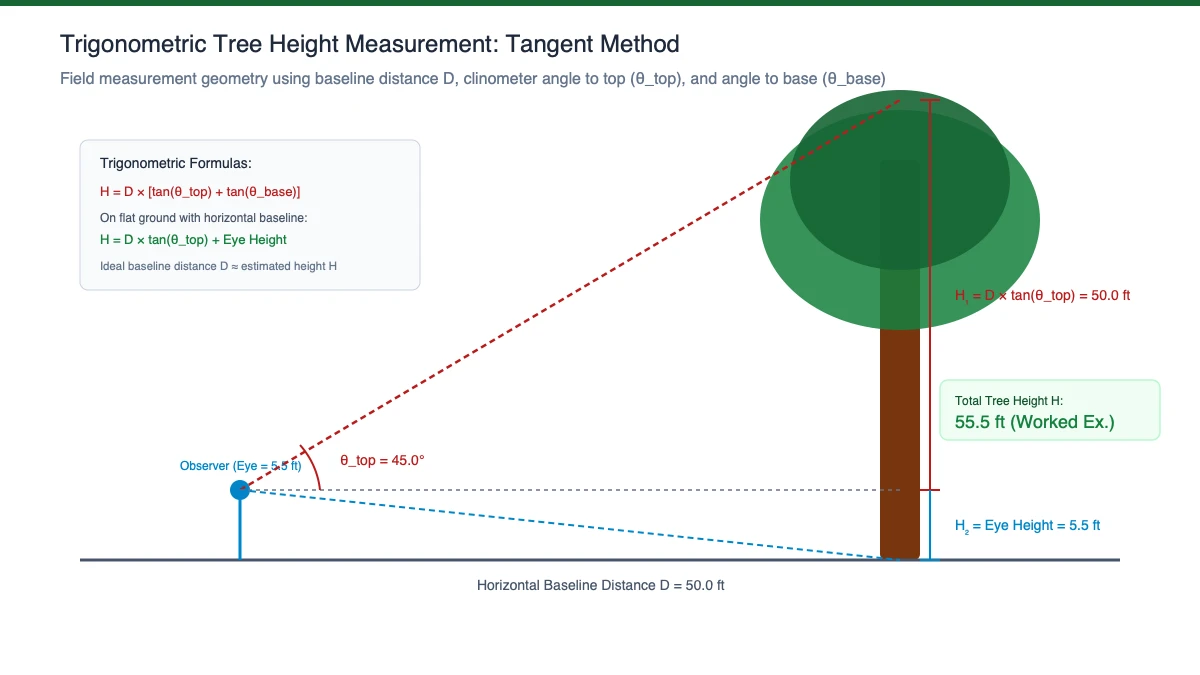
Because the top term and the base term are both measured from your eye line, eye height cancels: the base angle measures the drop from eye to stump, the top measures the rise from eye to treetop, and their difference is the tree. When the base sits at your eye level instead, eye height must be added back:
H = Dhorizontal × tan θtop + eye height
Sloped pacing is corrected to horizontal before either formula runs:
Dhorizontal = Dpaced × cos(slope)
| Symbol | Meaning | Unit | Typical range |
|---|---|---|---|
D | distance from eye to the trunk | ft | 5–300 ft |
θ_top | angle of elevation to the treetop | degrees | 1–89 |
θ_base | angle to the stump, negative below eye level | degrees | −89 to 89 |
slope | ground grade along the pace line | degrees | 0–60 |
eye | height of the eye above the ground | ft | 1–10 ft |
H | total tree height produced | ft and m | 5–350 ft |
Tree Height: worked example
Worked example: 50 ft out, top +35°, base −8°. tan 35° = 0.7002, tan(−8°) = −0.1405. Height = 50 × (0.7002 + 0.1405) = 50 × 0.8407 = 42.0 ft (12.8 m). The treetop sits 35.0 ft above your eye line and the base 7.0 ft below it. Eye height never enters. Top-angle-only variant: 50 × 0.7002 + 5.5 = 40.5 ft, where the assumed 5.5 ft of eye height does all the work at the bottom of the tree. Slope check: pace 50 ft along a 15° grade → Dh = 50 × cos 15° = 48.30 ft, and the two-angle method returns 48.30 × 0.8407 = 40.6 ft, nearly a foot and a half less than forgetting the slope.
Example B: top angle only
Example B: top angle only. On flat ground where the stump genuinely sits at your feet's elevation, switch to the single-angle form: 50 ft out at +35° gives 50 × 0.7002 = 35.0 ft above the eye, plus 5.5 ft of eye height, for 40.5 ft. Move the same shot to ground that falls away from you and the base is no longer level with your boots: the stump drops out of sight, the eye height is added anyway, and the answer comes back short by the difference in elevation. Sight the base angle whenever the terrain is anything but flat.
Field method
Back off until the tree looks smaller than you feel like standing, at least as far out as the tree is tall. Pace or tape the distance to the trunk centre, then take two clinometer sights: the top angle to the highest living point and the base angle to where the stem meets the ground. The base reading normally falls below horizontal and returns negative, which is exactly what the two-angle path expects. Pacing along a slope means entering the grade so the distance shortens to horizontal before anything else runs. Reserve the single-angle form for ground that is genuinely level with the soles of your boots.
Setting up the sight line
Sight to the vertical above the stump rather than along the lean, because a leaning or sweeping bole drags the top reading toward wherever the crown happens to hang. A hidden top is the other setup trap: aim at the apex you can actually see, and a co-dominant stem behind a foreground tree will hand you a perfectly reasonable number for the wrong tree. Steady the instrument (a half-degree wobble at close range is worth several feet) and take each reading twice before writing it down. The pair of angles pays for itself the moment the ground stops being flat.Photograph the tree from the measuring spot whenever the record matters; it settles later arguments about which apex was sighted and whether the top had already dropped out of view.
Instrument error
Distance and angle mistakes compound, and standing close magnifies both: at half the tree's height, a one-degree wobble in the top reading moves the answer by roughly a quarter of the tree. Pacing along the ground always overstates the horizontal distance, and the calculator corrects only when the grade is supplied. Eye height shifts the single-angle path one for one (misjudge it by four inches and the tree moves four inches), while the two-angle path cancels it by construction. The tangent function grows fast near the top, so readings above about 70 degrees deserve a second sight from farther out.
Common blunders
Walking uphill without entering the slope is the classic field error, and it always inflates the height. Entering a positive base angle where the clinometer reported a negative one shortens the tree by twice the eye-to-drop. Reading the top from too close produces a large angle and a large error in the same instant. Feeding a laser's already slope-corrected distance back through a second grade correction subtracts the same tilt twice. And the single-angle form on ground that falls away from you adds eye height to a stump that was never level with your feet.
Worked field example
Stand 50 ft out with readings of +35° to the top and −8° to the stump. tan 35° = 0.7002 and tan(−8°) = −0.1405, so height = 50 × (0.7002 + 0.1405) = 42.0 ft (12.8 m): the top 35.0 ft above your eye line, the base 7.0 ft below it, eye height never entering. Now pace the same shot along a 15° grade: the horizontal distance drops to 50 × cos 15° = 48.30 ft and the answer becomes 48.30 × 0.8407 = 40.6 ft. Ignoring the slope gives away a foot and a half on a single tree.
Unit systems
Distance is entered in feet here and the result prints in both feet and metres, so a site-index table and a metric record can be served from one reading. Slope arrives in degrees rather than percent (a 15 % grade is about 8.5°), and the cosine correction needs the angular form. Eye height follows the distance units, so a crew working in metres should convert before entry instead of dropping a 1.7 m eye into a foot-based distance. Angles themselves carry no units, which is why the same two sightings work whatever tape is in your pocket.Keep eye height in the same unit as the distance and write it on the sheet, because a different reader next season will not know what your boots were standing on.
What your tree height result means
Height is half of every volume equation: standing volume scales roughly as basal area × height, so a 10 % height error moves cruise volume by about 10 % before any diameter error is counted. Site index (the standard measure of site quality) is defined by the height of dominant trees at a base age, so the same two angles decide whether a site reads as poor or excellent.
The method choice is interpretive too: the two-angle form is self-contained (no assumption about your ground), while the top-angle-only form silently assumes the stump sits at your feet's elevation: fine on flats, wrong on a slope facing away from you.
How to read the output:| Result range | What it means | What to do next |
|---|---|---|
| 42.0 ft (12.8 m) | two-angle reading on level ground | Eye height cancelled: the default path |
| 40.6 ft | same shot after a 15° slope correction | Paced distances always need the grade |
| 40.5 ft | single-angle form with 5.5 ft eyes | Valid only when the stump is at your feet |
| Above about 70° | very steep top angle | Move back; the tangent amplifies every wobble |
| Feet and metres together | dual output | Quote one unit consistently in any report |
| Height down, distance up | too close to the tree | Retake from roughly one tree height out |
Learn how tree height translates to merchantable 16-foot logs in our sawlog volume and timber scaling guide.
Common mistakes with the tree height
- Pacing uphill and leaving the slope at zero: Enter the grade in degrees: ground distance always exceeds horizontal, and the cosine shortens it before the tangents run.
- Typing a positive base angle: Keep the minus sign the clinometer gives you; a base below eye level adds to the top term rather than subtracting from it.
- Standing closer than the tree is tall: Move back to about one tree height, where the angles stay modest and a fixed-degree wobble costs the least height.
- Reaching for the single-angle form on a slope: That path assumes the stump is level with your boots; anywhere else, sight the base angle and let eye height cancel itself.
- Trusting a leaning or hidden top: Sight to the vertical above the stump and confirm the apex first, since the wrong crown reads like an ordinary answer.
Limits of the tree height calculator
Distance and angle errors compound, and the geometry amplifies both when you stand too close: at half the tree's height, a 1° wobble in the top reading moves the answer by roughly a quarter of the tree's height. Hidden tops, leaning stems, and sweep (curved boles) each add bias the calculator cannot see. Sight to the vertical above the stump, not along the lean.
Slope handling is the other classic trap: pacing along the ground always overstates horizontal distance, and this calculator corrects only if you tell it the grade. Eye-height errors shift the top-angle-only result one-for-one: a 4-inch misestimate moves the tree 4 inches. When the number feeds a sale or a research plot, confirm it with a laser or a stick hypsometer sighting at a fixed 66 ft.
Forestry note from Dr. Dinesh A. Nagegowda, PhD: Tree height measurement using trigonometric hypsometry (measuring angles to top and base from a measured horizontal baseline distance) requires ensuring a clear line of sight to the actual highest living apical leader. In dense deciduous forest canopies, leaning crowns or lateral branches projecting forward frequently cause observers to sight on a false top, overestimating tree height by 10% to 15%.
Evaluate vertical crown dimensions and shade footprint with our urban tree canopy cover calculator.
Sources
- American Forests, Tree Measuring Guidelines (used for: tangent-method height measurement and the stand-off distance rule)
- Alabama Cooperative Extension FOR-2082, Forest Inventory Basics (used for: negative base-reading procedure within a stand inventory)
- Oregon State Extension EC 1129, Tools for Measuring Your Forest (used for: field tools for height and cross-checking against stick methods)
Cite This Calculator
For laboratory course reports, academic papers, or institutional protocols (APA format):
Tree Height: frequently asked questions
Why should I stand as far back as the tree is tall?
Angular error scales with distance: the farther out you stand, the smaller the angle the tree subtends and the smaller the height error a fixed-degree wobble produces. One tree-height out is the practical field rule of thumb.
What is the base angle for?
It locates where the ground actually is at the trunk from your eye line, so eye height cancels out of the math. A negative value (base below your eyes, the usual case) is added, not subtracted. Enter it with the minus sign exactly as the clinometer reports it.
How accurate is the clinometer tangent method?
With a clean sight line, correct distance, and practice, expect a few percent on open-grown trees, good enough for site index and cruise work. Lasers are faster; stick methods (the 66-ft Merritt rule) are coarser but serviceable for log counts.
Found a number that does not match its source? Report a mistake. Corrections are published in place and the page date is updated.
See a value here that won’t reconcile with its cited source? Report a mistake.

Dr. Dinesh A. Nagegowda, PhD: Plant & Molecular Biology Editor
Dinesh is a plant molecular biologist and Chief Scientist at CSIR-CIMAP whose research runs through functional genomics, transcriptomics, metabolomics, and biosynthetic pathways in plants. He writes and…