Guide · Trees & Forestry
Basal Area Explained: A Forester's Field Guide
Forest stand basal area calculation measures the total cross-sectional area of standing tree stems per acre ($ ext{ft}^2/ ext{acre}$) or hectare ($ ext{m}^2/ ext{ha}$) from diameter at breast height (DBH at 4.5 feet). Quantifying basal area density provides silviculturists with objective indices for stand competition, timber volume, and thinning schedules.
Key takeaways
- Basal area is the total cross-sectional area of stems at breast height over a unit of land.
- The forester's constant 0.005454 turns a DBH in inches straight into square feet.
- It weights every stem by its own size, so it reads occupancy better than a tree count.
- Report it with quadratic mean diameter and stems per acre, because one number hides structure.
Interactive Calculator: Calculate forest stand cross-sectional area (ft²/acre or m²/ha) from DBH with our timber basal area per acre calculator.
Stumps, not stems
Basal area is the cross-sectional area of tree stems at breast height, measured 4.5 feet above ground on the uphill side, summed over a unit of land. The clearest picture comes from the classic teaching device in extension material: imagine an acre of forest sawn off flat at breast height, leaving stumps: the total surface of those stumps, in square feet, is that acre's basal area. A single tree's basal area is the area of its own stump circle; the stand figure is the sum across every stem.
Two quantities, two habits. Per-tree basal area is what you calculate from one diameter tape reading. Stand basal area is what you report, in square feet per acre in imperial practice or square metres per hectare in metric, and it is the number that compares one stand to another.
One constant does the unit conversion
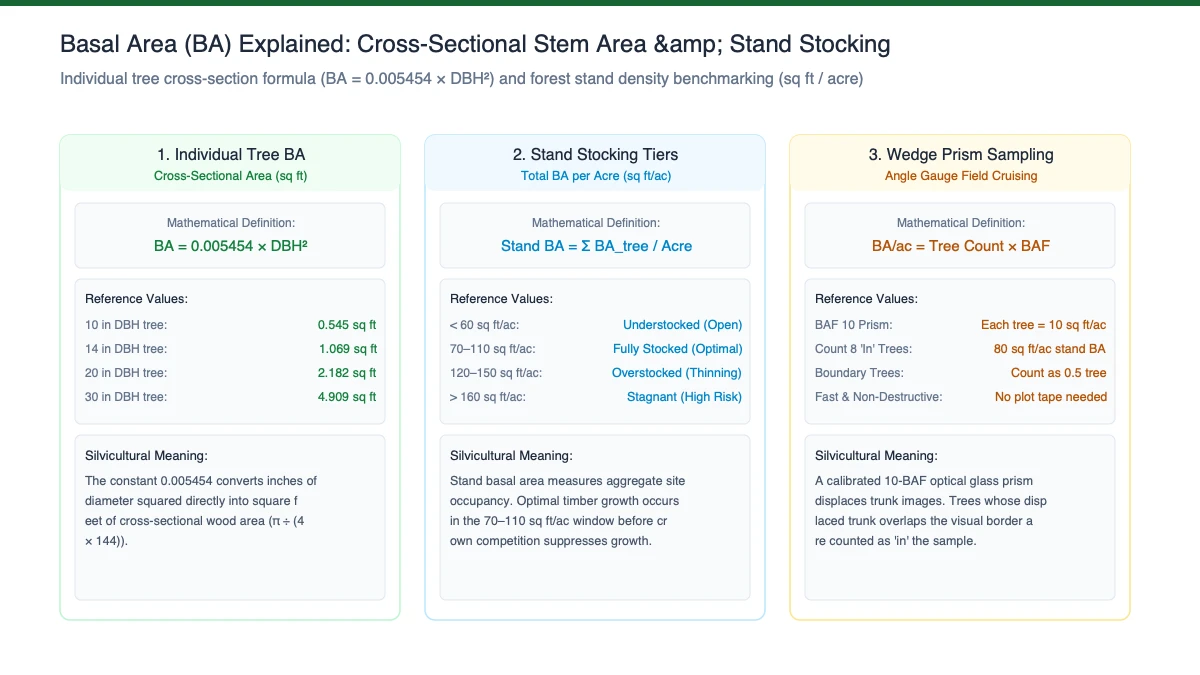
BA (ft²) = 0.005454 × DBH² (DBH in inches)
BA (m²) = π × (DBH ÷ 200)² (DBH in cm, radius in metres)
stand BA = (trees ÷ plot area) × per-tree BA
The imperial constant is foresters' shorthand: π/4 converts a diameter to a circle's area in square inches, and ÷144 converts those square inches to square feet. 0.005454 is the product, and university extension guides call it the forester's constant. Run it: a 12-inch tree gives 0.005454 × 144 = 0.785 ft², and the same guide's table shows a 14-inch tree landing at 1.07 ft², which is why field crews say a 14-incher 'has a square foot of basal area'. Eighty such trees per acre: 80 × 0.785 = 62.8 ft²/ac.
Metric switches units, not logic: with DBH in centimetres, radius is DBH ÷ 200 metres, and πr² returns square metres per tree, scaled to m²/ha. Convert with 1 m²/ha = 4.356 ft²/ac, so 25 m²/ha is about 109 ft²/ac. Avery and Burkhart's Forest Measurements treats both systems as the same mensuration problem seen through different units.
What the number buys you
Basal area tracks crown volume, leaf area, site occupancy and volume growth better than stem counts, because it weights each tree by size: a stand's growing space is written in cross-section, not head-count. It is also the quantity a prism measures: in angle-count sampling, each tree counts toward the plot if its apparent trunk exceeds the prism's cut-off angle, so a point-sample cruise returns basal area per acre almost directly, with stems per acre as the by-product.
Management reads come next. Many eastern hardwood stands are worked toward roughly 60–100 ft²/ac under extension guidance, with denser conifer plantations run higher; the local target depends on site quality, species and crop objectives, so the number to quote is your extension forester's, not a universal one. Rising basal area toward that band is the standard signal that a thin is due, and relative basal area (stand BA divided by the maximum the site supports) is the formal trigger.
What basal area hides
A single figure cannot separate structure. Forty trees at 20 inches and four hundred at 6 inches can post the same basal area while behaving as different forests: crown closure, future volume and wildlife cover all diverge. Report basal area with quadratic mean diameter (the mean diameter of an 'average' tree by area, QMD = √(Σd² ÷ n)) and stems per acre, and the trio describes the stand properly.
Calculation itself is unforgiving about averaging: area scales with the square of diameter, so a stand total must be the sum of individual trees, Σ 0.005454dᵢ², never 0.005454 × (mean diameter)² × count. A few big stems dominate the true total, and the mean-diameter shortcut systematically under-reads them.
Unit and field traps
- Measuring off-height. DBH is 4.5 ft on the uphill side; measuring at chest height on the downhill side changes the diameter and the squared result with it.
- Wrong radius in metric. DBH in cm must be divided by 200 to give a radius in metres: using cm directly inflates basal area by 10,000 times.
- Forgetting plot scaling. Eight trees on a tenth-acre plot is 80 per acre, not 8.
- Mixing the two unit systems. Keep 4.356 in your head: 60 ft²/ac is 13.8 m²/ha, not 60.
- Mean-diameter shortcuts in mixed stands. Sum per tree; diameter is squared for a reason.
What a prism is actually comparing
Angle-count sampling swaps the tape for geometry. Hold a wedge prism at eye level and every trunk seen through it appears wider or narrower than it really is, scaled by distance: the instrument carries a fixed cut-off angle, and a tree counts when its apparent trunk still beats that angle. A big trunk passes from farther out; a slender one has to stand close. Distance rather than a plot boundary is what sorts the trees, which is why the method runs from a single point and still lands on basal area per acre, with stems per acre as the by-product. Oregon State's extension guide to measuring your forest frames the prism as reading that quantity almost directly.
The efficiency is real, and so is the discipline: keep eye and instrument at one height on every turn, because the whole comparison rests on geometry held level. A cruise taken carelessly returns a confident number all the same, which is why plot placement and tape work, not the arithmetic, dominate disagreements between two crews.
Why one reading point keeps stands comparable
The 4.5-foot convention looks arbitrary until you watch what happens without it. Basal area scales with the square of diameter, so a stem read a few inches off the standard moves the stand figure by more than the tape error suggests, and two crews measuring the same trees at different heights will disagree without either being careless. Breast height fixes the reference: the same point on every stem, in every stand, on flat ground or slope, which is what lets a number from one cruise sit beside a target quoted by an extension forester.
The uphill side exists for the same reason. On sloping ground the soil line rises around the trunk, so four and a half feet above the ground has to mean above the ground you are standing on, not the ground on the far side of the tree. Fix both habits and the remaining error budget belongs where field disagreement actually lives: plot placement and the diameter tape.
Worked example: Basal Area Explained: A Forester's Field Guide
Measure a stem at 4.5 feet and the constant does the conversion: a 12-inch DBH gives 0.005454 × 144 = 0.785 ft² of stump. Multiply by what stands on the ground and the stand follows: 80 trees of that size per acre reads 62.8 ft²/ac, a figure you can hold against a local thinning target. Metric keeps the logic and swaps the units, dividing a centimetre diameter by 200 to get a radius in metres before πr² returns square metres per tree. Run your own diameters in the calculator →
Common mistakes: Basal Area Explained
- Squaring the mean diameter once and multiplying by the tree count, which systematically under-reads the stand, so sum each tree's squared diameter instead.
- Measuring at chest height on the downhill side, which moves the diameter and the squared result with it, so fix the tape at 4.5 feet on the uphill side.
- Feeding a centimetre DBH into the metric formula without dividing by 200, which inflates basal area by a factor of 10,000, so convert to a radius in metres first.
- Forgetting to scale a plot to the full area, since eight trees on a tenth-acre plot stand for eighty per acre, and multiply before you report.
- Reporting a figure in the wrong unit system without converting, so keep 4.356 in mind to move between square feet per acre and square metres per hectare.
Put it to work: Basal Area Explained: A Forester's Field Guide
The calculators below apply exactly what this guide explains: same formula, no mental arithmetic.
Basal Area Explained: A Forester's Field Guide: frequently asked questions
What is basal area used for?
Stand density in a size-weighted form: thinning triggers, growth and yield modelling, wildlife habitat targets, and comparing occupancy between stands where stem counts alone would mislead.
How do I convert m²/ha to ft²/acre?
Multiply by 4.356. So 25 m²/ha ≈ 109 ft²/ac, and 60 ft²/ac ≈ 13.8 m²/ha. The conversion is exact arithmetic, not an estimate.
What is DBH?
Diameter at breast height: diameter measured outside bark 4.5 feet (1.37 m) above ground, on the uphill side of the stem.
Why does my basal area disagree with the forestry consultant's?
Almost always plot placement, tree-measurement error, or a mean-diameter shortcut. Basal area is unforgiving: plot error dominates, and a handful of large stems can carry a third of the stand total.
Sources & further reading
Found a number that does not match its source? Report a mistake. Corrections are published in place and the page date is updated.

Dr. Dinesh A. Nagegowda, PhD: Plant & Molecular Biology Editor
Dinesh is a plant molecular biologist and Chief Scientist at CSIR-CIMAP whose research runs through functional genomics, transcriptomics, metabolomics, and biosynthetic pathways in plants. He writes and…