Free Other Animals tool
 Free Other Animals tool
Reptile Tank Size Calculator
The Reptile Tank Size Calculator determines minimum terrarium volume in gallons and floor footprint dimensions from adult reptile snout-to-vent length. Gallons are the wrong unit for a snake. Length is what counts, because snakes move in straight lines and need to stretch out fully. Enter the animal and its dimensions against your tank: this calculator converts volume, checks the enclosure against published species minimums and the evidence-based straightness rules, and flags the legacy gallon-per-inch rule for what it is.
Reptile Tank Size Calculator: result
At a glance
- What it does: Converts tank length, width and height to gallons, then checks the enclosure against species minimums.
- Who it is for: Runs the evidence-based straightness rules for snakes: one body length primary, the rest at 40%.
- Typical result: Stages the preset by weight and length, and flags the legacy gallon-per-inch rule for what it is.
How to use the reptile tank size calculator
- Measure the animal nose to tail-tip (snakes) or total length (dragons), and weigh it in grams. Both drive the stage selection and the fit checks. prefill →
- Measure the tank's internal length, width and height at the widest points; manufacturer labels round generously. prefill →
- Pick the species first. The preset row rewrites itself by stage (hatchling, juvenile, adult), so a wrong species makes every comparison meaningless.
- Read the species-minimum row before the volume row: two tanks with identical gallons can pass or fail on shape alone.
- For snakes, use the straightness row as the final word: primary dimension at least one body length, secondary dimensions at least 40% of it.
- Switch to centimetres if you work in metric; conversion happens on entry and the presets stay in their published units internally.
Reptile Tank Size: the formula & its source
Volume is geometry, but welfare is dimension-based:
gallons = internal length × width × height ÷ 231
snakes: primary dimension ≥ 1 × body length; every other dimension ≥ 40% of the primary
bearded dragons: floor length ≥ 3 × total length, height ≥ 24 in
Species presets come from published care guidance: ball python stages (hatchling under 300 g in a 10-gallon 20 × 11 × 13 in; juvenile under 3 ft at 36 × 18 × 18 in; adult over 3 ft at 48 × 24 × 24 in, about 8 sq ft of floor), bearded dragon 6 × 2 × 2 ft, leopard gecko 36 × 18 × 18 in, crested gecko 18 × 18 × 36 in above 12 g (12 × 12 × 12 in below). The snake checks come from the 2021 Animals review, which also documented that the older gallon-per-inch rules of thumb have no traceable evidence base. That rule appears in this calculator only to be flagged.
| Symbol | Meaning | Unit | Typical range |
|---|---|---|---|
tl × tw × th | Internal tank volume | in³ → gallons | ÷ 231 cubic inches |
1.0× / 0.4× | Snake straightness: primary and secondary | body length | Warwick 2021 review |
3× + 24 in | Bearded dragon length rule and height | multiple / inches | published rule of thumb |
stage | Preset chosen by weight and length | hatchling → adult | four species |
Reptile Tank Size: worked example
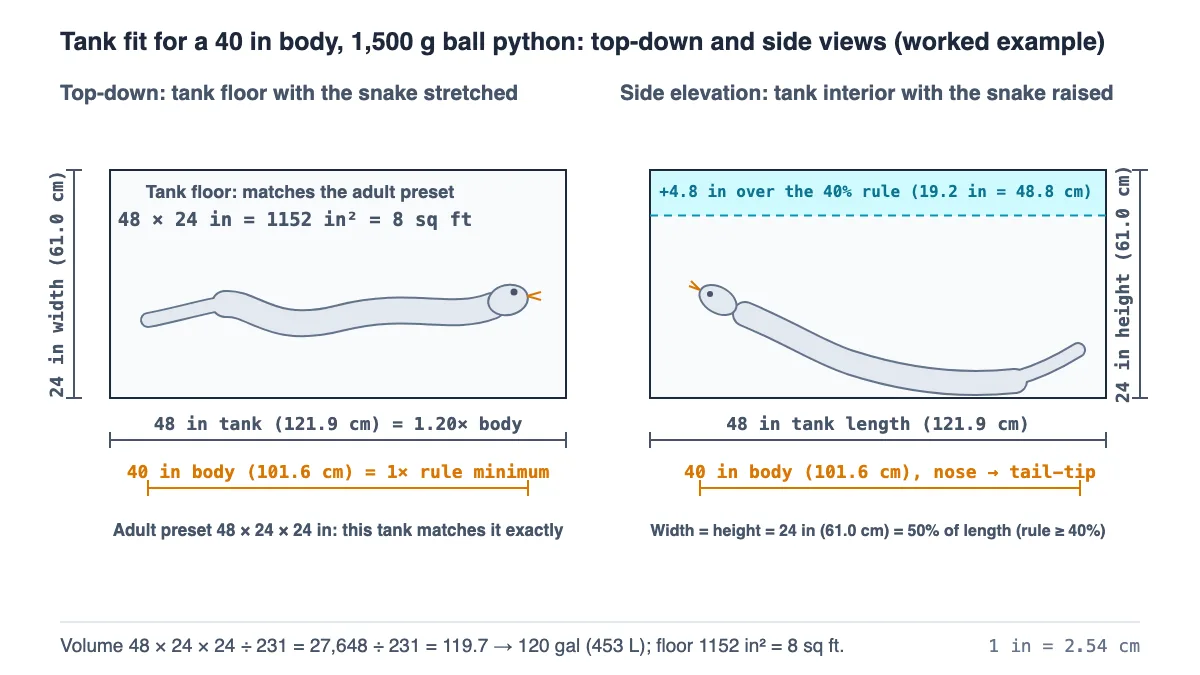
Worked example: 40-inch ball python (1,500 g) in a 48 × 24 × 24 in tank. Volume = 48 × 24 × 24 ÷ 231 = 27,648 ÷ 231 = 119.7 gallons, which the volume row rounds to 120 gal (453 L). Floor = 1152 ÷ 144 = 8 sq ft. Over 3 ft, the species preset is the adult 48 × 24 × 24. Your tank matches it exactly. Straightness: 48 ÷ 40 = 1.20× body length (clears the 1× rule), width and height each 50% of length (clear the 40% proportion). The legacy gallon-per-inch rule would have said 40 gallons, three times too small for this animal.
Example B: crested gecko, 15 g
Example B: crested gecko, 15 g, in an 18 × 18 × 24 in tank. Volume = 18 × 18 × 24 ÷ 231 = 7,776 ÷ 231 = 33.7 gallons, printed as 34 gal (128 L), with floor at 2.25 sq ft. Above 12 g the published preset is 18 × 18 × 36 in, so the minimum check fails with the tank twelve inches short in height, and the orientation row explains why that dimension is the one that matters: crested geckos are arboreal, and a longer-but-shorter tank is a downgrade rather than a swap. The legacy rule would have said 8 gallons, an aquarium figure with no husbandry source behind it.
Welfare-based minimums
The species presets are quoted from published care guidance: ball python stages run 20 × 11 × 13 in for hatchlings under 300 g, 36 × 18 × 18 in for juveniles under three feet, and 48 × 24 × 24 in (about eight square feet of floor) past three feet; bearded dragons get 6 × 2 × 2 ft with the additional rule that length reaches three times total length and height 24 inches; leopard geckos start at 36 × 18 × 18 in with 48 × 24 in recommended; crested geckos stage at 12 × 12 × 12 in under 12 g and 18 × 18 × 36 in above it.
For snakes the calculator layers the 2021 Animals review on top of the presets: the better-documented recommendations are straightness-based, with a primary dimension of at least one full body length and no other dimension below 40 percent of that primary. The review also documented that sub-one-times rules circulate without a traceable source, which is why the straightness row reports the ratio it measured rather than a pass phrase. The legacy gallon-per-inch figure appears as its own row precisely to be flagged: an aquarium stocking guideline that no snake- or lizard-husbandry publication was found standing behind.
How to measure
Measure the tank internally (length, width and height at the widest points) because manufacturer labels round generously and a two-inch rounding error moves the gallon figure by several units before any welfare check runs. For the animal, let a snake stretch along a tape on a flat surface rather than lifting it mid-body: a suspended snake curves and under-reports the length that both the stage selection and the straightness check depend on. Weigh it in grams too, since weight alone decides the hatchling and crested-gecko stages.
Units convert on entry while presets stay in their published dimensions internally, so a metric tank description lands on the same comparisons an imperial one does. Read the rows in order: volume and floor first as geometry, then the species-minimum check, then the body-length fit. The order matters because two tanks with identical gallons can pass or fail on shape alone, and the minimum row is where the stage logic (which the gallon number cannot see) gets applied.
Growth allowance
Stages move in both directions, and the inputs exist to catch each one. Ball pythons stage down to a ten-gallon starter under 300 g, up to the juvenile footprint until three feet, and up again to the adult 48 × 24 × 24 beyond it; crested geckos switch presets at 12 grams; the beardie and leopard gecko rules track length rather than weight. A hatchling parked in an adult-sized tank gets lost and refuses food, an adult compressed into a hatchling tank gets stressed. Both failures come from buying for the animal you plan for rather than the animal you have.
Re-run the calculation on a schedule, not a whim: weigh and measure every few months while an animal is growing, because a subadult ball python crosses the three-foot boundary in a single season and the preset jumps a full tier when it does. The shortfall message is deliberately specific (it names the dimension that is short and by how much), so the next purchase answers the actual gap. For long-lived species the same discipline continues into adulthood: floor area, once adequate, stays adequate, while a growing animal never stops testing the height row.
Gallons versus shape
Volume is arithmetic, welfare is dimension-based. The gallon row divides internal length by width by height by 231 and tells you how much water the tank would hold; it says nothing about whether a snake can stretch out, whether a gecko can climb, or whether the thermal gradient a reptile needs can exist along the length you measured. That is why the shape rows follow the volume immediately and the species check overrides it when they disagree.
Orientation closes the loop. Terrestrial species read a row saying long beats tall (extra height buys a leopard gecko nothing) while arboreal species read the opposite, because the 36 inches above twelve grams is the whole point of the crested preset and a longer tank with half the height is a downgrade. Everything outside the arithmetic still matters: ventilation, a secure screened top for climbers, substrate, and a gradient the animal can actually move through. The calculator prints the dimensions those decisions hang off.
What your reptile tank size result means
Snakes assess their enclosures by contact and stretch, not by volume: the straightness rules exist because a snake that cannot lay out along its primary dimension cannot perform the rectilinear locomotion its body is built for. That is also why the gallon number is a poor guide. A 40-gallon 'breeder' footprint (36 × 18 in) fails a 40-inch snake on length while a longer, shallower tank with fewer gallons passes.
The species-minimum row carries the stage logic most guides bury: hatchlings in adult tanks get lost and refuse food, adults in hatchling tanks get stressed and compressed. Weight and length inputs exist so the preset tracks the animal, not the owner's purchase timeline.
How to read the output:| Result range | What it means | What to do next |
|---|---|---|
| Enclosure volume | tl × tw × th ÷ 231 | Geometry only: check shape before trusting it |
| Species minimum check | preset for species and stage | Stage is chosen by weight and length together |
| 1.20× body length | the straightness ratio for snakes | Sub-1× rules have no source behind them |
| Legacy rule: 40 gal | gallon-per-inch figure, flagged | Aquarium guideline, no husbandry source |
Ensure proper terrarium temperature gradients for feeder insects via our cricket chirping ambient temperature tool.
Common mistakes with the reptile tank size
- Shopping by gallons for a snake: Check the straightness row first, because volume hides shape and a snake needs one full body length along its primary dimension whatever the gallon count says.
- Measuring a coiled snake mid-body: Let the animal stretch along a tape instead, since a suspended snake curves and under-reports the length that both the stage and fit checks depend on.
- Keeping a hatchling in an adult tank: Re-run on weight as well as length, because the presets stage downwards too and small animals get lost and refuse food in oversized enclosures.
- Trusting the gallon-per-inch rule: Use the species minimum and length checks instead, since that figure is an aquarium stocking guideline no snake- or lizard-husbandry source stands behind.
Limits of the reptile tank size calculator
The gallon-per-inch rule is flagged, not modelled: it is an aquarium-fish guideline, and no snake- or lizard-husbandry publication was found standing behind it. The verified requirements here are dimension-based. Presets are minimums from single published care guides; localities, body condition and individual temperament vary, and a larger enclosure with proper thermal gradient always beats the minimum. Ventilation, secure lids for arboreal species, substrate and humidity control are outside what this calculator measures. A crested gecko's 36 inches of height needs a screened top to mean anything.
Clinical note from Dr. Chyrle Bonk, DVM: In captive herpetological medicine, reptile vivarium sizing must be dictated by the animal's adult length and thermoregulatory requirements. An enclosure is only adequate if it is long enough to establish a true thermal gradient—with an appropriate basking focal point at one end and a cool retreat at the other. Without adequate thermal gradient length, reptiles suffer from chronic metabolic bone disease and immune collapse.
Model habitat bio-load and spatial carrying limits on our habitat carrying capacity calculator.
Sources
- Warwick et al., Getting It Straight: accommodating rectilinear behavior in captive snakes, Animals (2021) (used for: the 1× primary-dimension and 40% secondary rules, and the finding behind the flagged legacy rule)
- ReptiFiles, bearded dragon care sheet (used for: the 6 × 2 × 2 ft adult minimum and the three-times-length, 24-inch-height rule)
- ReptiFiles, ball python care sheet (used for: the stage footprints: hatchling, juvenile under 3 ft and adult 48 × 24 × 24 in)
- ReptiFiles, leopard gecko care sheet (used for: the 36 × 18 × 18 in minimum and the 48 × 24 in recommendation above it)
- ReptiFiles, crested gecko care sheet (used for: the weight-based 12 g preset switch and the vertical 18 × 18 × 36 in minimum)
Cite This Calculator
For laboratory course reports, academic papers, or institutional protocols (APA format):
Reptile Tank Size: frequently asked questions
Why do sources say one gallon per inch of snake?
Because the rule crossed over from aquarium fish stocking. It has no traceable snake-husbandry source. The 2021 evidence review found the documented recommendations are dimension-based instead: primary dimension at least one snake length, no other dimension below 40% of it. This calculator shows the gallon rule only to flag it.
How do I measure a ball python's length safely?
Let it stretch along a tape on a flat surface rather than lifting it mid-body. A suspended snake curves and under-reports. Nose to tail-tip on a relaxed, straightened animal, then check the stage row: under 36 inches is the juvenile preset.
Why is the crested gecko tank so tall?
Crested geckos are arboreal: the published preset above 12 grams is 18 × 18 × 36 inches, and height is the dimension that carries the species' climbing behaviour. The orientation row says the same thing the other way round: a longer tank with half the height is a downgrade for this species and an upgrade for leopard geckos.
Is a 40-gallon tank enough for an adult ball python?
An adult needs 48 × 24 × 24 inches, about 120 gallons of enclosure by these dimensions, with 8 sq ft of floor. A 40-gallon breeder (roughly 36 × 18 in) matches the juvenile preset only, so the species-minimum row will flag it as short in length for a snake over three feet.
Found a number that does not match its source? Report a mistake. Corrections are published in place and the page date is updated.
A value here that won’t reconcile with its reference? Report a mistake.

Dr. Chyrle Bonk, DVM: Veterinary Editor
Chyrle is a mixed-animal veterinarian in rural Idaho who has practised since 2010, with a particular emphasis on food-animal medicine and cattle alongside her companion-animal caseload. She reviews the…