Free Livestock tool
 Free Livestock tool
Dry Matter Calculator
The Dry Matter Calculator converts forage feed weights between as-fed basis and 100% dry matter basis (DM%) to standardize ration nutritional density. Two feeds carrying identical protein numbers can deliver completely different amounts of it, because one is carrying far more water. This calculator strips moisture out of the equation: dry-matter percentage from a moisture test, dry-matter weight from an as-fed weight, nutrient percentages rebased to a dry-matter basis, and the as-fed weight you actually need to scoop to hit a target intake.
Dry Matter Calculator: result
At a glance
- What it does: Strips water from feed numbers: DM percent, dry-matter weight, rebased nutrients, and scoop weight.
- Who it is for: Built for anyone comparing a hay tag with a silage tag or hitting a ration target.
- Typical result: Reports the as-fed pounds needed to deliver a target dry-matter intake.
How to use the dry matter calculator
- Get the moisture figure: a forage test reports it directly, or weigh a sample before and after drying (Koster tester, oven at 212 °F until constant weight). prefill →
- Enter the as-fed weight you are dealing with: a bale, a bucket, a mixer load. prefill →
- Type the nutrient percentage exactly as the lab or tag prints it: if the tag says 10 % crude protein on an as-fed basis, enter 10.
- Set the dry-matter target from the ration and read how many as-fed pounds deliver it.
- Compare feeds on the DM line only: 11.4 % CP on 88 % DM hay and 11.4 % CP on 33 % DM silage are the same feed quality. The as-fed numbers are not.
Dry Matter: the formula & its source
Dry matter is what remains after water is removed, and every conversion runs through it:
DM % = 100 − moisture %
DM amount = as-fed weight × (DM % ÷ 100)
nutrient (DM basis) = nutrient (as-fed) ÷ (DM % ÷ 100)
as-fed needed = target DM ÷ (DM % ÷ 100)
The divisions and multiplications by the DM fraction are the same operation seen from both sides: water dilutes as-fed percentages, so removing it always raises the nutrient percentage, and re-wetting a dry-matter target always raises the as-fed weight you must feed. Most 'dry' feeds (grains and hays) test 85–92 % DM; silages and wet distillers grains run 25–35 %.
| Symbol | Meaning | Unit | Typical range |
|---|---|---|---|
M | moisture measured in the feed sample | % | 5 – 90 |
DM | dry matter percentage, 100 minus moisture | % | 10 – 95 |
W | weight of the feed as it goes in the bunk | lb or kg | 0.5 – 1,500 |
CP | nutrient percentage exactly as printed on the tag | % | 2 – 50 |
target | dry matter the ration calls for per feeding | lb or kg | 1 – 100 |
Dry Matter: worked example
Worked example: hay at 12 % moisture, 10 % crude protein as-fed. DM % = 100 − 12 = 88 %. A 50 lb as-fed sample contains 50 × 0.88 = 44.0 lb DM (and 6.0 lb of water). Crude protein on a dry-matter basis = 10 ÷ 0.88 = 11.4 %: always higher than the as-fed figure, because removing water concentrates what is left. To deliver a 25 lb DM ration: 25 ÷ 0.88 = 28.4 lb as-fed.
Example B: corn silage at 40 % DM
Wet feed: corn silage at 60 % moisture, 8 % crude protein as-fed. Dry matter is 40 %, so a 200 lb load carries 80 lb of feed and 120 lb of water. Rebased, the protein reads 8 ÷ 0.40 = 20 % on a dry-matter basis, two and a half times the tag number. Delivering a 25 lb dry-matter target needs 25 ÷ 0.40 = 62.5 lb as-fed, more than twice the scooping the hay in the worked example required.
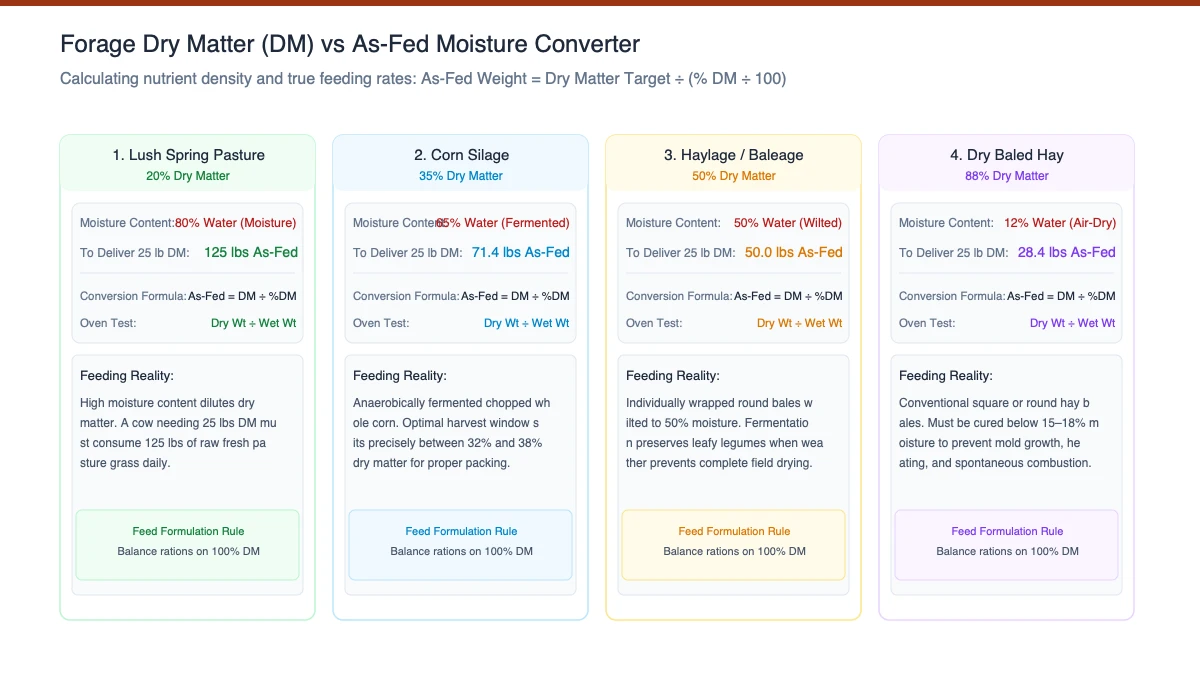
The conversion every ration runs through
Dry matter is what remains after water is removed, and one divisor stands between every feed tag and every bunk. Dry-matter percent equals 100 minus moisture, so hay at 12 % moisture is 88 % DM. From there four conversions run: dry-matter weight from an as-fed weight by multiplying the DM fraction, nutrient percentages rebased to a dry-matter basis by dividing by that fraction, and as-fed weight needed for a target by dividing the target the same way. The divisions and multiplications are the same operation seen from two sides, because water dilutes as-fed figures and removing it always raises what is left.
Working ranges keep the arithmetic honest. Most grains and hays test 85–92 % dry matter, with air-dry hay sitting near 10–12 % moisture, while silages and wet distillers grains run 25–35 %. The worked example shows the whole sequence: 88 % DM, a 50 lb bale holding 44 lb of feed, 10 % crude protein as-fed becoming 11.4 % on a dry-matter basis, and a 25 lb target requiring 28.4 lb of hay in the bunk. Every number nutritionists quote about intake and requirements lives on the dry-matter side of that sequence.
Getting a moisture figure you can trust
The conversion is only as good as the moisture test behind it. Bales from the same field vary, and surface moisture differs from core moisture, so sample across the lot rather than trusting the outside of one bale. A forage test reports moisture directly, or weigh a sample before and after drying on a Koster tester or in an oven at 212 °F until the weight stops changing. Whatever method you use, apply it to a representative sample and record the number with the feed, because next month's bale will not match this one.
Moisture also decides how feed behaves in storage. Hay that tests too wet heats and moulds in the stack, while very dry hay shells and loses leaves every time it is handled, so 'dry' is a target rather than a virtue. Beyond the arithmetic sits the question this tool never answers: whether the ration meets the animal's requirements. Protein, energy, and mineral adequacy depend on the analysis and the class of stock, which is a nutritionist's or extension adviser's call. The calculator handles units; ration balance is a separate conversation.
Working a forage test
Start with the test report itself. Moisture comes printed on the analysis, or you can weigh a sample before and after drying if you are testing at home. Enter the as-fed weight of whatever you are dealing with (a bale, a bucket, a mixer load), and type the nutrient percentage exactly as the lab or the tag prints it. If the tag says 10 % crude protein on an as-fed basis, enter 10; if the report is already dry-matter basis, convert it back before entering rather than letting the tool double-correct.
The comparison this enables is the one that changes feeding decisions. Two feeds can both read 11.4 % crude protein on a dry-matter basis while one is hay at 88 % DM and the other is silage at 33 % DM, and on the tag those feeds look nothing alike. Set the target from the ration, read how many as-fed pounds deliver it, and compare feeds on the dry-matter line only. That single habit removes most of the quiet under-feeding that shows up later as thin cows or slow gains.
What your dry matter result means
Every number that governs an animal's day (dry-matter intake, nutrient requirements, ration balance) is defined on a dry-matter basis, while every number you handle in the barn is as-fed. This calculator is the bridge, and it is the difference between a ration that meets requirements and one that quietly under-delivers because two feeds were compared across bases.
It also explains label illusions: a 12 %-moisture hay and a 50 %-moisture haylage can be nutritionally identical per pound of dry matter while their tags read 9 % and 2.7 % protein 'as fed'. Feed the dry-matter line, book the as-fed line.
How to read the output:| Result range | What it means | What to do next |
|---|---|---|
| 88 % DM | hay at 12 % moisture | 50 lb as-fed holds 44 lb of feed |
| 11.4 % CP | 10 % as-fed rebased to DM | Compare feeds on this line only |
| 28.4 lb | as-fed weight for 25 lb of DM | What actually goes in the bunk |
| 25 – 35 % DM | silages and wet by-products | Expect heavy scoops for light targets |
| 85 – 92 % DM | grains and hay | The usual stored-feed band |
Common mistakes with the dry matter
- Comparing two tags printed on different bases: Rebase both to dry matter first. Ten percent as-fed means something different at 88 % DM than at 40 %.
- Testing moisture on the outside of a single bale: Sample across the field or core several bales; moisture varies within a stack and surface readings mislead badly.
- Feeding the dry-matter target straight from the scale: Divide the target by the DM fraction. The scoop always weighs more than the dry-matter number on the ration sheet.
- Treating the conversion as a ration evaluation: Adequacy depends on analysis and stock class; this tool handles arithmetic, not whether requirements are actually met.
Limits of the dry matter calculator
Moisture is not uniform: bales from the same field vary, and surface moisture differs from core moisture: test a representative sample, not the outside of one bale. Feeds above about 90 % DM still support mould and heating; 'dry' does not mean stable.
This converts quantities and percentages; it does not evaluate whether the ration meets the animal's requirements. Protein, energy, and mineral adequacy depend on the analysis and the class of stock. That is a nutritionist's (or extension's) call, not an arithmetic one.
Clinical note from Dr. Chyrle Bonk, DVM: In ruminant nutrition, rations are formulated entirely on a 100% Dry Matter (DM) basis, yet cattle consume feed on an "As-Fed" basis. When feeding fermented forages like corn silage or haylage, moisture content can shift from 55% to 70% following heavy rains. If dry matter is not recalculated weekly using a Koster tester or microwave drying protocol, cattle receive significantly less actual nutrition than formulated, stalling milk and meat production.
Sources
- Oregon State University Extension EM8801, Understanding Your Forage Test Results (used for: dry matter percent equals 100 minus moisture and the as-fed conversion example)
- Montana State University Animal and Range Sciences, Dry Matter and As Fed Conversions (used for: as-fed to dry-matter weight conversions and nutrient rebasing)
- Mississippi State University Extension, Interpreting Forage and Feed Analysis Reports (used for: typical dry matter ranges of 85–92 % for hay and 25–35 % for wet feeds)
- Mississippi State University Extension, Beef Cattle Nutrient Requirements (used for: stating intake and nutrient requirements on a dry-matter basis)
Cite This Calculator
For laboratory course reports, academic papers, or institutional protocols (APA format):
Dry Matter: frequently asked questions
What is dry matter?
Everything in the feed that is not water: the part that carries protein, energy, fibre, and minerals. DM % = 100 − moisture %, so hay at 12 % moisture is 88 % DM.
Why is dry-matter protein always higher than as-fed protein?
Because water weighs nothing nutritionally but still occupies the sample. Dividing by the DM fraction removes the water's dilution: 10 % CP as-fed ÷ 0.88 = 11.4 % CP on a DM basis.
What dry matter should my hay be?
Air-dry hay equilibrates near 88–90 % DM; anything below about 85 % risks heating and mould in storage, and hay above 90 % DM can shell and lose leaves at loading.
How much dry matter does cattle eat?
Roughly 2.5–3 % of body weight per day, about 26–30 lb for a 1,000 lb cow. Dividing that target by the DM fraction of your forage gives the as-fed weight to put in front of them.
Found a number that does not match its source? Report a mistake. Corrections are published in place and the page date is updated.
Does a figure on this page disagree with the source behind it? Let us know.

Dr. Chyrle Bonk, DVM: Veterinary Editor
Chyrle is a mixed-animal veterinarian in rural Idaho who has practised since 2010, with a particular emphasis on food-animal medicine and cattle alongside her companion-animal caseload. She reviews the…