Guide · Livestock
Dry Matter Intake Explained for Livestock Producers
Ruminant Dry Matter Intake (DMI) calculation determines daily livestock feed consumption on a moisture-free basis to balance metabolizable energy and crude protein rations. Converting as-fed feedstuffs into dry matter percentages accounts for varying forage water content and prevents cattle undernutrition.
Key takeaways
- Dry matter is feed minus its water; as-fed weight is what you scoop.
- Hay and grain sit near 85–92 percent dry matter; silages and wet by-products run 25–35.
- The extension rule is 2–3 percent of bodyweight a day: 20 to 25 lb for a 1,000-lb cow.
- Rebase every tag number through the DM fraction before comparing two feeds.
Interactive Calculator: Convert as-fed forage weights to 100% dry matter basis with our forage dry matter intake calculator.
The units hiding in every feed number
Dry matter is what remains after water is removed: the actual feed. As-fed weight is what you scoop: feed plus whatever moisture it carries. Every conversion between the two runs through one number:
DM% = 100 − moisture%
DM amount = as-fed weight × DM fraction
nutrient (DM basis) = nutrient (as-fed) ÷ DM fraction
as-fed needed = target DM ÷ DM fraction
Extension guidance collected in Oregon State's EM 8801, Understanding Your Forage Test Results, and Mississippi State's forage-analysis extension material give the working ranges: most hays and grains sit at 85–92% DM (air-dry hay near 10–12% moisture) while silages and wet by-products run 25–35%. A tag quoting 10% crude protein on an 88% DM hay and a silage quoting 10% are not the same feed: rebased, the hay is 11.4% CP on a dry-matter basis. Comparing an as-fed number against a dry-matter number is the classic way rations get quietly mis-formulated.
The two-to-three-percent rule
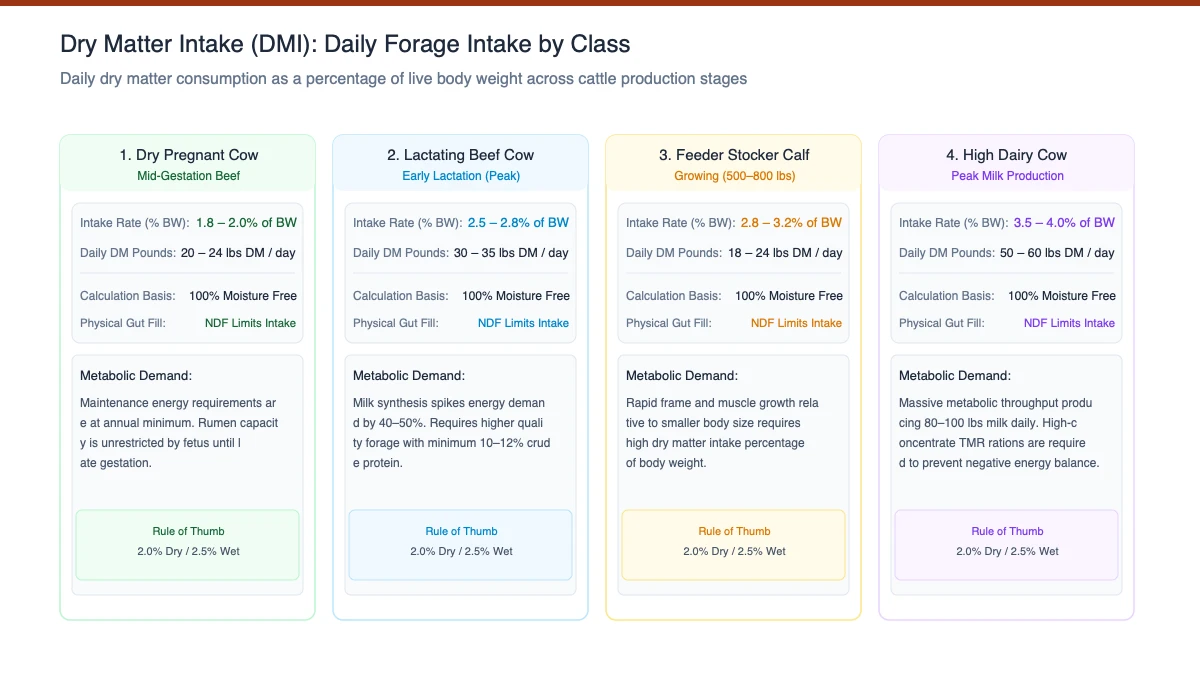
Intake itself is quoted in dry matter, and the extension rule of thumb is stable across sources. Texas A&M AgriLife's rangeland drought guidance (Carpenter and Hart) states that livestock require 2 to 3 percent of body weight per day in dry forage: for a 1,000-pound dry cow, 20 to 25 pounds per day. Oklahoma State's animal-unit definition lands inside that band at 26 pounds per day, 2.6 percent of bodyweight, which is the constant every stocking-rate calculation runs on. Production level moves the dial within the band: Texas A&M's stocking-rate extension reports average annual intake of 2.6, 3.0, and 3.5 percent for beef cows of low, medium and high milk production, and documents a dairy cow reaching 7 percent of bodyweight. The percentage is the handle; the pounds are what you haul to the bunk.
From the scoop to the scale
Work a feeding. Your ration calls for 25 pounds of dry matter per head per day. The hay tests 12% moisture (88% DM), so the scoop needs 25 ÷ 0.88 = 28.4 pounds as-fed. Switch to corn silage at 40% DM and the same 25 pounds of nutrition requires 25 ÷ 0.40 = 62.5 pounds as-fed. Identical dry matter, wildly different shovelling, and the dry-matter calculator prints exactly this pairing so the difference is visible before the feed truck moves. The same divisor rebases nutrients: 10% crude protein as-fed on that 88% DM hay is 10 ÷ 0.88 = 11.4% on a DM basis, the number a nutritionist actually compares across feeds.
Why poor forage fills cows but fails to feed them
This is where dry matter intake earns its name. Rumen fill sets the ceiling: low-quality, high-fibre forage sits in the rumen longer, so an animal eating by appetite takes in less dry matter precisely when the forage is least nutritious, the winter and drought trap that turns a modest feed gap into a body-condition crisis. Texas A&M's drought extension frames the same reality from the land side: the 2–3 percent is what animals require, and when standing forage quality collapses, actual intake slides under it while demand from the animal does not. The management levers follow directly: supplement to lift intake and diet quality, or reduce the number of mouths so demand matches what the place can actually deliver. Stocking equations built on a fixed 2.6 percent demand assume the forage will let the animal eat it.
Putting it to work
Three places the arithmetic changes a decision. In the ration: set the target in dry matter, then let the DM percentage of each feed dictate how many as-fed pounds reach it. Never compare two feeds on tag numbers alone. In the forage budget: cattle-per-acre runs demand as bodyweight × intake% × days, which is why the intake field defaults to 2.6 for a thousand-pound cow and why raising it for heavy milkers changes the acreage answer. In the feed bill: rebasing shows whether a cheaper per-ton feed is actually cheaper per pound of dry matter and per unit of nutrient: water weight is the oldest trick in the ledger. Moisture in, water out; the dry-matter calculator handles the conversions, and this guide is the reasoning behind every number it prints.
Why water weight distorts a feed bill
Feed is bought by the ton and eaten by the pound of dry matter, and the two measures only agree when moisture happens to match. Put the trick in one line: a feed priced at half as much per ton but carrying half the dry matter of another costs exactly the same per pound of actual feed. The discount was a discount on water. It runs in reverse as well, which is why a higher-priced hay at 88 percent dry matter can beat a bargain wet by-product once both are rebased. Dividing every price through its DM fraction puts hay, silage, grain and by-products on one scale, and only then does an invoice describe feed instead of moisture. Labels work the same way: an as-fed nutrient percentage always flatters the wetter feed, which is why nutritionists refuse to compare two numbers until the water has been divided out of both. The same divider answers the purchasing question directly: cost per ton divided by the DM fraction is cost per ton of feed, and that quotient, not the sticker, is what the ration is actually paying for.
Turning an intake percentage into a forage budget
The 2-to-3-percent rule is a daily rate, and a grazing plan needs a total, so the two join through the calendar. Demand is bodyweight times intake percent times days. A 1,000-pound cow at the 2.6 percent animal-unit figure eats 26 lb of dry matter a day: 780 lb across 30 days, 2,340 lb across a 90-day stretch. Those are dry-matter pounds, so the standing forage must deliver them after its own moisture is divided out, exactly as the bunk conversion does. Production level then moves the rate inside the band: low, medium and high milk at 2.6, 3.0 and 3.5 percent lift that 90-day demand to 2,340, 2,700 and 3,150 lb per head. Divide what the paddock can supply by whichever figure matches the herd, and the cattle-per-acre answer becomes arithmetic rather than optimism.
Worked example: Dry Matter Intake Explained for Livestock Producers
The ration calls for 25 lb of dry matter per head per day. Hay testing 12 percent moisture is 88 percent dry matter, so the bunk gets 25 ÷ 0.88 = 28.4 lb as-fed; switch to corn silage at 40 percent dry matter and the same nutrition costs 62.5 lb shoveled. The divisor also rebases nutrients: that hay's 10 percent crude protein as-fed is 10 ÷ 0.88 = 11.4 percent on a dry-matter basis, the figure you compare against other feeds. Convert a ration yourself →
Common mistakes: Dry Matter Intake Explained for Livestock Producers
- Comparing tag numbers across feeds without rebasing: divide each as-fed figure by its DM fraction first, or the wetter feed always looks weaker.
- Scooping the dry-matter target straight into the bunk: divide the target by the DM fraction, because the water still has to be hauled to the yard.
- Counting a bale's stamped weight as intake: a 50-lb bale at 88 percent dry matter delivers 44 lb of feed, and only that counts toward the requirement.
- Letting appetite stand in for requirement: poor forage fills the rumen slowly, so supplement to lift intake and diet quality or reduce the mouths carrying demand.
- Planning a forage budget on a flat percentage: demand is bodyweight times intake percent times days, and heavier milkers push the rate to the top of the band.
Put it to work: Dry Matter Intake Explained for Livestock Producers
The calculators below apply exactly what this guide explains: same formula, no mental arithmetic.
Dry Matter Intake Explained for Livestock Producers: frequently asked questions
Why do nutritionists quote nutrients on a dry-matter basis?
So different feeds can be compared at all. Water dilutes as-fed percentages: removing it always raises the nutrient number, so DM basis is the only common scale for hay, silage, grain and by-products in the same ration.
How much should my cow eat per day?
Extension rules of thumb: 2–3% of bodyweight in dry forage, 20 to 25 pounds a day for a 1,000-pound dry cow, with Oklahoma State's animal unit set at 26 pounds. Lactation, milk production and forage quality move the actual figure.
What is the difference between as-fed and dry matter weight?
As-fed is the feed with its water; dry matter is the weight after water is removed. A 50-pound bale of 88% DM hay contains 44 pounds of feed and 6 pounds of water. The dry matter is what counts toward intake.
Why does intake drop on low-quality hay?
Fibre slows rumen passage, so fill limits how much the animal eats before nutrition is adequate. The gap between required intake (2–3% of bodyweight) and what poor forage allows is what supplements or destocking have to cover.
Sources & further reading
Found a number that does not match its source? Report a mistake. Corrections are published in place and the page date is updated.

Dr. Chyrle Bonk, DVM: Veterinary Editor
Chyrle is a mixed-animal veterinarian in rural Idaho who has practised since 2010, with a particular emphasis on food-animal medicine and cattle alongside her companion-animal caseload. She reviews the…