Free Human & Cell Biology tool
 Free Human & Cell Biology tool
Surface-Area-to-Volume Ratio Calculator
The Surface-Area-to-Volume Ratio Calculator calculates cellular surface area, volume, and the surface-area-to-volume ratio (SA:V) to demonstrate geometric diffusion limits. A cell's surface area supplies nutrients and removes waste; its volume demands them. When volume outpaces surface, the cell starves despite living in plenty, which is why cells stay small and why your body folds its gut lining into villi. Enter a size to compute surface area, volume, and the SA:V ratio for a cube or sphere, with half- and double-size comparisons that make the scaling law obvious.
Surface-Area-to-Volume Ratio Calculator: result
At a glance
- What it does: Computes surface area, volume and the SA:V ratio for a cube, sphere or cylinder at any size.
- Who it is for: Made for students and tissue engineers checking why cells stop growing past a certain size.
- Typical result: Halving the size doubles the ratio, doubling it halves the ratio, for every shape there is.
How to use the surface-area-to-volume ratio calculator
- Choose the shape: sphere approximates most free-living cells, cube models tissue blocks and microcarrier scaffolds, cylinder covers elongated cells and plant cells with vacuoles. prefill →
- Enter the radius (sphere/cylinder) or edge length (cube). Pick units matching the microscope scale you are working in. prefill →
- Read the SA:V ratio; higher means more exchange capacity per unit of metabolic demand.
- Compare the half- and double-size rows: halving size doubles the ratio, doubling size halves it (the arithmetic behind 'why cells stay small').
Surface-Area-to-Volume Ratio: the formula & its source
For a sphere of radius r (the standard cell model):
SA = 4πr² · V = ⁴⁄₃πr³ · SA:V = 3/r
For a cube of edge a: SA = 6a², V = a³, SA:V = 6/a. Because SA scales with the square of a dimension while V scales with the cube, the ratio always simplifies to a constant divided by size: SA:V ∝ 1/size. Halve the size and the ratio doubles; double the size and it halves, for every shape there is.
Metabolic demand scales with volume, so as an organism or cell grows, exchange surfaces cannot keep up without folding, branching, or internal transport systems.
| Symbol | Meaning | Unit | Typical range |
|---|---|---|---|
SA | surface area available for exchange with the surroundings | unit² (µm², mm², m²) | 3 – 3×10⁶ for cell-scale inputs |
V | volume: the metabolic demand the surface has to serve | unit³ (µm³, mm³, m³) | 1 – 10⁶ for cell-scale inputs |
r | radius of a sphere, or edge length when shape is set to cube | µm, mm or m | 0.01 – 100 |
SA:V | exchange capacity per unit of metabolic demand | per unit (1/µm) | 0.03 – 300 |
Surface-Area-to-Volume Ratio: worked example
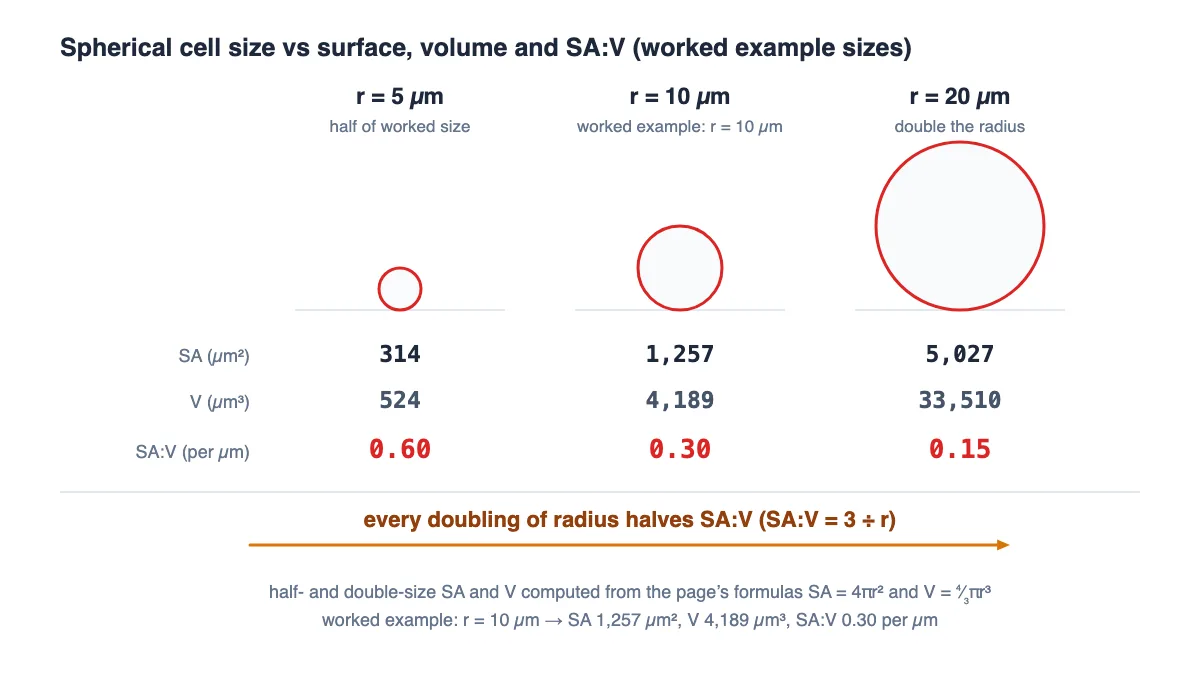
Worked example: spherical cell, r = 10 µm. SA = 4π × 100 = 1,257 µm². V = ⁴⁄₃π × 1,000 = 4,189 µm³. SA:V = 1,257 ÷ 4,189 = 0.30 per µm (equal to 3/r = 0.3). A 20 µm cell has SA:V = 0.15. It has twice the demand per surface unit and must rely on diffusion over greater distances, which is why large cells evolve internal transport or fold their membranes.
Example B: shape switch, elongated cell
Same cell, different shape. Set shape to cylinder with size 2.5 µm (the option keeps r at a quarter of the length, so the cell runs 10 µm long). Surface area comes out at 196.3 µm², volume at 196.3 µm³, and the ratio at 1.00 per µm (three times the sphere of radius 10 µm). Elongation buys exchange surface without adding much interior, which is the same trick a root hair uses.
Why volume grows faster than surface
Area and volume never grow at the same rate. Double a cell's radius and its surface climbs fourfold while its volume climbs eightfold, so the amount of membrane serving each unit of interior falls by half with every doubling. The calculator shows the shortcut this forces: for a sphere the whole ratio collapses to 3 divided by the radius, and for a cube to 6 divided by the edge length. Whatever shape you pick, SA:V ends up as a constant divided by a size.
Run the defaults and the pattern is visible immediately. A spherical cell of radius 10 µm carries 1,257 µm² of surface over 4,189 µm³ of interior, a ratio of 0.30 per µm. The same cell at radius 20 µm drops to 0.15. Nothing about its chemistry changed, yet it now has twice the demand behind every square micrometre of membrane.
Why cells stay small, and why guts are folded
Volume sets the work: metabolism, enzyme traffic and waste output all scale with how much cell there is. Surface does the serving, because every nutrient entering and every waste molecule leaving must cross the membrane. Grow past the point where the membrane can keep up and the cell starves in the middle of plenty, or poisons itself from inside. That one constraint explains most of the shapes biology settles on.
Capillaries run only a few micrometres wide so blood cells pass single file and diffusion distances stay short. The intestine packs its lining into villi and microvilli to add surface without adding bulk, leaves stay flat and thin, and mitochondria fold their inner membranes into cristae. Endotherms in cold climates trend toward compact bodies, because a lower ratio sheds less heat. Tissue engineers size scaffold pores the same way: pores too large leave cells without surface, pores too small starve the core of the construct. Division itself is the reset, splitting one large cell into many small ones so total surface rises while total volume stays put.
The rule also predicts what happens when a tissue outgrows its plumbing. A block of cells far from a capillary sits in the same position as one giant cell: plenty of interior, not enough face. This is why wounds heal from the edges inward, why engineered constructs are limited in thickness before blood vessels arrive, and why tumours that grow fastest often end up with dead, poorly supplied cores.
Using the half- and double-size rows
The comparison rows exist to make the scaling law tactile. Halve the size and the ratio doubles; double the size and it halves, and that holds for the cube, the sphere and the cylinder alike. Before reading anything, choose the shape that matches the object: a sphere suits a free-living cell, a cube models tissue blocks and microcarrier scaffolds, and a cylinder covers elongated cells or plant cells stretched around a large vacuole.
Then set the unit selector to the scale you are actually working in, micrometres at the microscope, millimetres for a tissue chunk, metres for an organ-level estimate. A useful habit is to run the same object at half and double its size before settling on a design. Watch how quickly exchange capacity drains away as something grows, and you will see why a developing embryo keeps dividing rather than simply getting bigger, and why a bioreactor designer stops long before a scaffold looks large enough.
Shape changes only the constant in front, never the behaviour. The cylinder option fixes the radius at a quarter of the length, so elongation shifts the ratio without touching the underlying law. Swap between the three shapes at one size and you will see the ranking, then scale that shape up and watch the advantage fade.
Where the smooth-shape number stops being honest
The clean geometry is a model, not a membrane. Real cells wear microvilli, ruffles and deep invaginations that lift effective surface area to somewhere around 20 to 40 times the smooth figure, which is precisely how a large absorbing cell buys back the ratio it lost by growing. An intestinal lining or a kidney tubule counts on that extra hardware; a bare fibroblast does not have it.
So treat every output here as a scaling comparison or a first estimate. Use it to weigh two sizes against each other, size a scaffold, or check a claim from a textbook. Do not use it to bookkeep absolute membrane area, and do not hunt for one universal target: spherical cells with radii around 5 to 15 µm simply sit in a band near 0.2 to 0.6 per µm, and organisms tune the effective ratio through shape rather than through a set point. When the number and the biology disagree, shape is usually the explanation.
What your surface-area-to-volume ratio result means
SA:V is the geometric constraint under all membrane biology. It explains why capillaries are ~5 µm wide (diffusion distance), why intestinal villi exist (folded surface in a fixed volume), why leaves are thin, and why endotherms in cold climates evolve compact bodies (Bergmann's rule). Minimizing SA:V reduces heat loss.
In tissue engineering the same number sizes scaffold pores: too large and cells lack surface; too small and nutrients cannot penetrate the core.
How to read the output:| Result range | What it means | What to do next |
|---|---|---|
| High ratio, small object | surface keeps up with demand | diffusion alone can service the volume |
| 0.2 – 0.6 per µm | typical spherical cell, r 5–15 µm | compare your value against this band |
| Ratio halves as size doubles | growth is outrunning exchange | divide, fold or add transport |
| Very low ratio, large object | volume demand exceeds supply | expect internal transport systems |
| Output far below lab values | microvilli add 20–40× real area | use this for scaling, not bookkeeping |
Common mistakes with the surface-area-to-volume ratio
- Typing a radius into the cube option: The cube wants an edge length; set shape correctly and the formula switches to 6/a so the scaling stays right.
- Comparing µm and mm runs without changing the selector: The same numeral in millimetres rather than micrometres inflates volume a billionfold; pick the unit before reading.
- Treating the smooth-shape area as literal membrane area: Microvilli and ruffles lift effective area 20–40 times over, so treat the result as a comparison, not a measurement.
- Waiting for one correct target ratio: No universal value exists; watch how the ratio moves as size changes and adjust shape instead of hunting a set point.
Limits of the surface-area-to-volume ratio calculator
A real cell is not a sphere: microvilli, ruffles, and invaginations raise effective surface area 20–40× above the smooth-geometry value. Use this calculator for scaling comparisons and first estimates, not for absolute membrane-area bookkeeping.
Physiology note from Dr. Dinesh A. Nagegowda, PhD: The geometric constraint that surface area scales with the square of linear dimension while volume scales with the cube sets the physical boundary on single-cell size. In our cellular physiology investigations, when a spherical cell enlarges, the diffusion distance from the plasma membrane to the cell center increases linearly while the membrane exchange capacity per unit of metabolic volume halves with every doubling of diameter. Cells cheat this limit through invagination, microvilli, flattening, or active cytoplasmic streaming.
Sources
- Alberts et al., Molecular Biology of the Cell (W. W. Norton) (used for: surface area versus volume as the constraint on cell size, folding and transport)
- Prokaryotic Cells (OpenStax Biology 2e, Section 4.2) (used for: cell size ranges and the diffusion limit that the ratio quantifies)
- Studying Cells: Cell Size (Biology LibreTexts) (used for: the cube-doubling demonstration and the constant-over-size scaling law)
Cite This Calculator
For laboratory course reports, academic papers, or institutional protocols (APA format):
Surface-Area-to-Volume Ratio: frequently asked questions
Why do cells stay small?
Because SA:V falls as size rises. A bigger cell needs more nutrients per unit of surface, so diffusion can no longer supply its volume fast enough. Division resets the ratio.
What is a good SA:V value for a cell?
It has no universal target. What matters is the trend. Spherical cells of r ≈ 5–15 µm sit around 0.2–0.6 per µm; organisms adjust the effective ratio through shape (flattening, folding) rather than size alone.
How does SA:V relate to heat loss?
Heat is lost across surfaces but generated in volume, so smaller animals and compact shapes lose heat faster. Bergmann's rule (larger bodies at higher latitudes) is SA:V at work.
Does the shape I choose matter much?
Less than you would think: the ratio always ends up as a constant divided by a characteristic dimension, so the scaling behaviour (halve size → double ratio) is universal.
Found a number that does not match its source? Report a mistake. Corrections are published in place and the page date is updated.
Something on this page not matching its cited source? Report it.

Dr. Dinesh A. Nagegowda, PhD: Plant & Molecular Biology Editor
Dinesh is a plant molecular biologist and Chief Scientist at CSIR-CIMAP whose research runs through functional genomics, transcriptomics, metabolomics, and biosynthetic pathways in plants. He writes and…