Free Human & Cell Biology tool
 Free Human & Cell Biology tool
Osmosis & Tonicity Calculator
The Osmosis & Tonicity Calculator determines solution osmolarity (mOsm/L) and calculates osmotic water flux and cellular volume changes across semipermeable membranes. Whether a cell swells, shrivels or holds steady comes down to one number: how many osmotically active particles the surrounding solution carries. Enter a solute and its concentration to get ideal and physiological osmolarity, a tonicity verdict against plasma, and the equivalent in g/L and % w/v, the units you actually weigh at the bench.
Osmosis & Tonicity Calculator: result
| Solution | Osmolarity |
|---|---|
| Blood plasma (reference band) | 285–295 mOsm/L |
| 0.9% saline (154 mM NaCl) | 308 ideal → ~286 measured |
| Half saline (77 mM NaCl) | 154 ideal → ~143 measured |
| 5% glucose (~278 mM) | ~278 mOsm/L (no dissociation) |
| Distilled water | 0 mOsm/L: maximally hypotonic |
At a glance
- What it does: Turns millimolar solute concentration into ideal and measured osmolarity with a tonicity verdict.
- Who it is for: Made for bench work where protocols say mM, recipes say g/L and clinicians say mOsm.
- Typical result: Also reports g/L and % w/v so you can check how the solution was actually weighed out.
How to use the osmosis & tonicity calculator
- Pick the solute. Electrolytes like NaCl and KCl dissociate into two ions (i = 2), while sugars stay whole (i = 1). prefill →
- Enter the millimolar concentration from your protocol; 154 mM NaCl is physiological saline. prefill →
- Set the reference osmolarity. 290 mOsm/L approximates blood plasma. prefill →
- Read the verdict row for the direction water moves, and the fate note for what the cell does about it.
- Cross-check against the g/L and % w/v row to confirm how the solution was actually weighed out.
Osmosis & Tonicity: the formula & its source
The van 't Hoff relation gives ideal osmolarity from molarity and particle count:
osmolarity (mOsm/L) = i × concentration (mM)
Electrolytes dissociate imperfectly, so measured values run ~7% below ideal (NaCl behaves near i = 1.86 rather than 2):
measured ≈ ideal × 0.93 (salts) | measured = ideal (non-electrolytes)
Mass conversions from the molecular weight:
g/L = mM × MW ÷ 1000 | % w/v = mM × MW ÷ 10000
And the verdict rule used here:
|osmolarity − ref| ≤ 10% of ref → isotonic ; below → hypotonic ; above → hypertonic
| Symbol | Meaning | Unit | Typical range |
|---|---|---|---|
i | van 't Hoff factor: particles released per molecule | unitless | 1 for sugars, 2 for NaCl and KCl |
C | solute concentration entering the calculation | mM | 0.1 – 1000 |
Osm | osmolarity: osmotically active particles per litre | mOsm/L | 10 – 1000 |
ref | reference osmolarity, usually blood plasma | mOsm/L | 285 – 295 |
Osmosis & Tonicity: worked example
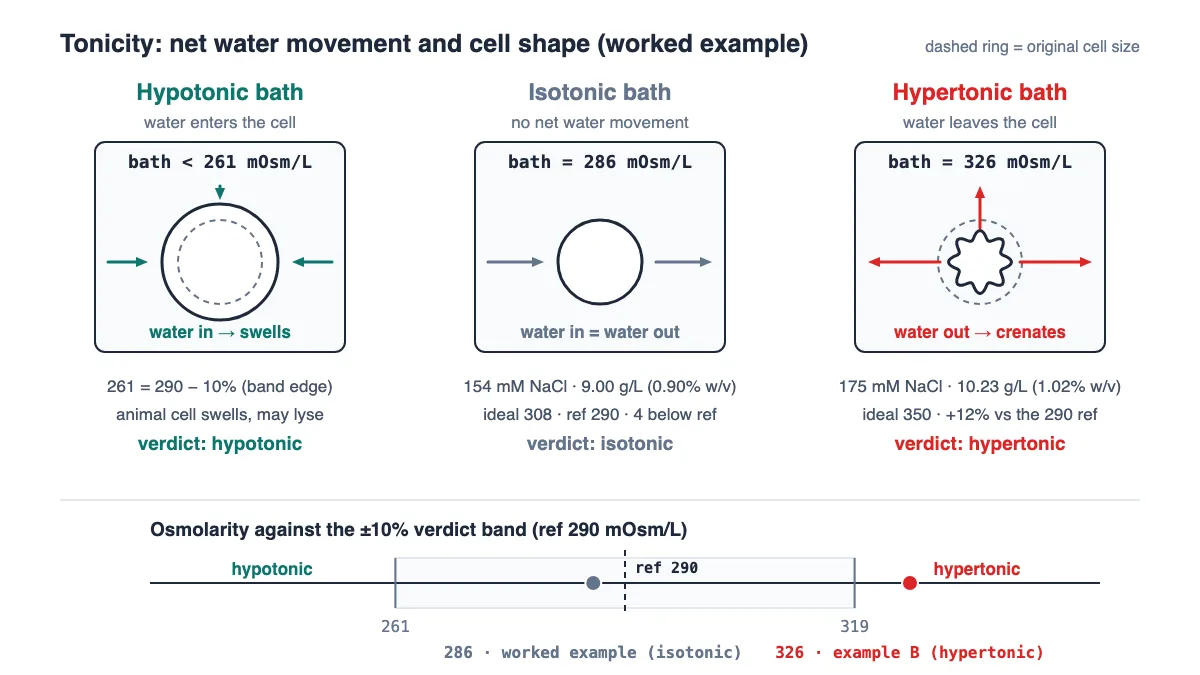
Worked example: 154 mM NaCl (0.9% saline). NaCl dissociates, so i = 2: ideal = 154 × 2 = 308 mOsm/L, corrected by ~7% for incomplete dissociation to 286 mOsm/L. Against a 290 mOsm/L reference that lands inside the ±10% band: isotonic, no net water movement, the reason physiological saline is safe for cells. The mass check: 154 mM × 58.44 = 8.99976 g/L → 9.00 g/L (0.90% w/v), exactly the bottle's label. The measured value sits 4 mOsm/L below your reference.
Example B: hypertonic at 175 mM
Just outside the band. Push the concentration to 175 mM NaCl. Ideal osmolarity is 175 × 2 = 350 mOsm/L, and the salt correction brings it to about 326 mOsm/L. Against a 290 mOsm/L reference that sits 12% high, so the verdict flips to hypertonic and water leaves the cell. The mass row reads 175 × 58.44 ÷ 1000 = 10.23 g/L, or 1.02% w/v, a saline slightly stronger than the 0.90% bottle.
Why a cell swells, shrivels or sits still
Water crosses lipid membranes freely and quietly, always drifting toward the side holding more dissolved particles. Bathe a cell in a hypotonic solution and water loads it until the membrane's tension in an animal cell, or the wall's back-pressure in a plant cell, balances the pull. Bathe it in a hypertonic solution and the flow reverses: the protoplast shrinks away from the wall and an animal cell crenates.
Isotonic does not mean still. Water keeps crossing in both directions at every moment; the two directions simply cancel, so nothing net changes. That is the state cells are held in during routine culture and infusion, not because transport pauses, but because it balances. The verdict row tells you which way the imbalance points and the fate note spells out what the cell does about it.
The fates are worth naming plainly. Red cells dropped into pure water swell and burst, which is exactly why infusions run in saline rather than water. Plant cells in the same bath go turgid instead, pressurised against the wall, and that turgor is what keeps cut herbs crisp in a glass. Push the other way and the contents pull inward.
Three units describing one bottle
The van 't Hoff relation converts molarity into osmolarity by counting particles: multiply the millimolar concentration by i, two for NaCl and KCl because each salt splits into two ions, one for sugars that stay whole. Electrolytes dissociate imperfectly, so measured values land roughly 7% below ideal, with NaCl behaving nearer i = 1.86 than 2. Non-electrolytes skip that correction entirely.
The mass conversions close the loop between the bench and the clinic. Grams per litre come from multiplying by molecular weight and dividing by 1,000; percent weight per volume divides by 10,000 instead. Run the defaults and 154 mM NaCl reads as 308 ideal, 286 measured and 9.00 g/L, which is 0.90% w/v, the label on a saline bottle. Protocols write millimolar, recipes weigh grams, clinicians quote mOsm/L, and all three describe the same liquid. Spotting a unit error before it reaches the cells is the whole point of showing every form at once, and it takes one glance to confirm the three agree.
What the verdict does and does not promise
The isotonic window here runs plus or minus 10% of the reference, a teaching tolerance wide enough to forgive rounding in a hand-prepared solution. Clinical plasma osmolality is watched in a tighter band of 285 to 295 mOsm/L, and laboratories keep cells closer to iso-osmotic still. Read a verdict near the edge of the band as a caution rather than a green light.
More important than the band is which solutes count. Tonicity follows only particles that cannot cross the membrane. Osmolarity tallies everything dissolved, including penetrators like urea, so a urea solution can read perfectly osmotic while water keeps chasing the solute straight through the cell. Infuse or add a penetrating solute without checking permeability and the number will mislead you about where water ultimately settles.
Mixtures deserve the same care. Every dissolved species adds to the particle count the calculator reports, but only the non-penetrating members of that mixture hold water in place afterwards. Run the dominant solutes individually before trusting a combined verdict, especially when a protocol carries a buffer, a salt and a sugar at once.
Where the arithmetic reaches its limit
Everything above assumes dilute, ideal solutions at fixed temperature. Real activity coefficients shift as concentration climbs, and the 7% salt correction is a rule of thumb that holds comfortably near physiological strength but drifts elsewhere. The calculator is built for the range where that rule of thumb serves.
When precision decides an experiment, measure instead of calculating. Vapour-pressure and freezing-point osmometers report what is actually in the cuvette, accounting for solutes the van 't Hoff relation can only estimate. Keep the calculated figure for planning, cross-checks and teaching, and let the instrument have the final word on anything sensitive.
One advantage of the arithmetic being this simple is that you can redo it by hand: multiply the millimolar value by i, halve the result mentally for the ballpark, and apply the salt correction when you need the measured figure. Checking the calculator against a known bottle, 154 mM coming back as 0.90% w/v, tells you both the tool and your inputs are sound before anything depends on them.
What your osmosis & tonicity result means
Water follows solute: always, quietly, across whatever membrane separates the two. A hypotonic bath loads the cell until the membrane's tension (animal cell) or the wall's back-pressure (plant cell) balances the pull; a hypertonic bath reverses it and the protoplast shrinks away from the wall. Isotonic is not 'no osmosis' but balanced osmosis: water keeps moving, in both directions, with no net change.
The calculator's three-unit presentation is deliberate bench practice: protocols write millimolar, recipes weigh grams, and clinicians quote mOsm/L: all the same solution. Knowing 154 mM NaCl is simultaneously 308 ideal / 286 measured mOsm and 0.90% w/v is what lets you rebuild a bottle from scratch or spot a unit error before it kills an experiment.
How to read the output:| Result range | What it means | What to do next |
|---|---|---|
| Inside ±10% of the reference | isotonic | no net water movement either way |
| Below the band | hypotonic | water enters: swell, lyse, or plant turgor |
| Above the band | hypertonic | water leaves: shrink and crenate |
| Measured about 7% under ideal | incomplete dissociation in salts | sugars skip this correction |
| High osmolarity, penetrating solute | tonicity does not follow | check permeability before trusting it |
Analyze how solute and pressure potentials govern water movement in plant cells on our botanical water potential calculator.
Common mistakes with the osmosis & tonicity
- Trusting osmolarity when the solute crosses the membrane: Urea counts toward osmolarity but not tonicity; only non-penetrating particles set where water settles in the end.
- Comparing a calculated value against the clinical 285–295 window: The ±10% verdict is a teaching tolerance, while plasma is watched more tightly than this band.
- Forgetting the van 't Hoff factor on salts: NaCl and KCl split in two, so double the mM first; sugars stay whole and multiply by one.
- Reading a bottle label without a unit cross-check: Confirm the g/L and % w/v row: 154 mM NaCl must come back as 9.00 g/L, exactly 0.90%.
Limits of the osmosis & tonicity calculator
The calculations assume dilute ideal solutions at fixed temperature; real activity coefficients shift with concentration, and the 7% salt correction is an approximation, not a law. More importantly, tonicity depends on non-penetrating solutes only. Infuse urea or mannitol without checking and osmolarity alone will mislead you about where the water ultimately goes.
The ±10% verdict band is a teaching tolerance; clinical plasma osmolality is watched in a tighter 285–295 mOsm/L window, and laboratories run cells closer to iso-osmotic still. For precise work, measure osmolarity directly with a vapor-pressure or freezing- point osmometer rather than calculating it.
Physiology note from Dr. Dinesh A. Nagegowda, PhD: Distinguishing solution osmolarity from physiological tonicity is essential in cell biology and medical therapeutics. While osmolarity measures total dissolved solute particles per liter regardless of membrane permeability, tonicity reflects only non-penetrating solutes that generate a sustained trans-membrane osmotic gradient. For example, a 300 mOsm/L urea solution is iso-osmolar to human cells, but because urea rapidly permeates cell membranes, it behaves as a hypotonic solution, causing rapid erythrocyte hemolysis.
Sources
- Clinical tonicity review (PMC8900995) (used for: plasma osmolality of 285–295 mOsm/L and 0.9% saline measuring about 286)
- Serum Osmolality (StatPearls, NCBI Bookshelf) (used for: the reference osmolality range behind the isotonic band)
- 0.9% Sodium Chloride Injection, Solution: DailyMed label (used for: the 0.9% w/v saline composition the g/L cross-check reproduces)
Cite This Calculator
For laboratory course reports, academic papers, or institutional protocols (APA format):
Osmosis & Tonicity: frequently asked questions
What is the van 't Hoff factor (i)?
The number of particles a solute splits into in solution: 2 for NaCl and KCl (one Na⁺/K⁺ plus one Cl⁻), 1 for sugars. Ideal osmolarity is i × molarity.
What is the difference between osmolarity and tonicity?
Osmolarity counts all dissolved particles; tonicity describes the effective, lasting osmotic gradient, set only by solutes that cannot cross the membrane. Penetrating solutes (urea) count for the first but not the second.
Why is 0.9% saline called isotonic?
154 mM NaCl produces about 286 mOsm/L measured, within a few mOsm of plasma's 285–295, close enough that cells neither swell nor shrink in it.
What happens to a cell in hypotonic solution?
Water floods in: animal cells swell and may lyse (the reason red cells burst in pure water), while plant cells go turgid, pressurized against the wall, which is how herbs stay crisp.
Found a number that does not match its source? Report a mistake. Corrections are published in place and the page date is updated.
Found a number on this page that doesn’t match its source? Email the correction →.

Dr. Dinesh A. Nagegowda, PhD: Plant & Molecular Biology Editor
Dinesh is a plant molecular biologist and Chief Scientist at CSIR-CIMAP whose research runs through functional genomics, transcriptomics, metabolomics, and biosynthetic pathways in plants. He writes and…