Free Animal Pregnancy tool
 Free Animal Pregnancy tool
Cow Gestation Calculator
The Cow Gestation Calculator determines the expected bovine calving date, dry-off deadline, and herd health milestones based on a 283-day gestation average. Cows carry a calf about 283 days (nine months minus a week) with most calving between days 279 and 287 and clear breed differences from dairy (279) to zebu (296). Enter the breeding date for her due date, gestational day, and the herd schedule that follows: ultrasound day 28–30, palpation day 35–40, fetal sexing days 55–60, and dry-off about 60 days before calving.
Cow Gestation Calculator: result
At a glance
- What it does: Adds a breed gestation average to a service date and prints the calving date, day of pregnancy, and herd milestones.
- Who it is for: Made for herd managers timing checks, fetal sexing, dry-off, and the move into the close-up group.
- Typical result: Returns the due date, percent of term, and the diagnostic window that is open on any given day.
How to use the cow gestation calculator
- Enter the service date: the date she was bred or artificially inseminated. Heat-detection errors are the main source of dating mistakes. prefill →
- Pick the breed type so the average gestation matches her genetics; Holstein-type dairy cows run short (279 days), beef breeds longer (287), zebu longer again (296). prefill →
- Leave the check date as today, or set any date to see gestational day, percent of term, and what confirmatory work is due then.
- Use the milestone list to schedule the herd work: ultrasound day 28–30, palpation day 35–40, fetal sexing days 55–60, dry-off around day 223.
- Watch the red flags in the result panel as she enters the calving window and keep colostrum and a calving kit ready.
Cow Gestation: the formula & its source
Bovine gestation is counted from service and averages 283 days, roughly nine months. Normal calving falls between days 279 and 287 for most breeds, and breed means shift that average: Holstein about 279, Charolais-type beef about 287, and Bos indicus (zebu) about 296. Bull calves average a few days longer than heifers, and some heifers calve about 10 days earlier than the breed mean.
Stages: days 0–44 cover implantation (starting day 19–20, complete by ~42) and the high-loss period; days 45–149 are the diagnosis, sexing, and fetal-aging window; days 150–283 are fetal growth, with dry-off about 60 days before the due date.
due date = breeding date + gestation average (283 days)
gestational day = (check date − breeding date) in days
| Symbol | Meaning | Unit | Typical range |
|---|---|---|---|
breed_date | Date the cow was bred or artificially inseminated | date | any date within the last 300 days |
ref_date | Date her status is read for, left blank for today | date | the service date through day 287 |
breed | Breed type that sets the gestation average | select | 279 dairy to 296 zebu days |
D | Gestational day counted from the service date | days | 0 to 283 |
due | Expected calving date, computed as D plus the breed average | date | 279 to 296 days after service |
Cow Gestation: worked example
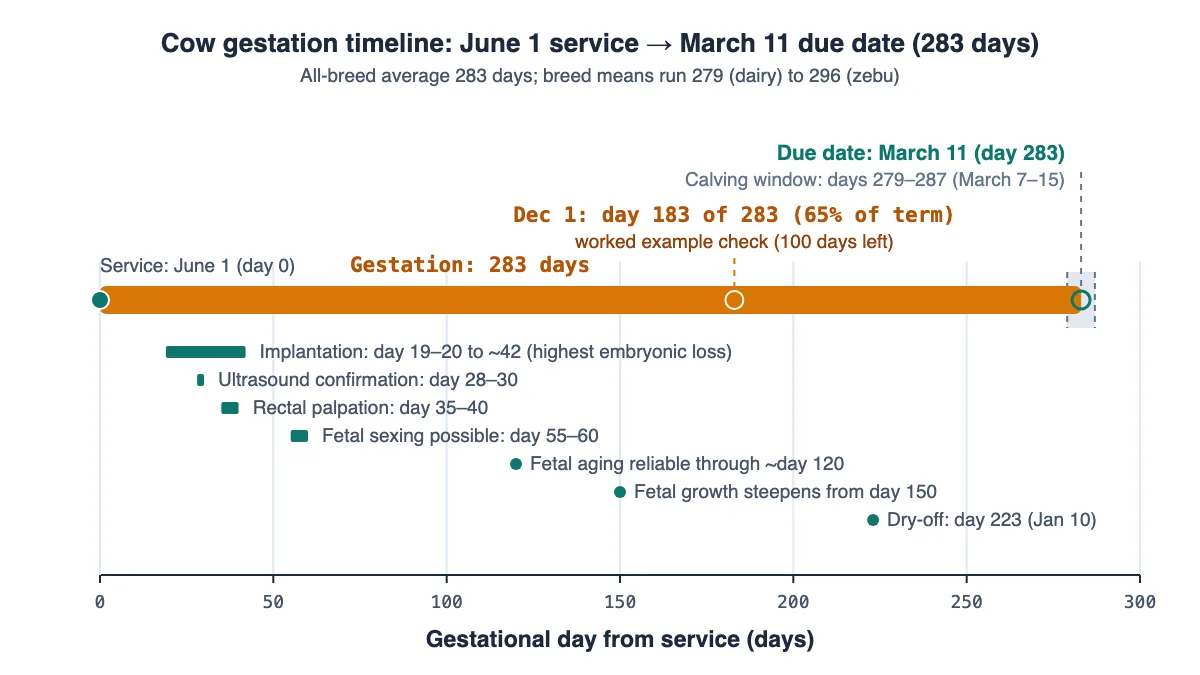
Worked example: bred June 1, all-breed average. Due date: June 1 + 283 = March 11. Calving window: March 7 – March 15. Checking on December 1 puts her at day 183 of 283 (65% of term) with 100 days left: deep into the quiet mid-gestation stretch, with dry-off planned for January 10 (day 223).
Example B: zebu cross served 1 March
Example B: a zebu cross served on 1 March. Switching the breed type from the all-breed average to Bos indicus moves the gestation from 283 to 296 days, so the calving date lands on 21 December instead of 8 December. The gestational day on any check date is unchanged, because that is pure calendar arithmetic, but every milestone built on percent of term shifts with it. Dry-off calculated at day 223 of her actual gestation now falls in August rather than July, which is exactly the kind of drift a single averaged table hides.
Average and range in days
Bovine gestation is counted from service and averages 283 days, roughly nine months, with most calving between days 279 and 287. Breed means sit inside that band rather than on it: Holstein-type dairy cows run short at about 279, Charolais-type beef breeds run about 287, and Bos indicus cattle average around 296. Selecting the matching breed type is the difference between a due date and a plausible due date.
Sex adds a smaller, consistent drift, since bull calves average a few days longer than heifers and some heifers calve about ten days ahead of the breed mean. Four days of ordinary variation sits within the normal window for every breed, so the number should be read as the centre of a scheduling band. Herd work hangs off that band: when to scan, when to sex a fetus, when to dry her off, and when to move her into the close-up group.
Early signs and timeline
The first six weeks are quiet. Implantation begins around day 19 to 20 and completes near day 42, and early embryonic loss during this stretch simply returns the cow to heat, which is why a cow that fails to come back into cycle is the earliest real signal that the service took. Nothing visible happens externally during this period.
Diagnosis, then, is scheduled rather than observed. Ultrasound from day 28 to 30 is the first confirmation, rectal palpation works from day 35 to 40, and a herd check 45 to 60 days after breeding ends catches open cows while there is still time to rebreed or manage them separately. Fetal sexing is possible from about day 55 to 60, and aging a fetus is reliable through roughly day 120. From day 150 the growth curve steepens, dry-off sits near day 223 on the all-breed average, and the last two months are about nutrition and a calving plan rather than about diagnosis.
A second diagnostic pass is worth scheduling for the herd rather than the individual. Checking 45 to 60 days after the breeding season closes finds the cows that slipped past the first pass while there is still time to rebreed, sell or house them separately. Herds running that pass on a calendar date, then comparing the results against these computed windows, keep their calving distribution tight instead of discovering open cows at day 300.
Close-up dry cows during the final 3 weeks of gestation require balanced rations to prevent ketosis; verify nutritional density with our forage dry matter calculator.
When to see a vet
Two situations belong to a veterinarian rather than to a herdsman with a calendar. The first is a cow past her due window who shows no sign of calving, especially with a swollen udder and no nesting behaviour, because a wrongly dated or obstructed pregnancy cannot be resolved by waiting. The second is active dystocia: contractions without progress, a malpresented calf, or a cow that has been straining long enough to exhaust herself.
Beyond those, a cow that appears bred but has not calved by the far edge of her window is more often open or misdated than genuinely late, and settling that question takes palpation or ultrasound, not another look at the breeding record. Embryonic loss before about day 42 shows up as a return to heat rather than as a late calving, so record those returns properly, since they explain most of the cows whose dates look wrong later in the year.
How accurate is the estimate
Precision starts with the service date, and heat-detection error is the main reason estimates drift. A cow served a cycle off, a doubled service recorded on one day, or a misfiled breeding date will move the real due date well outside the computed window, and no amount of arithmetic repairs a wrong input. Four days of variation is normal once the date itself is right.
Confirmation and aging come from imaging. Ultrasound at day 28 to 30 confirms pregnancy, palpation from day 35 to 40 adds experience-based dating, and fetal aging before about day 120 refines the estimate further. Herds that rely on a check 45 to 60 days after breeding ends rather than on service dates alone keep the calving distribution tight, because open cows are found early instead of discovered at day 300. When the schedule depends on an exact date, let the scan set it and use this calculator for the work that sits between checks.
Allocating adequate maternal pasture acreage for pregnant beef herds is detailed in our pasture carrying capacity and AUM guide.
What your cow gestation result means
The due date is a scheduling tool, not a diagnostic. What the gestational day actually drives is management: diagnosis timing, fetal-sexing opportunity, dry-off placement, and when to move her into the close-up group.
Because ±4 days sits inside the normal window for every breed, herds that check 45–60 days after breeding ends (rather than guessing from service dates) catch open cows early and keep the calving distribution tight.
How to read the output:| Result range | What it means | What to do next |
|---|---|---|
| Days 0–44 | implantation and the period of highest embryonic loss | Watch for a return to heat as the sign of a failed service |
| Days 28–40 | ultrasound and palpation confirmation windows | Book the herd check once day 28 has passed |
| Days 55–60 | fetal sexing becomes possible | Schedule sexing if it affects breeding or feeding decisions |
| Day 223 | typical dry-off point on the all-breed average | Set the dry date from her computed calving date |
| Days 279–287 | normal calving window around the computed date | Move her to the close-up group ahead of the window |
Common mistakes with the cow gestation
- Using one gestation average for every breed: Pick the breed type that matches her genetics, since dairy, beef and zebu averages differ by up to 17 days.
- Trusting a service date recorded from a poor heat: Confirm with ultrasound at day 28–30 or palpation at day 35–40 before the date drives any scheduling.
- Reading the due date as a single expected day: Plan around the 279–287 day window, because a four-day spread inside the normal range shifts the calving watch.
- Assuming a late cow is simply overdue: Check her status first, since embryonic loss and open cows explain most dates that look too far advanced.
Limits of the cow gestation calculator
Service date, ovulation, and conception are not the same day. Heat-detection error of a cycle, a doubled service, or mis-recorded breeding dates will move the real due date well outside the computed window.
Embryonic loss before about day 42 simply returns her to heat, so an apparently 'late' cow is more often an open or misdated one. Twins are more common in high-producing dairy lines and are best detected early by ultrasound. When precision matters, confirm with palpation or ultrasound instead of relying on dates alone.
Clinical note from Dr. Chyrle Bonk, DVM: Bovine gestation averages 283 days, but breed variation is substantial: continental beef breeds (Charolais, Simmental) frequently carry calves 286–290 days, whereas Jersey and dairy breeds often calve closer to 279 days. In our food-animal practice, transrectal ultrasonography at day 30 to 45 provides early pregnancy confirmation and fetal sexing, allowing ranchers to schedule calving pasture moves and nutritional flushing for late gestation.
Sources
- Merck Veterinary Manual, Approximate gestation periods table (used for: breed gestation averages from 279 to 296 days)
- Merck Veterinary Manual, Pregnancy determination in cattle (used for: ultrasound day 28–30, palpation day 35–40, and fetal aging windows)
- SDSU Extension, Pregnancy diagnosis in your cow calf herd (used for: herd check timing and blood and ultrasound confirmation after service)
- Merck Veterinary Manual, Management of calving in cattle (used for: calving observation, dry-off placement, and dystocia response)
Cite This Calculator
For laboratory course reports, academic papers, or institutional protocols (APA format):
Cow Gestation: frequently asked questions
How long are cows pregnant?
About 283 days on average, with a normal calving window of 279–287 days. Dairy cows run short (Holstein ~279), beef a little longer (~287), and zebu cattle about 296 days.
When can pregnancy be diagnosed?
Ultrasound from day 28–30 and rectal palpation from day 35–40. Herds commonly run a herd check 45–60 days after breeding ends to catch open cows.
Do bull calves or heifers change the length of pregnancy?
Yes, modestly: bull calves average a few days longer, and some heifers calve roughly 10 days earlier than the breed average.
When should she be dried off?
About 60 days before the due date (around day 223 on a 283-day average), so she has a full dry period and peaks well after calving.
Found a number that does not match its source? Report a mistake. Corrections are published in place and the page date is updated.
A value here that won’t reconcile with its reference? Report a mistake.

Dr. Chyrle Bonk, DVM: Veterinary Editor
Chyrle is a mixed-animal veterinarian in rural Idaho who has practised since 2010, with a particular emphasis on food-animal medicine and cattle alongside her companion-animal caseload. She reviews the…