Free Animal Pregnancy tool
 Free Animal Pregnancy tool
Goat Gestation Calculator
The Goat Gestation Calculator determines the doe kidding date, ultrasound scanning window, and pre-kidding vaccination schedule from the breeding date. A doe's pregnancy runs about 150 days (roughly five months) with normal kidding between days 145 and 155. Enter the breeding date for her due date, gestational day, and the checks that depend on timing: ultrasound vesicle at day 18–26, fetal sexing days 55–70, the last reliable fetus count at day 85, and a CDT booster four weeks before kidding.
Goat Gestation Calculator: result
At a glance
- What it does: Adds 150 days to a breeding date and prints the kidding date, gestational day, and the 145–155 day window.
- Who it is for: Made for smallholder and farm use timing ultrasounds, fetal counts, and the pre-kidding vaccination.
- Typical result: Returns the expected date, her stage today, and the diagnostic deadlines that fall at that stage.
How to use the goat gestation calculator
- Enter the date the doe was served (by a buck or recorded at AI). A doe that is not bred returns to heat roughly every 17–21 days, so the last observed heat bounds the date. prefill →
- Leave the check date as today to see her gestational day and percent of term, or set a date to plan a specific check. prefill →
- Time the ultrasound: earliest vesicle day 18–26, most reliable abdominal scan after day 45, and a fetus count only up to day 85.
- Book the CDT booster about four weeks before the due date so the kid's passive immunity is covered at birth.
- Use the kidding window and red-flag list as your barn plan for the last week of gestation.
Goat Gestation: the formula & its source
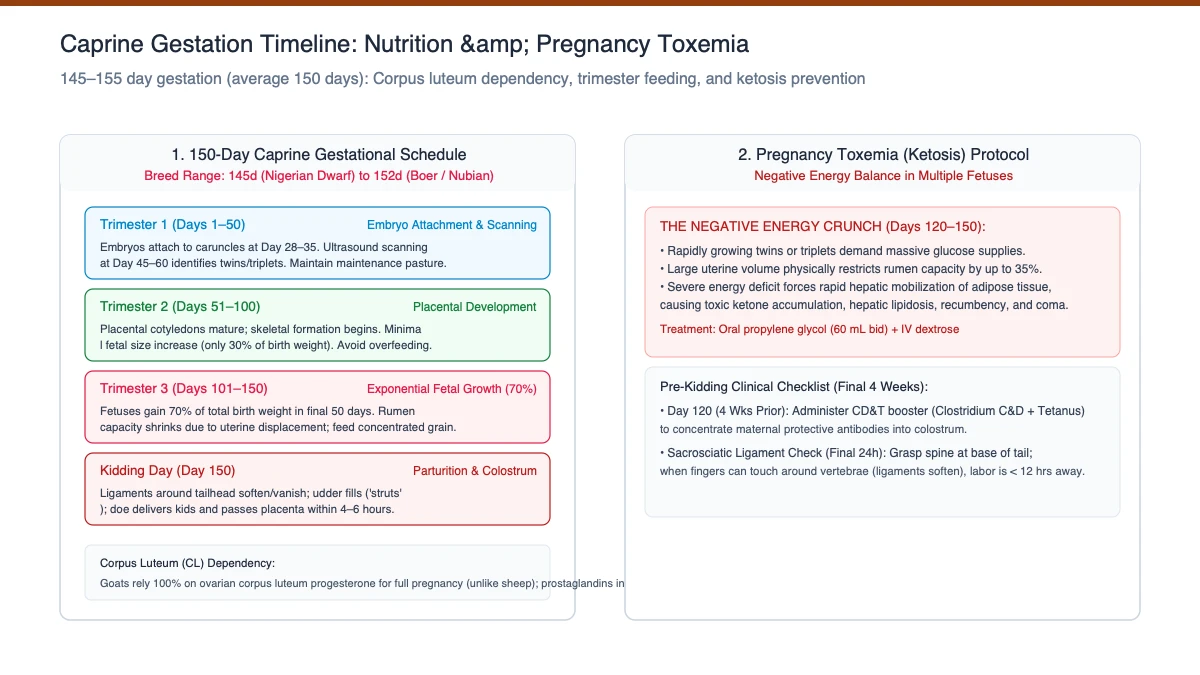
Caprine gestation averages 150 days, with a normal kidding window of days 145–155. Early pregnancy depends entirely on corpus luteum progesterone (the goat placenta does not take over hormone production the way some species do), and progesterone falls in the 12–24 hours before labor.
Stages: days 0–29 (embryonic period and the first ultrasound window), days 30–89 (confirmation, sexing to day 70, counting to day 85), and days 90–150 (rapid fetal growth, udder development, pre-kidding vaccination).
due date = breeding date + 150 days
gestational day = (check date − breeding date) in days
| Symbol | Meaning | Unit | Typical range |
|---|---|---|---|
breed_date | Date the doe was served by a buck or at AI | date | any date within the last 160 days |
ref_date | Date her status is read for, left blank for today | date | the service date through day 155 |
D | Gestational day counted from the service date | days | 0 to 150 |
due | Expected kidding date, computed as D plus 150 | date | 145 to 155 days after service |
Goat Gestation: worked example
Worked example: bred July 15. Kidding date: July 15 + 150 = December 12. Kidding window: December 7 – December 17. Checking on October 1 puts her at day 78 of ~150 (52% of term) with 72 days left: well past the day-45 confirmation point, with the fetus-count deadline still a week away (day 85 falls October 8) and the CDT booster due about November 14.
Example B: count scan past day 85
Example B: checking a fetus count after its deadline. A doe served on 10 May reaches day 85 on 3 August, the last point at which a scan can be trusted to count kids. Scan her on 10 August instead and the number on the screen may be right, but nothing marks it as reliable, so decisions made about feed or pen space are being taken on a count that could be quietly wrong. Book counting scans early in the pregnancy rather than late, and treat every later number as an opinion.
Average and range in days
Caprine pregnancy averages 150 days, about five months, with normal kidding between days 145 and 155. The date is counted from the last service, and a doe that is not pregnant returns to heat roughly every 17 to 21 days, so the last observed heat places a useful bound on when that service could have happened. A buck running with the herd gives you exposure dates rather than service dates, which is the usual source of drift in backyard records.
Five days of variation either side is normal. Unlike cattle, the goat placenta does not take over hormone production, so the entire pregnancy depends on progesterone from the corpus luteum, and that progesterone falls in the 12 to 24 hours before labor. The practical consequence is that timing matters twice: once for planning the kidding watch, and again for knowing that a pregnancy which looks advanced can still be a fluid-filled uterus rather than a doe carrying kids.
Early signs and timeline
Days 0 to 29 cover the embryonic period, and the first diagnostic opportunity sits at the end of it. A vesicle can be seen transrectally from about day 18 to 21 and transabdominally from day 22 to 26, while a blood test for pregnancy-associated glycoproteins works from roughly day 25. After that the window widens: abdominal scanning is most reliable past day 45, fetal sexing runs from day 55 to 70, and a dependable kid count is only possible through day 85.
The back half of pregnancy is about growth rather than diagnosis. The last 50 days carry most of the fetal weight gain, which is when nutrition, body condition and the pre-kidding CDT booster actually pay for themselves. Udder development and a widening abdomen arrive in the final fortnight, and a doe that has been confirmed pregnant by scan at day 45 or beyond can be managed with a firm date instead of a guess.
When to see a vet
Dystocia is the clearest reason to call. Doelings carrying their first kid and older does both carry higher risk, and a doe straining without progress, or carrying a kid in an awkward position, needs help rather than more time. Rich feed in late gestation raises the odds of kidding problems instead of preventing them, so a doe that goes off her feed or appears distressed in the final week should be examined.
The other call is for a pregnancy that never arrives. A doe that looks bred at day 155 may be carrying fluid instead of kids, because hydrometra mimics a late pregnancy closely and can be difficult to distinguish by feel alone. Ultrasound is the only reliable way to settle it, and dystocia caused by it is a veterinary emergency. Dates on a calendar cannot make that distinction at any stage of the final month.
How accurate is the estimate
Expect about five days of normal variation around the computed date, and treat a breeding date recorded from buck exposure as a proxy for service rather than proof of it. The single most useful thing you can do for accuracy is record the date of observed breeding or a witnessed service, because the calculator's output is only ever as sound as that entry.
Imaging is what tightens the estimate. Vesicle sighting from day 18 to 26 confirms early pregnancy, abdominal scanning becomes trustworthy after day 45, and the count deadline at day 85 is a hard limit rather than a soft one. Sexing between days 55 and 70 gives a further cross-check on dating when a fetus of a known stage is measured. Where a decision depends on precision, confirm by scan and use the 145 to 155 day band to plan the week of kidding itself.
Records improve the input. Write the date of observed breeding alongside the buck's exposure dates, and mark any doe served by AI rather than by natural service, because the two carry different certainty. A herd book that distinguishes an observed service from a guess gives the calculator something solid to work from, and the five days of normal variation left afterwards are then the only uncertainty worth worrying about. Where the breeding date is genuinely unknown, confirm by scan and work backward from what the scan shows instead of forward from a guess.
What your goat gestation result means
The number that changes decisions is which diagnostic window you are in: before day 45 your scan is less trustworthy, and after day 85 you can no longer count kids. Those dates shape more management than the due date itself.
In the last 50 days fetal growth accelerates sharply, which is when nutrition, body condition, and the pre-kidding vaccination actually pay off. Earlier feeding mostly supports the doe, not the fetuses.
How to read the output:| Result range | What it means | What to do next |
|---|---|---|
| Days 18–26 | earliest window for a pregnancy vesicle | Book a transrectal or early abdominal scan now |
| Days 45–70 | reliable abdominal scanning and fetal sexing | Confirm pregnancy and sex kids if that matters |
| Day 85 | last point where a kid count is dependable | Get the count scanned before this date passes |
| Days 90–150 | rapid fetal growth and pre-kidding vaccination | Adjust ration and give the CDT booster about four weeks out |
| Days 145–155 | normal kidding window around the computed date | Prepare shelter and a kidding watch for the whole band |
Common mistakes with the goat gestation
- Recording buck exposure as a confirmed service: Treat the exposure date as an estimate and confirm by scan, since a doe may not have been served on the day the buck was present.
- Counting kids after day 85: Book the count before day 85, because later scans may show a plausible number that no longer counts as reliable.
- Assuming a visibly late doe definitely carries kids: Scan her, as hydrometra fills the uterus with fluid and mimics an advanced pregnancy until imaging separates the two.
- Rushing nutrition in mid-gestation: Concentrate feed where it matters, in the final 50 days, when most fetal growth happens and the booster is due.
Limits of the goat gestation calculator
±5 days is normal variation, and a breeding date recorded from buck exposure is a proxy for the fertile service, not a guarantee of it. Doelings and old does both carry higher dystocia risk.
Pseudopregnancy (hydrometra) can mimic a late pregnancy: a fluid-filled uterus that looks and feels bred but contains no fetus. Ultrasound settles it, and dystocia from it requires a vet. Nutrition that is too rich in late gestation raises kidding problems rather than preventing them.
Clinical note from Dr. Chyrle Bonk, DVM: Caprine gestation spans an average of 150 days (range 145–155 days), with miniature breeds (Nigerian Dwarfs) often kidding slightly earlier. Because does are corpus luteum-dependent throughout their entire pregnancy, stress or illness that disrupts progesterone causes immediate abortion. In our herd health work, ultrasound at day 45 to 60 is vital for detecting multiple fetuses (twins, triplets) so energy intake can be increased to prevent pregnancy toxemia (ketosis).
Sources
- Merck Veterinary Manual, Pregnancy in goats (used for: 150-day average, 145–155 day window, and corpus luteum hormone dependence)
- Merck Veterinary Manual, Pregnancy determination in goats (used for: vesicle timing, PSPB testing from day 25, sexing days 55–70, and counts through day 85)
- Mississippi State University Extension, Goat reproduction guidance (used for: late-gestation fetal growth and pre-kidding CDT timing)
Cite This Calculator
For laboratory course reports, academic papers, or institutional protocols (APA format):
Goat Gestation: frequently asked questions
How long is a goat pregnant?
About 150 days on average, with normal kidding between days 145 and 155 from the last service.
How early can pregnancy be confirmed?
A vesicle can be seen transrectally from day 18–21 or transabdominally from day 22–26; abdominal scanning is most reliable after day 45, and a blood test (PSPB) works from about day 25.
Can a doe have a false pregnancy?
Yes. Hydrometra mimics a late pregnancy closely. Ultrasound is the only way to distinguish fluid from a fetus, which is why dates alone should never be trusted in the final weeks.
How many kids should I expect?
Meat breeds often carry twins or triplets, dairy breeds more often singletons. Counts are only reliable up to day 85, so confirm the number early if you are managing nutrition around litter size.
Found a number that does not match its source? Report a mistake. Corrections are published in place and the page date is updated.
See a value here that won’t reconcile with its cited source? Report a mistake.

Dr. Chyrle Bonk, DVM: Veterinary Editor
Chyrle is a mixed-animal veterinarian in rural Idaho who has practised since 2010, with a particular emphasis on food-animal medicine and cattle alongside her companion-animal caseload. She reviews the…