Free Trees & Forestry tool
 Free Trees & Forestry tool
Tree Age Calculator
The Tree Age Calculator estimates a living tree's age from trunk circumference at breast height and published species growth factors. Ring counts settle arguments about plantation dates, veteran-tree status, and which fence line came first (without felling anything). Feed in a diameter tape reading and either an increment-core ring width, a rings-per-inch slab count, or a growth factor, and this tool converts to years, correcting for the sapling decade a tree spends before it starts adding wood at breast height.
Tree Age Calculator: result
At a glance
- What it does: Estimates a tree's age from DBH using an increment-core ring width, rings per inch, or a growth factor.
- Who it is for: Made for landowners, students and planners checking planting dates, veteran status or rotation length.
- Typical result: Returns years with a range, plus the sapling decade spent before wood began stacking at breast height.
How to use the tree age calculator
- Measure DBH with a diameter tape at 4.5 ft on the uphill side, the same number every other tool on this site uses. prefill →
- Choose the method that matches your evidence: an increment core for ring width (best), a sanded slab for rings per inch, or a published growth factor when you have nothing else. prefill →
- For the ring-width route, average the last 10–20 rings rather than trusting one wide ring. Recent growth reflects the conditions the tree actually grew under.
- Set the years-to-breast-height correction: the sapling period before diameter starts accumulating at 4.5 ft, typically 6–10 years (8 is a sensible default under a moderately stocked canopy).
- Read the range alongside the point estimate: a ±25 % ring-width band is the honest output of any ring-based method, and the method row shows which route produced the number.
Tree Age: the formula & its source
The ring-width method counts growth recorded at breast height, where each light/dark band pair is one year, and converts diameter to rings through the annual increment:
age = DBH ÷ (2 × annual ring width) + years to breast height
The factor of 2 converts radial increment (one flank of the stem) to diameter (both flanks). The growth-factor method skips the core entirely:
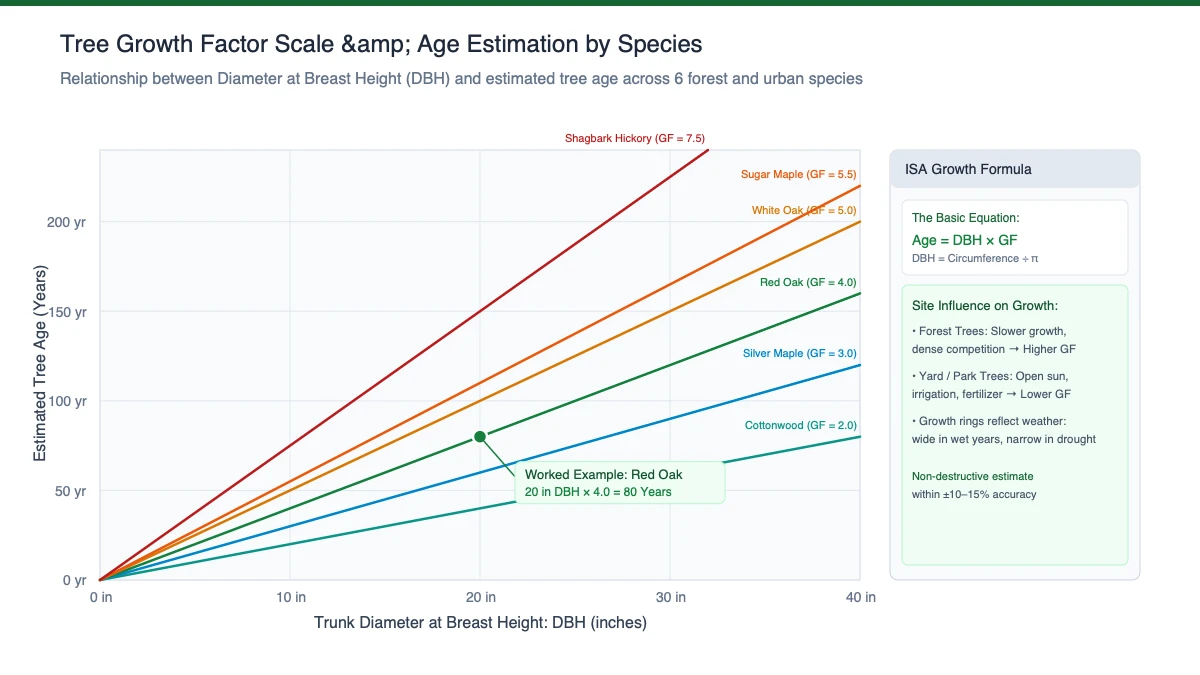
age = DBH × growth factor
age = DBH × rings per inch + years to breast height
Propagating a ±25 % ring-width error through the reciprocal gives the reported range: rings × 0.8 up to rings × 1.33, plus the breast-height years.
| Symbol | Meaning | Unit | Typical range |
|---|---|---|---|
DBH | stem diameter measured 4.5 ft above ground | in | 3–40 in |
w | average annual ring width from a core or slab | in/yr | 0.005–0.5 |
f | growth factor, years of age per inch of diameter | yr/in | 2–20 |
rpi | rings counted per inch of radius | rings/in | 1–30 |
t | years spent reaching breast height | years | 0–30, usually 6–10 |
age | estimated years since germination | years | 5–500 |
Tree Age: worked example
Worked example: 18-inch DBH, 0.12 in of ring width per year. Rings at breast height = 18 ÷ (2 × 0.12) = 18 ÷ 0.24 = 75 rings. Add 8 years to reach breast height: 83 years. The ±25 % band runs 75 × 0.8 + 8 = 68 to 75 × 1.33 + 8 = 68–108 years: wide, because age sits on the reciprocal of ring width: half-rate growth doubles the count. Diameter growth is 2 × 0.12 = 0.24 in/yr = 6.10 mm/yr. Switching to rings per inch at 3 rings/in: 18 × 3 + 8 = 62 years, implying a faster 0.33 in/yr ring. The methods disagree precisely because the slab count and the recent core decade are telling different stories.
Example B: growth factor route
Example B: growth-factor route. Switch the method to growth factor, keep the 18-inch diameter, and enter 6 years per inch: the answer is 18 × 6 = 108 years, and the establishment field is deliberately ignored because published factors already carry the sapling stage of the open-grown trees they were calibrated on. Treat that figure as an order of magnitude. The same 18-inch stem under a closed canopy can hide two or three times the table's age, so name the method alongside the number whenever it leaves your notebook.
Field method
Take a diameter-tape reading at 4.5 feet first, then match the method to the evidence in your pack. An increment core pulled at breast height gives the strongest route: count the bands under magnification and average the last ten to twenty years rather than trusting one fat ring. A sanded slab supplies rings per inch instead, and a published growth factor covers the day you carry nothing but a tape. Whichever route runs, add the establishment years on the ring methods (the sapling period during which no wood accumulated at breast height), because the core only records growth that happened above that mark.Carry a pencil: writing the count down with its method and correction already applied stops the whole exercise being reconstructed from memory in the truck at the end of the day.
Choosing between the three routes
The methods fail in opposite directions, and knowing which way each leans matters more than the point estimate. Ring width from a fresh core tracks what the tree actually experienced and usually lands within a few percent of a count made on a felled stem. Rings per inch from a slab average the entire radius, which smooths old suppressions and hands back a rounder, blunter figure. Growth factors skip field equipment altogether and were fitted to open, fully lit trees; beneath a closed canopy the same diameter can conceal two or three times the tabulated age. Name the route you used whenever the estimate is quoted.Where the date carries real weight (a veteran-tree application, the first thinning year of a plantation, a boundary dispute), pay for the core and the microscope time, since the better route costs an afternoon rather than a wrong record.
Instrument error
Age divides by ring width, so ring error inflates rather than cancels: a core read 25 % narrow returns an answer about a third too old. False rings from a mid-season drought split one year into two, missing rings erase years of heavy suppression, and a core that drifted past the pith overstates the radius it travelled. The diameter tape includes bark while rings are read to the cambium boundary, a mismatch of a few tenths on heavy-barked species. Slope-side placement errors add a further small shift, and every one of them passes straight through the reciprocal into the final count.
Common blunders
The most expensive mistake available here is applying a growth-factor table to a shade-tolerant tree under a closed canopy, and it fails without warning. Omitting the establishment years makes every ring-based answer young by the sapling decade. Reading one wide ring as the annual rate lets a wet year impersonate vigour and shrinks the count accordingly. Entering a centimetre diameter into an inches field doubles or halves the answer before any correction gets a chance to run, which is why the field hint asks for the conversion up front.
Worked field example
An 18-inch stem averaging 0.12 inch of ring width per year holds 18 ÷ (2 × 0.12) = 75 rings at breast height, the factor of two converting radial growth into diameter growth. Add eight establishment years and the tree reads 83 years, with the ±25 % band running from 75 × 0.8 + 8 = 68 up to 75 × 1.33 + 8 = 108. Diameter increment works out at 0.24 in/yr, or 6.10 mm/yr. The same stem at 3 rings per inch returns 18 × 3 + 8 = 62 years: the routes disagree because a slab average and a recent core decade are different records.
Unit systems
The fields take inches, so a metric diameter is divided by 2.54 before entry. Ring width stays in inches per year while the increment it implies is often quoted in millimetres for growth-plot records: multiply by 25.4 to join those tables. Establishment years and the final age carry no unit at all. Settle on one system at the start of a measuring session and convert on paper: a metric DBH paired with an imperial ring width will still calculate, and it will be wrong by more than any later correction can repair.
What your tree age result means
Age reframes every other measurement. An 18-inch tree at 83 years is growing at a miserly pace befitting a suppressed or old-field stand; the same diameter at 40 years is a vigorous, thinnable crop tree. Foresters pair age with height to build site index curves, planners use it to judge when a planting will close canopy, and conservation bodies use it to confirm veteran status: 80 years is a common threshold for ancient/legacy-tree designation in many jurisdictions.
The ring record itself is a logbook: fire scars, drought bands, and insect years are stamped into the sequence, which is why increment cores serve forest-history research as well as dating.
How to read the output:| Result range | What it means | What to do next |
|---|---|---|
| 68–108 years | the band for the default core | Quote the range rather than the midpoint |
| Younger than the deed | establishment years left out | Add the sapling decade and any nursery age |
| Factor route, low figure | table fitted to open-grown trees | Treat as an order of magnitude only |
| Range wider than ±25 % | short core or uneven rings | Retake the average over more years |
| 80 years and above | common veteran-tree threshold | Check local designation rules before claiming it |
| Ring record with gaps | suppression or false rings | Crossdate under magnification if the date matters |
Common mistakes with the tree age
- Adding establishment years to a growth-factor estimate: Published factors already absorb the sapling stage of open-grown trees, so the breast-height correction belongs to the ring routes only.
- Reading one wide ring as the annual rate: Average the last ten to twenty rings from the core, since a single wet year exaggerates vigour and shrinks the age you report.
- Feeding a centimetre diameter into an inches field: Divide by 2.54 before entry; the ring and factor arithmetic is built entirely in inches and cannot absorb the difference later.
- Quoting a factor-table result as a firm date: Shade-tolerant trees under closed canopy can carry two or three times the tabulated age, so report it as an order of magnitude.
- Ignoring a core that missed the pith: An off-centre core overstates the radius it crossed, so check both flanks or accept a wider range than the ±25 % band.
Limits of the tree age calculator
Growth-factor tables are the weakest method here: calibrated on open-grown, fully lit trees, they break for shade-tolerant species under a closed canopy, where the same DBH can mean two or three times the table's age. Treat factor output as an order of magnitude, not a date.
Ring methods have their own failure modes: false rings (a mid-season drought can split one year into two), missing rings in severely suppressed trees, and pith offsets when the core missed the true centre. DBH includes bark while rings are read to the cambium boundary, and hollow or multi-stemmed veterans can defeat the diameter premise entirely. Where the date truly matters, crossdate the core under a microscope and corroborate with independent evidence.
Forestry note from Dr. Dinesh A. Nagegowda, PhD: Estimating live tree age by multiplying diameter-at-breast-height (DBH) by published species growth factors provides a coarse order-of-magnitude estimate. In our dendrochronological fieldwork, growth factors assume average forest competition; open-grown urban park trees receiving supplemental irrigation and fertilizer grow twice as fast, resulting in growth factor formulas overestimating tree age by 30 to 50 years.
Sources
- Extension EM 9058, Measuring Your Trees: ring counts and the breast-height correction (used for: the years-to-breast-height addition of roughly 6–10 for the seedling stage)
- Smith, K.T. 2018, Big trees, old trees, and growth factor tables (USDA Forest Service) (used for: growth-factor tables and the cautions attached to using them)
- Eastern OLDLIST of Maximum Tree Ages (Virginia Tech Dendrology) (used for: published species maxima used to sanity-check an estimate)
- University of Missouri Extension G5050, How to Measure Trees and Logs (used for: diameter-tape procedure at breast height feeding the calculation)
Cite This Calculator
For laboratory course reports, academic papers, or institutional protocols (APA format):
Tree Age: frequently asked questions
How accurate is a tree age estimate from diameter?
Ring-width cores with a breast-height correction are typically good to a few percent on healthy, well-formed trees; growth-factor tables can be off by a factor of two or more. The range row shows the honest band for the ring method.
How do you tell a tree's age without cutting it down?
Drill a small-diameter increment core at breast height and count rings under magnification, read fire scars or old wounds, or fall back on growth factors and historical records. Coring leaves only a pencil-thin hole that the tree compartmentalises.
Why does my estimate differ from the known planting date?
Usually the breast-height correction: the tree spent its first years as a sapling adding no wood at 4.5 ft, and nursery stock was often a year or two old at planting. Add the establishment years and any nursery age before comparing to the deed.
Found a number that does not match its source? Report a mistake. Corrections are published in place and the page date is updated.
A value here that won’t reconcile with its reference? Report a mistake.

Dr. Dinesh A. Nagegowda, PhD: Plant & Molecular Biology Editor
Dinesh is a plant molecular biologist and Chief Scientist at CSIR-CIMAP whose research runs through functional genomics, transcriptomics, metabolomics, and biosynthetic pathways in plants. He writes and…