Free Lab & Molecular Biology tool
 Free Lab & Molecular Biology tool
Serial Dilution Calculator
The Serial Dilution Calculator determines stock volumes, diluent volumes, and step-by-step concentration factors across geometric multi-tube dilution series ($C_1V_1 = C_2V_2$). Serial dilutions are how labs reach concentrations no pipette can deliver in one step - six ten-fold tubes take you from an undiluted overnight culture to 10⁻⁶ for countable plates. This calculator plans the series tube by tube: cumulative dilution factor, concentration at every step, and the transfer and diluent volumes to pipette. A single-dilution mode solves C₁V₁ = C₂V₂ for the one-off working solution you also need.
Serial Dilution Calculator: result
| Tube | Cumulative dilution | Concentration | Transfer in | Diluent |
|---|---|---|---|---|
| 1 | 10¹ | 100 ng/µL | 100 µL | 900 µL |
| 2 | 10² | 10 ng/µL | 100 µL | 900 µL |
| 3 | 10³ | 1 ng/µL | 100 µL | 900 µL |
| 4 | 10⁴ | 0.1 ng/µL | 100 µL | 900 µL |
| 5 | 10⁵ | 0.01 ng/µL | 100 µL | 900 µL |
At a glance
- What it does: Plans a dilution series tube by tube: cumulative factor, concentration at each step, transfer and diluent volumes.
- Who it is for: Serves plate counts, standard curves and stocks too strong for one accurate pipetting step.
- Typical result: Single mode solves C1V1 = C2V2; five 10× steps take a 1,000 ng/µL stock down to 0.01 ng/µL.
How to use the serial dilution calculator
- Decide the factor and the number of steps: an overnight culture plated for countable colonies usually needs 10⁻⁵-10⁻⁷, i.e. five or six 10× tubes. prefill →
- Label every tube with its dilution before you touch a pipette - mislabeled tubes are the classic source of 'impossible' CFU results. prefill →
- Add diluent first: 900 µL in each tube for a 10× step with a 1,000 µL working volume.
- Transfer, mix thoroughly, change tip, move down the series - mix before every single transfer, because incompletely mixed error propagates into every later tube.
- Plate or read from the middle of the series so counts land in the 30-300 window, then back-calculate with the reciprocal dilution.
- For a one-off working solution, switch to single mode: enter C1, C2 and V2 to get the stock volume V1 directly.
Serial Dilution: the formula & its source
Every dilution conserves the amount of solute: what leaves the stock in volume V₁ at concentration C₁ must equal what ends up in the final volume at C₂:
C₁V₁ = C₂V₂ · V₁ = C₂V₂ ÷ C₁
In a serial series each tube is diluted from the one before it, so the factors multiply and concentrations fall geometrically:
cumulative DF = step DFn · Cn = C₁ ÷ DFn · transfer volume = working volume ÷ DF
A 1:10 step is one part sample in ten parts total - 100 µL into 900 µL, or 1 mL into 9 mL. Six such tubes reach 10⁻⁶, a dilution no single pipetting step can deliver accurately.
Before plating dense bacterial suspensions, estimate the starting culture concentration from spectrophotometer turbidity using the OD600 to cell density calculator.
| Symbol | Meaning | Unit | Typical range |
|---|---|---|---|
C1 | stock or starting concentration | ng/µL, mg/mL, M or CFU/mL | any positive value |
DF | dilution factor applied at every step | fold | 2 – 1000 |
n | number of tubes in the series | tubes | 1 – 12 |
V₂ | volume of working solution needed in single mode | µL | 10 – 10,000 |
Serial Dilution: worked example
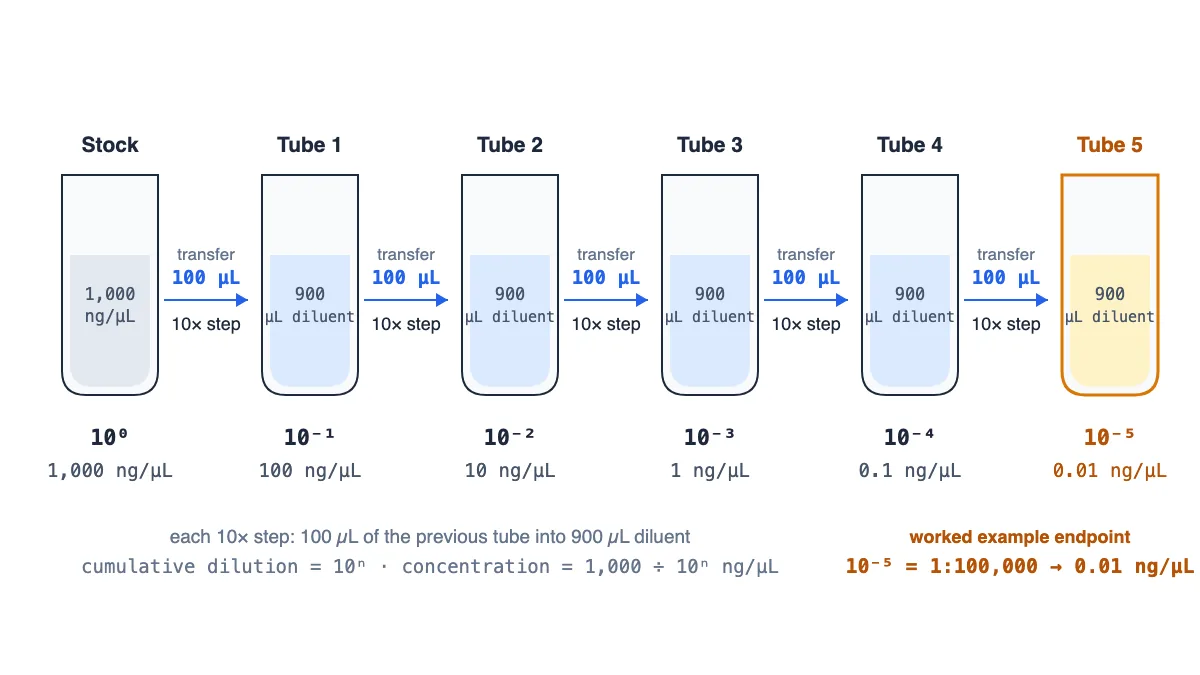
Worked example - series (the defaults). A 1,000 ng/µL stock diluted five times at 10×: tube 5 sits at 10⁻⁵ = 1:100,000 → 1,000 ÷ 100,000 = 0.01 ng/µL. Each step transfers 1,000 ÷ 10 = 100 µL into 900 µL of diluent. Single mode: to make 2,000 µL of 25 ng/µL from a 1,000 ng/µL stock, V₁ = 25 × 2,000 ÷ 1,000 = 50 µL stock + 1,950 µL diluent - a 1:40 dilution.
Example B: a 2-fold series in CFU/mL
A gentle step, and why ten-fold wins. Set the factor to 2 with a 1,000 µL working volume: each transfer is 500 µL into 500 µL, and after eight tubes the cumulative factor is only 2⁸ = 256, nowhere near the 10⁻⁶ that six ten-fold tubes deliver. Switch the units to CFU/mL and start from 8 × 10⁸ and the same series reaches 3.1 × 10⁶ at tube eight, still a hundredfold above a countable plate. Half-step series earn their keep when a target concentration falls between two ten-fold rungs, not when range is the goal.
Why the steps multiply
Every dilution conserves the amount of solute: what leaves the stock in volume V₁ at concentration C₁ must equal what lands in the final volume at C₂, which is the C₁V₁ = C₂V₂ relation the single mode solves directly. A series applies that rule repeatedly, each tube drawn from the one before it, so factors multiply and concentrations fall geometrically: cumulative DF = step DF raised to the power n, and tube n sits at C₁ ÷ DFⁿ. Five 10× tubes take a 1,000 ng/µL stock to 0.01 ng/µL because 10⁵ = 100,000.
Language is where this goes wrong. Here '1:10' means one part sample plus nine parts diluent, ten parts total, the ten-fold reading; write it as 1+9 when the distinction matters. The alternative reading changes every number downstream by about ten percent, which is enough to turn a countable plate into a discarded one.
The table exists so the arithmetic happens before the pipette moves. It answers two bench questions at once: what concentration each tube ends at, and how much diluent to have waiting in the rack. Cumulative factor is the quantity every later calculation divides by. Plate counts, absorbance readings and qPCR standards all lean on it.
Running the series without copying the error
Add diluent first, then label every tube with its factor before touching a pipette. Mislabeled tubes are the classic source of impossible colony counts, because a back-calculation divides by whatever factor the label claims. Transfer, mix thoroughly, change tip, move down the row: incomplete mixing is the dominant error, since whatever clings to the tip or sits unmixed in tube one is copied with the same relative error into every tube after it.
Keep transfers in the comfortable range of the pipette. Below one or two microlitres, tip retention and adsorption dominate, so scale the working volume up instead of trusting a sliver of liquid. Very dilute solutions also lose molecules to tube walls, which is why carrier protein or prompt plating matters at the far end of a long series.
Plate from the middle of the series so counts land in the 30–300 window, then back-calculate: CFU/mL = colonies ÷ (dilution × volume plated in mL). Forty-five colonies from 100 µL of a 10⁻⁵ tube is 45 ÷ (10⁻⁵ × 0.1) = 4.5 × 10⁷ CFU/mL. Only plates inside the window carry statistics worth quoting. Write the factor on the plate label with the colony count, since a count recorded without its dilution has to be guessed later, and guessing which tube the spread came from reproduces exactly the error the labels were meant to prevent.
When one dilution is enough
Not every job needs a rack of tubes. A single working solution (2,000 µL at 25 ng/µL from a 1,000 ng/µL stock) is one equation: V₁ = C₂V₂ ÷ C₁, giving 50 µL of stock made up to volume with 1,950 µL of diluent. Switch the mode and the same page solves it, reporting the dilution factor alongside so the arithmetic can be checked at a glance.
Choose the mode by the size of the step. One ten-fold change belongs in single mode; six of them belong in a series, because a single step reaching 10⁻⁶ would need about 1 µL into 999,999 µL, a volume no pipette delivers accurately. Splitting the work into comfortable transfers trades one impossible measurement for six reliable ones.
Units travel with the numbers. Switch the selector to M for a buffer recipe, CFU/mL for an overnight culture, or ng/µL for a plasmid stock, and every concentration in the table follows. Mixing unit systems between the stock and the target is the fastest way to produce a confident answer to the wrong question. Convert once, before the first transfer, and let every downstream figure inherit the unit you chose rather than rescuing each row with its own correction factor.
What your serial dilution result means
Serial dilutions trade one risky tiny-volume step for many comfortable ones: 1 µL into 999 µL is a 1000-fold error waiting to happen, while 100 µL into 900 µL five times gets you there with each transfer well inside pipette accuracy. The cumulative factor is what you back-calculate with - plate counts, spectrophotometer readings and qPCR standard curves all divide by it.
The plan table also answers the question people actually ask at the bench: how much diluent to have in the rack before you start, and where each transfer comes from.
How to read the output:| Result range | What it means | What to do next |
|---|---|---|
| Cumulative factor after n steps | what you divide counts by | write it on the plate label |
| Tube 5 at 10⁻⁵ | concentration fell 100,000-fold | plate from the countable range |
| 30–300 colonies on the plate | count is statistically usable | back-calculate with the reciprocal |
| Transfer volume under 2 µL | tip retention dominates error | raise the working volume instead |
| Single mode returns V₁ | stock volume for one solution | make the rest up with diluent |
Common mistakes with the serial dilution
- Reading '1:10' as one part of sample plus ten parts of diluent: Ten-fold here means one part in ten total, so 1+9 is the intent; the other reading shifts every downstream concentration by about ten percent.
- Moving to the next tube without mixing the current one: Unmixed solute carries the same relative error into every later tube, so pipette-mix up and down and change tips before each transfer.
- Plating from the strongest tube that shows colonies: Aim for 30–300 colonies by plating further down the series; outside that window the count carries too much variance to divide by.
- Splitting a 10⁻⁶ target across one single-step dilution: A single transfer would need roughly 1 µL into 999,999 µL; six 100 µL steps reach the same factor inside pipette accuracy.
- Forgetting which tube the sample came from: Label tubes with their factor before starting, because the back-calculation divides by that factor and a wrong label yields impossible counts.
Limits of the serial dilution calculator
Incomplete mixing is the dominant error: whatever clings to the tip or sits unmixed in tube 1 is copied - with the same relative error - into every tube after it. Vortex or pipette-mix up and down before each transfer, and change tips every time.
'1:10' is ambiguous in casual speech: here it means one part sample in ten parts total (1 + 9), the 10-fold meaning. Written '1+9' it is unambiguous. Getting this wrong changes every number downstream by 10%.
Below about 1-2 µL of transfer, tip retention and adsorption dominate - scale the working volume up instead. Very dilute solutions also lose molecules to tube walls, so add a carrier (BSA) or plate promptly at low concentrations. Evaporation in small open tubes concentrates what is left.
Laboratory note from Dr. Dinesh A. Nagegowda, PhD: Serial dilutions represent the backbone of quantitative microbiology and bioassays, but pipetting errors compound exponentially down the dilution series. In our laboratory trials, failing to vortex each tube thoroughly for 5 seconds between transfer steps results in significant stratification and inaccurate colony plate counts. We recommend changing pipet tips between each dilution tube to prevent carryover on outer tip surfaces.
Sources
- R&D Systems (Tocris) Dilution Calculator (used for: the C1V1 = C2V2 equation behind both the single mode and each step of the series)
- FDA Bacteriological Analytical Manual, Chapter 3: Aerobic Plate Count (used for: serial dilution plating conventions and back-calculation of counts from diluted samples)
- Bio-Techne / R&D Systems dilution calculator (used for: transfer and diluent volume arithmetic for a chosen dilution factor and working volume)
Cite This Calculator
For laboratory course reports, academic papers, or institutional protocols (APA format):
Serial Dilution: frequently asked questions
Is a 1:10 dilution the same as a 10-fold dilution?
In this calculator, yes: one part sample plus nine parts diluent gives a final volume ten times the sample volume, so the concentration drops ten-fold (10⁻¹). Some protocols write '1+9' to make the parts explicit - if you see '1:10' it almost always means the same thing.
How do I back-calculate CFU/mL from a plate?
CFU/mL = colonies ÷ (dilution × volume plated in mL). From 45 colonies on 100 µL of a 10⁻⁵ tube: 45 ÷ (10⁻⁵ × 0.1 mL) = 4.5 × 10⁷ CFU/mL. Only count plates in the 30-300 colony window.
Why not just do one big dilution in a single tube?
Because a single step big enough to reach 10⁻⁶ would need something like 1 µL into 999,999 µL - a volume no pipette delivers accurately at that scale. Splitting the dilution into steps keeps every transfer in the 10-100 µL range where pipettes are calibrated.
How many tubes do I need for 10⁻⁶?
Six 10× steps, because 10⁶ = 1,000,000. For a 2-fold series you would need twenty steps to get the same range - which is exactly why ten-fold is the default.
What transfer volume should each step use?
Transfer volume = working volume ÷ step dilution factor: a 10× step into a 1,000 µL working volume is 100 µL of the previous tube into 900 µL of diluent, and a 1:5 step is 200 µL into 800 µL. Keep transfers in the 10-100 µL range where pipettes are calibrated; below about 1-2 µL tip retention and adsorption take over.
What happens if I skip mixing between transfers?
Every later tube inherits the error with the same relative size. If tube 2 ends up 10% low because diluent and sample were not mixed, tubes 3 through 6 are each 10% low too, and your back-calculated CFU/mL is wrong by that same 10% - a bias no replicate plating will reveal. Vortex or pipette-mix before every transfer.
When should I use single mode instead of a series?
Single mode is for one working solution, not a dilution ladder: enter C1, C2 and V2 and it returns V1 = C2V2 ÷ C1. Making 2,000 µL of 25 ng/µL from a 1,000 ng/µL stock needs 50 µL stock plus 1,950 µL diluent, a 1:40 dilution. Switch to series mode when you need several orders of magnitude - plate counts, standard curves, titre estimates.
Why do very dilute tubes lose accuracy?
At picogram-per-millilitre levels molecules adsorb to tube walls and tips, and evaporation in small open tubes concentrates what is left - a 5% volume loss raises the concentration about 5%. Add a carrier such as BSA, keep tubes capped, and plate or read promptly rather than storing the last tubes of the series.
Found a number that does not match its source? Report a mistake. Corrections are published in place and the page date is updated.
Question a result, or spotted a number that doesn’t match its source? Email the correction →.

Dr. Dinesh A. Nagegowda, PhD: Plant & Molecular Biology Editor
Dinesh is a plant molecular biologist and Chief Scientist at CSIR-CIMAP whose research runs through functional genomics, transcriptomics, metabolomics, and biosynthetic pathways in plants. He writes and…