Free Lab & Molecular Biology tool
 Free Lab & Molecular Biology tool
PCR Master Mix Calculator
The PCR Master Mix Calculator computes component reagent volumes (buffer, dNTPs, primers, polymerase, water) needed to prepare single or multi-reaction cocktails with pipetting excess margins. Setting up N reactions one component at a time multiplies every pipetting error; one master mix divides it out. Enter your per-reaction volumes, the number of reactions, and an overage percentage - kit manuals ask for about 10% extra - and this calculator scales each component, balances the water, and hands you a dispense table. Template stays out of the mix and is counted separately, the way protocols intend it.
PCR Master Mix Calculator: result
| Component | Per reaction (µL) | Total (µL) |
|---|---|---|
| 2x master mix | 10.00 | 110.0 |
| 10x buffer | 0.00 | 0.0 |
| 50 mM MgCl2 | 0.00 | 0.0 |
| 10 mM dNTP mix | 0.00 | 0.0 |
| Primers (F + R) | 1.00 | 11.0 |
| Taq polymerase | 0.00 | 0.0 |
| Water | 7.00 | 77.0 |
| Master mix (dispensed) | 18.00 | 198.0 |
| Template (added per tube) | 2.00 | 20.0 (10 tubes) |
Remember to include your controls as reactions: one NTC (template replaced with water) and, for RT-qPCR, a no-RT control - they belong in the count above.
At a glance
- What it does: Scales per-reaction reagent volumes across N tubes with overage, then balances the water line.
- Who it is for: Works as a kit's 2× mix or a home-brew recipe, with template kept out of the bulk.
- Typical result: Defaults: 10 reactions at 20 µL and 10% overage dispense 198 µL, 18 µL per well plus 2 µL template.
How to use the pcr master mix calculator
- Set the number of reactions (samples + controls you plan to run) and the reaction volume; keep 10% overage unless your plate format justifies less. prefill →
- Pick one approach: a kit's 2× mix (usually half the reaction volume), or the individual home-brew components - set the other set to zero so nothing double-counts. prefill →
- Enter the primers (both strands combined) and any other per-reaction reagents; leave the template field at its per-tube value.
- Check the water line: it must be positive and plausible - typically 30-60% of a 20 µL reaction. A negative number means the components outrun the reaction volume.
- Use the dispense table: aliquot the master-mix total across the prepared reactions, then add template to each tube individually and spin down.
PCR Master Mix: the formula & its source
One master mix is every non-template component scaled from one reaction to the batch, with a little extra to cover pipetting losses:
component total = per-reaction volume × n′ where n′ = ⌈n × (1 + overage ÷ 100)⌉
water = reaction volume − Σ (all other per-reaction volumes) · dispense volume = master-mix total ÷ n′
Kit manuals state the same rule - 'scale the components according to the number of reactions and include 10% overage' - because N+1 bulk dispenses are far more repeatable than N sets of six. Template is deliberately excluded: it is added per tube after the mix is dispensed, which keeps the shared stock out of a bulk tube and leaves the no-template control honest.
When amplifying DNA fragments with 20–40 bp terminal overlaps for isothermal cloning, calculate reaction molar ratios with the Gibson assembly calculator.
| Symbol | Meaning | Unit | Typical range |
|---|---|---|---|
n′ | prepared reactions: N × (1 + overage), rounded up | count | 1 – 400 |
overage | extra share covering tip and reservoir losses | % | 0 – 50, 10 typical |
master mix | every non-template component scaled to n′ | µL | (reaction volume − template) × n′ |
water | reaction volume minus all other per-reaction volumes | µL | must balance to ≥ 0 |
Calculate optimal thermodynamic primer melting (Tm) and annealing temperatures on our PCR primer annealing temperature calculator.
PCR Master Mix: worked example
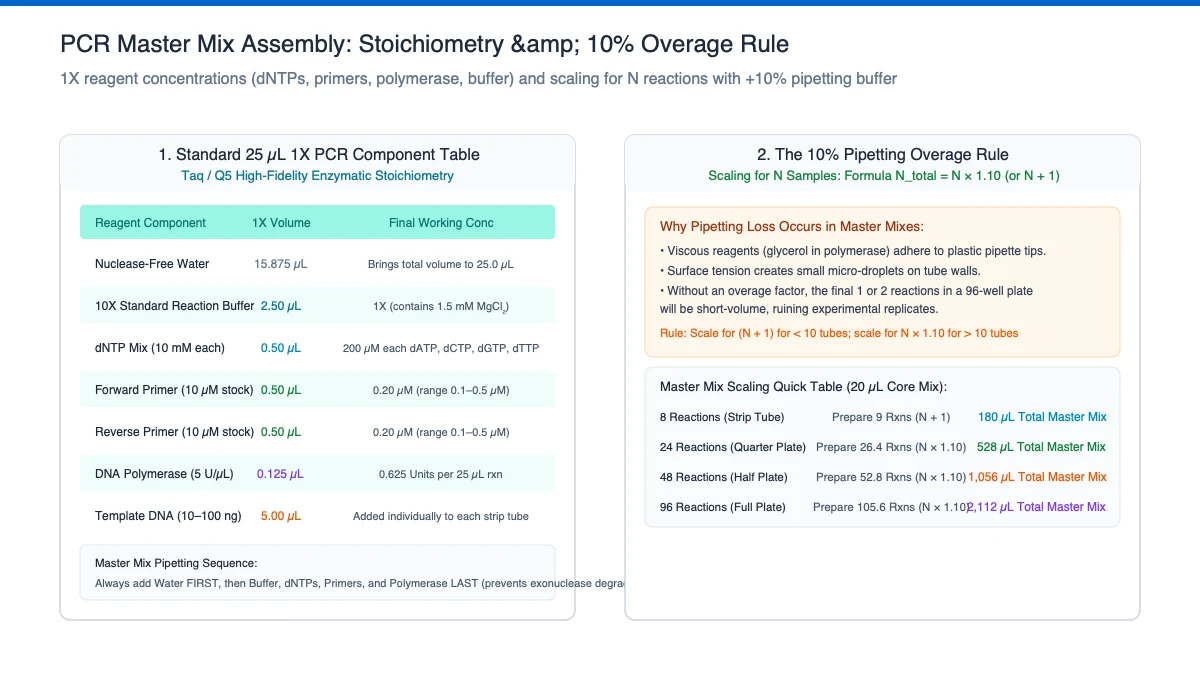
Worked example - the defaults. 10 reactions at 20 µL with 10% overage: n′ = ⌈10 × 1.1⌉ = 11 prepared reactions. Non-template components = 10 (2× mix) + 1 (primers) + 2 (template) = 13 µL, so water = 20 − 13 = 7 µL and the master mix (everything except template) is 18 µL per reaction → 198 µL to aliquot, i.e. 18 µL per well plus 2 µL template per tube. Template stock needed: 2 µL × 10 = 20 µL (the overage covers mix only).
Example B: a home-brew recipe at 15% overage
Eight reactions of 20 µL with the kit mix left at zero and home-brew components filled in: 2 µL buffer, 1.2 µL MgCl₂, 0.4 µL dNTPs, 1.6 µL primers and 0.4 µL Taq each. At 15% overage the table rounds up to n′ = 10 prepared tubes, and the water line balances at 20 − 7.6 = 12.4 µL, the largest single component and the reason water is calculated rather than eyeballed. The bulk mix comes to 18 µL × 10 = 180 µL, dispensed as 18 µL per tube with 2 µL of template added afterwards from 16 µL of stock.
One measurement instead of N
Pipetting every reagent into every tube turns each addition into an independent error. Ten reactions assembled one by one differ from each other by whatever the thumb did between tube one and tube ten, and because the differences are independent, they show up as scatter between samples that were supposed to differ only in their templates. A master mix measures each component once. Every well then carries the same relative error in buffer, magnesium, nucleotides and polymerase, so when two samples compare differently the comparison reflects the templates rather than the pipetting.
The scaling itself is arithmetic. Each component total is the per-reaction volume multiplied by n′, the reaction count grossed up for overage and rounded up so the last well is not the one that runs dry: n′ = ⌈n × (1 + overage ÷ 100)⌉. Ten reactions at 10% become eleven prepared volumes. The water line is not a recipe but a balance, the reaction volume minus every other per-reaction entry, which is why it doubles as a check: a plausible positive number means the components fit the reaction, and the dispense step is simply the bulk total divided by n′ to give the volume each tube receives. Prepared this way, the plate inherits one measurement per reagent, and the differences between wells become the templates' differences rather than the operator's.
Kit mix or home brew: choose one
A 2× master mix is designed to occupy half the final reaction, so a 20 µL reaction takes 10 µL of it; the kit already carries buffer, magnesium, nucleotides, stabilisers and often dye, and the protocol's remaining lines are primers, template and water. A home-brew setup exposes each of those pieces separately: 10× buffer at a tenth of the reaction volume, 50 mM magnesium chloride dosed to a final 1.5–2 mM, a 10 mM dNTP mix landing near 0.2 mM, both primers entering from working stocks, and polymerase last.
The two approaches must never be combined. Adding a 2× kit mix to a home-brew buffer and dNTPs double-counts salts and nucleotides, and the magnesium that looked modest in one column becomes inhibitory across two. The water balance catches this class of mistake before the thermocycler does, because components summing past the reaction volume drive the water negative. Primer and template volumes themselves come from C₁V₁ = C₂V₂ solved beforehand; this page scales the volumes you already decided on, it does not choose stock concentrations for you. When in doubt, zero the approach you are not using and let the arithmetic show a single coherent recipe.
Overage, template discipline, and the dispense order
Kit manuals ask for roughly 10% extra, and the number is insurance rather than generosity. Liquid clings to tips, residues stay in reservoirs, and the last wells of a plate are fed from whatever the previous wells left behind; ten percent keeps the final dispense the same size as the first without burning expensive polymerase on a safety margin nobody needs. Overage well beyond 50% is not caution, it is a unit that slipped somewhere in the table, and the check is to audit each per-reaction volume until one of them is obviously a stock figure sitting in a per-reaction field.
Template stays out of the bulk. Added tube by tube after the mix is dispensed, it keeps a precious or viscous stock out of a shared vessel, keeps variable dispenses from contaminating everything downstream, and leaves the no-template control a true negative: if the control shares a contaminated bulk mix, every result on the plate becomes unreadable. The working order is conventional for a reason. Assemble the mix on ice, vortex and spin it so no component settles, dispense with a multichannel where the plate allows, add template last, then spin again. Cosolvents such as DMSO or glycerol count inside the volume budget, and the overage you set covers the mix, not the template stock, which is calculated from the actual sample count. Controls join the count as reactions, since a no-template control and a positive control each consume a prepared volume and would otherwise leave the last sample short.
What your pcr master mix result means
Master mixes convert a pipetting-error problem into a single measurement: one component scaled once is wrong by the same fraction in every well, so relative comparison between samples survives even when the absolute volume is slightly off. Dispensing eight wells with a multichannel is faster and more even than touching eight tubes with a single-channel.
Overage is insurance, not generosity: at 10% you always have enough for the last well even after tip retention, without wasting expensive polymerase. And keeping template out of the bulk is what makes a contamination event containable - it touches one tube, not the whole batch.
How to read the output:| Result range | What it means | What to do next |
|---|---|---|
| Water lands around a third to half the reaction | components balance against the reaction volume | dispense the table as written |
| Water returns zero or a negative number | something was double-counted or entered in stock units | zero the other approach, or fix the unit |
| Overage shows above 50% | a unit slipped somewhere in the component list | audit each per-reaction volume |
| Bulk mix covers fewer tubes than samples | overage too small for the plate's dead volume | keep about 10% extra in the reservoir |
| Template absent from the bulk | controls stay honest and the stock stays safe | add it tube by tube after dispensing |
Common mistakes with the pcr master mix
- Pouring the template into the bulk mix: Add it after dispensing, tube by tube; a contaminated stock then touches one vessel instead of the batch, and the no-template control remains a true negative.
- Combining a 2× kit mix with home-brew buffer and dNTPs: The two setups double-count salts and nucleotides; fill either the kit line or the individual lines, leave the rest at zero, and let the water balance check the recipe.
- Reading a negative water line as a rounding quirk: It means the components physically exceed the reaction volume; trim the double-counted reagent or raise the reaction volume instead of dispensing an impossible recipe.
- Skipping overage when the plate is nearly full: Dead volume in the reservoir empties before the last well, so keep about 10% extra and the final wells will receive the same dose as the first ones.
Limits of the pcr master mix calculator
This tool scales volumes; it does not compute stock-to-final concentrations. To choose how much primer stock to add, solve C₁V₁ = C₂V₂ first - the table assumes you already know the per-reaction volume of each component.
Do not mix approaches: a 2× kit mix plus a 10× home-brew buffer double-counts buffer, salts and dNTPs. Likewise, an overage larger than 50% usually means a unit slipped somewhere, and water that comes out negative means the components physically exceed the reaction volume.
Overage does not fix a wrong ratio - it just makes the wrong ratio consistent. Keep cosolvents (DMSO, formamide, glycerol) inside their volume budget, keep polymerase on ice, and vortex then spin the mix before dispensing so no component settles.
Laboratory note from Dr. Dinesh A. Nagegowda, PhD: When assembling multi-reaction PCR master mixes, calculating exact reagent volumes without factoring in pipetting overage is the most common cause of short-pipetting the final sample well. In our laboratory protocols, we always include a 10% volume excess (an extra 1 reaction for every 10 samples) to compensate for liquid retention on tip walls, ensuring consistent enzyme and dNTP concentrations across all 96-well plate positions.
Sources
- Thermo Fisher Scientific, AmpSure Universal SYBR Green qPCR Master Mix quick reference (MAN1000090) (used for: the instruction to scale components by reaction count with about 10% overage, and the default component set)
- Thermo Fisher Scientific, gene expression troubleshooting and qPCR support (used for: setup practice around reaction volumes, master-mix handling and contamination control)
- Integrated DNA Technologies, Real-time qPCR guide Part 1: Assay design (used for: keeping template out of the bulk mix and the assembly order before thermocycling)
Cite This Calculator
For laboratory course reports, academic papers, or institutional protocols (APA format):
PCR Master Mix: frequently asked questions
How much overage should I use?
About 10% is what kit manuals specify - enough to cover tip and tube losses without wasting reagent. With a multichannel on a full plate, 5% usually suffices; for tiny volumes (≤10 µL reactions) go toward 15% because dead volume matters more.
Should the template go into the master mix?
No. Add it to each tube after the mix is dispensed. That keeps your precious stock out of a bulk tube, prevents variable viscous dispenses, and keeps the no-template control a true negative - if the NTC shares contaminated bulk mix, every result is unreadable.
My water came out negative - why?
The components you entered sum to more than the reaction volume. The usual culprit is a 2× mix set equal to the full reaction volume while other reagents are also filled in, or a component entered in the wrong units (stock volume instead of per-reaction volume). Trim the components or raise the reaction volume.
How do I get stock concentrations from these volumes?
Work backwards with C₁V₁ = C₂V₂ per component: the table gives you V₁ (the per-reaction volume of stock), C₂ is the final concentration in the reaction, so C₁ = C₂V₂ ÷ V₁. See the DNA concentration calculator for the absorbance side of that arithmetic.
Why does the prepared-reaction count get rounded up?
The multiplier is n′ = ⌈n × (1 + overage ÷ 100)⌉, so 10 reactions at 10% overage prepare 11, not 10.9. A fractional prepared reaction would leave the last well short after tip retention and wall losses, and master-mix arithmetic only works in whole dispenses.
How much mix goes into each well?
Dispense volume = master-mix total ÷ n′. With the defaults, 18 µL of mix per reaction × 11 prepared reactions = 198 µL total, so each well gets 18 µL of mix plus 2 µL of template added afterwards. Vortex and spin the bulk mix before dispensing so nothing settles.
Can I add home-brew buffer to a 2× kit mix?
No. A 2× mix already carries buffer, salts and dNTPs at final concentration; topping up with a 10× home-brew buffer double-counts all three and distorts Mg²⁺ and dNTP levels. Set one approach to zero in the table so nothing double-counts - the same rule applies to enzyme and additives.
Where do DMSO or glycerol fit in the volume budget?
They come out of the water, not on top of it. In a 20 µL reaction the defaults leave 7 µL of water; adding 5% DMSO (1 µL) means 6 µL of water and 1 µL of cosolvent - the total still sums to 20 µL. Overrunning the budget pushes every other component down.
Found a number that does not match its source? Report a mistake. Corrections are published in place and the page date is updated.
Question a result, or spotted a number that doesn’t match its source? Email the correction →.

Dr. Dinesh A. Nagegowda, PhD: Plant & Molecular Biology Editor
Dinesh is a plant molecular biologist and Chief Scientist at CSIR-CIMAP whose research runs through functional genomics, transcriptomics, metabolomics, and biosynthetic pathways in plants. He writes and…