Free Gardening & Crops tool
 Free Gardening & Crops tool
Plant Spacing Calculator
The Plant Spacing Calculator determines the total number of plants required to fill landscape or garden beds under square and triangular spacing grids. Whether you plant in a grid or in rows, the only number that matters for the stand is the ground each plant gets. Enter a spacing to see plants per square foot, per 1,000 square feet and per square metre, plus how many plants fit in the bed or row length you actually have.
Plant Spacing Calculator: result
Other layout, same spacing - 30 in rows at 12 in: 2.50 ft² per plant, 0.40 per ft², 400 per 1,000 ft². Rows give each plant a rectangle (row × plant spacing); a grid gives it a square.
At a glance
- What it does: Works out plants per square foot, per 1,000 ft² and per square metre from grid or row spacing.
- Who it is for: Made for gardeners laying out a bed or row before seeds and transplants are bought.
- Typical result: A 12 in grid holds one plant per square foot, so a 24 ft² bed takes 24 plants.
How to use the plant spacing calculator
- Choose the layout: a grid spaces plants equally in both directions, rows keep them wider apart between beds. prefill →
- Enter the plant spacing in inches - for thin crops such as carrots this is the spacing after thinning. prefill →
- In row layout, enter the row spacing too (the width you leave for feet, hose and hoe).
- Give either the bed area (grid) or the row length (row) to see how many plants those dimensions hold.
- Use the plants-per-1,000-ft² line to scale the same layout up to a whole plot.
Plant Spacing: the formula & its source
A grid gives each plant a square of side s; rows give it a rectangle of row spacing × plant spacing:
grid: ft² per plant = (s ÷ 12)²
rows: ft² per plant = (row ÷ 12) × (s ÷ 12)
plants per ft² = 1 ÷ ft² per plant
plants in bed = floor(bed ft² ÷ ft² per plant)
The floor function reflects reality: you can only plant whole plants. Conversion: 1 plant per ft² = 10.76 per m².
| Symbol | Meaning | Unit | Typical range |
|---|---|---|---|
s | distance between plants in the grid or row | in | 2–36 in |
r | distance between rows, row layout only | in | 12–60 in |
A | bed area being filled, grid layout | ft² | 4–10,000 ft² |
L | length of one row, row layout | ft | 2–1,000 ft |
n | whole plants the bed or row holds | plants | 1–10,000 |
Plant Spacing: worked example
Worked example - 12 in grid in a 24 ft² bed. ft² per plant = (12 ÷ 12)² = 1.00 ft² → 1.00 plant per ft² → 1,000 per 1,000 ft² → 10.76 per m² (107,639 per hectare). A 24 ft² bed holds floor(24 ÷ 1.00) = 24 plants. Switching to 12 in plants in 30 in rows: (30 ÷ 12) × (12 ÷ 12) = 2.50 ft² per plant, only 0.40 per ft² - 400 per 1,000 ft².
Example B: grid switched to rows
Example B: the same plants in rows. Switch Layout to Rows, keep 12 in spacing and 30 in rows: area per plant becomes (30 ÷ 12) x (12 ÷ 12) = 2.50 ft², density drops to 0.40 per ft² (400 per 1,000 ft²), and 8 ft of row holds floor(8 ÷ 1.00) = 8 plants. The bed-area field goes quiet in this mode while the row length does the counting. Same spacing, half the density, and that difference is the walking space the row layout keeps open between beds.
One square or one rectangle
Layout decides what each plant is owed. A grid hands every plant a square whose side is the spacing: at 12 inches that is one square foot each, so density is one per square foot, 1,000 per thousand square feet and 10.76 per square metre. Rows hand it a rectangle instead, row spacing times plant spacing, and the same 12 inch plant in 30 inch rows gets 2.50 square feet, cutting density to 0.40 per square foot.
The fit lines count what those areas hold. In a grid, bed area divided by space per plant gives the stand, floored because only whole plants exist: 24 square feet at one square foot each is 24 plants, while a 6 inch grid in the same bed is 128. In rows, row length divided by plant spacing gives plants in that row, again floored, so the leftover fraction of a plant simply stays unplanted.
Spacing is the cheapest yield lever
Nothing about weather or soil changes when you move a plant two inches, but everything about competition does. Widening spacing raises the size of individual fruit and lowers the total count of fruit; narrowing it does the reverse. The art sits at the point where your water and fertility stop supporting more plants, which is a decision about the site rather than a number a chart can settle.
Published spacings already assume that decision has been made for average ground: uniform soil, even water and no machinery to get between the rows. Thin planting on light soil and crowded planting in shade both punish you later, which is why the number you enter should match the conditions you actually have rather than the optimistic end of a seed catalogue.
The fit lines keep this practical. A bed area converts straight into a plant count, and the per-thousand-square-feet row scales the same layout to a whole plot, which is how a corner bed and a market row end up comparable. Nothing in that scaling changes the competition each plant faces; it only reports how many contests you have arranged.
Why the bed looks crowded on paper
A grid never wastes a square foot on pathways, so the same ground carries far more plants than a row layout with 30 inch aisles. That is the whole reason raised beds read as dense on paper: a 4 x 8 foot bed at a 12 inch grid really does hold 32 plants, and at 6 inches it holds 128, with no walking space inside the frame because you reach every plant from the edge.
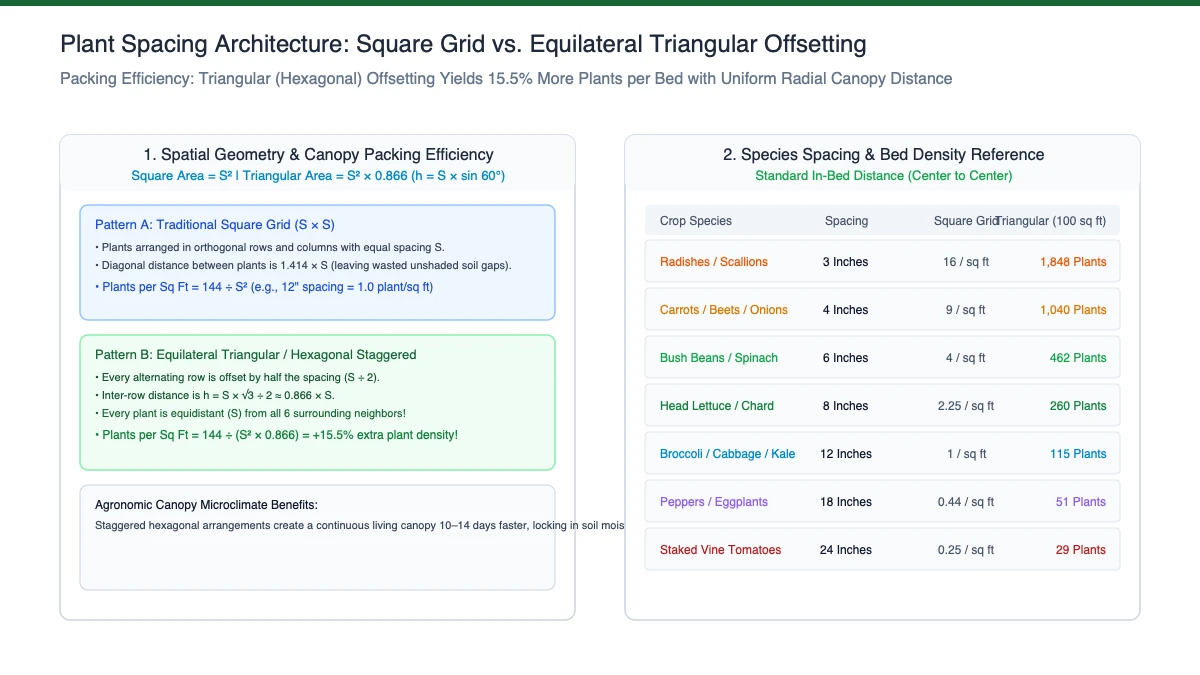
Rows trade that density for access. The wider gap is where feet, hose and hoe go, and in a larger plot that access is worth more than the lost plants. An offset, triangular grid fits about 15% more plants than a square one, but square grids are far easier to lay out with a string grid or a planting board, so most beds stay square.
Sowing density, final stand, and root crops
This calculator reports the stand the plant occupies at maturity, which is not the number you sow. Thinned crops such as carrots, beets and lettuce go in thicker than they stand: the seed calculator works the sowing rate from germination and seeds per station, and this page supplies the spacing they are thinned down to.
Root crops need the full spacing in every direction or they will not size up. A three inch carrot at six inch spacing in both directions is fine, while a three inch carrot in three inch rows stays a pencil no matter how tidy the row looks. Enter the spacing the crop has to have at harvest, then let the layout follow from the ground you actually have.
Layout choice folds into the same decision. Rows cost density to buy access for feet and tools, a grid reclaims it by removing the path, and either way the plants per square foot line tells you what the ground is being asked to carry. Read that line against your soil and season before committing the order, because plants are cheap to space on paper and expensive to replace once the season has started.
What your plant spacing result means
Spacing is the cheapest yield lever there is: it changes nothing about weather or soil, only how hard each plant competes with its neighbours. Widening spacing raises individual fruit size and lowers total fruit count; the art is finding where your water and fertility stop supporting more plants.
The grid-versus-row comparison shows why raised beds look dense on paper: a grid never wastes a square foot on pathways, so the same ground carries far more plants than a row layout with 30 in aisles.
How to read the output:| Result range | What it means | What to do next |
|---|---|---|
| 1.00 /ft² | 12 in grid, one square foot each | 24 plants fill a 24 ft² bed |
| 0.40 /ft² | 12 in plants in 30 in rows | Row aisles cost the ground a grid reclaims |
| 128 plants | 6 in grid in that same bed | Spacing alone can double the stand |
| Whole plants only | area divided by space per plant | The last partial plant is dropped |
| 3 in carrots | spacing after thinning | Sow thicker, then thin to this stand |
Common mistakes with the plant spacing
- Using sowing spacing as final spacing: Thinned crops are sown denser than they stand. Enter the post-thinning spacing here and leave the heavy sowing to the seed calculator.
- Tightening rows while keeping the in-row spacing: Root crops need full spacing in every direction. Three inch carrots in three inch rows will not size up, however neat the row looks.
- Ignoring the walking space a row layout exists for: Set row spacing to the aisle you really hoe and walk through, or the count quietly assumes a path wider than the bed allows.
- Comparing grid and row counts as if the layouts were equal: A grid wastes no square foot on pathways. Compare against the layout you will actually build, not the denser one on paper.
- Expecting a fractional plant in the bed count: The fit is floored to whole plants: a bed holds floor(area ÷ space per plant), and the leftover strip stays unplanted.
Limits of the plant spacing calculator
Published spacings assume uniform soil, even water and no machinery access - thin planting on light soil and crowded planting in shade both punish you later. Thinned crops (carrots, beets, lettuce) need a denser sowing than this calculator's final stand; use the vegetable seed calculator for the sowing rate.
Root crops need the full spacing in every direction: a 3 in carrot in a 6 in grid is fine, but a 3 in carrot in 3 in rows will not size up.
Agronomy note from Dr. Dinesh A. Nagegowda, PhD: Proper crop spacing balances canopy light interception with root competition for moisture and mobile soil nutrients. In intensive vegetable gardening, hexagonal (equilateral triangular) spacing arrangements pack roughly 15% more plants into the same square footage than traditional square grids while maintaining identical root clearance between neighboring plants.
Sources
- Virginia Tech Extension 426-335, Intensive Gardening Methods (used for: row versus intensive spacing and the plant density each layout produces)
- WSU Extension, Square Foot Gardening planting guide (used for: square-foot grid layout with equal spacing in both directions)
- Clemson Extension HGIC, Small Scale Gardening (used for: bed dimensions and plant counts in small home gardens)
Cite This Calculator
For laboratory course reports, academic papers, or institutional protocols (APA format):
Plant Spacing: frequently asked questions
How many plants fit in a 4x8 raised bed?
At a 12 in grid, 32 ft² holds 32 plants; at a 6 in grid, 128 plants. In 30 in rows with 12 in plants, 10 per 8 ft row - 40 in the bed.
What is the difference between grid and row spacing?
A grid spaces plants equally in both directions; rows keep them closer together along a narrow row and wider apart between rows to leave walking space.
How many plants per square foot for carrots?
About 1 per ft² at 3 in spacing - roughly 100 per 1,000 ft² - if sown thickly and thinned to that stand.
Should I plant in a square grid or offset rows?
An offset (triangular) grid fits about 15% more plants than a square grid, but square grids are far easier to lay out with a string grid or planting board.
Found a number that does not match its source? Report a mistake. Corrections are published in place and the page date is updated.
Question a result, or spotted a number that doesn’t match its source? Email the correction →.

Dr. Dinesh A. Nagegowda, PhD: Plant & Molecular Biology Editor
Dinesh is a plant molecular biologist and Chief Scientist at CSIR-CIMAP whose research runs through functional genomics, transcriptomics, metabolomics, and biosynthetic pathways in plants. He writes and…