Free Gardening & Crops tool
 Free Gardening & Crops tool
Corn Yield Calculator
The Corn Yield Calculator estimates grain corn harvest yield (bushels per acre at 15.5% moisture) from 1/1,000th acre ear counts, kernel rows, and kernels per row. Field corn yield can be estimated before a single bushel crosses a scale: count the ears, estimate the kernels, and divide by the standard kernels-per-bushel factor. Enter ears per acre, kernels per ear and the fudge factor to get bushels, pounds and tonnes per acre, the same yield-component method extension agronomists walk fields with.
Corn Yield Calculator: result
This is the yield-component method extension agronomists use in the field: count ears in a known area (a 1/1000-acre strip, 435.6 ft², works well), estimate kernels per ear from kernels-around times kernels-on-two-rows, then divide by the kernel count per bushel. The fudge factor absorbs test weight: heavy corn packs more weight into fewer kernels, so adjust it if your grain is unusually light or plump.
At a glance
- What it does: Estimates bushels, pounds and tonnes per acre from ears, kernels per ear and the standard bushel factor.
- Who it is for: Built for growers making pre-harvest calls before a scale ticket or elevator receipt exists.
- Typical result: Returns the yield-component estimate alongside weight conversions for feed, freight and contract arithmetic.
How to use the corn yield calculator
- Count ears in a known area: a 1/1000-acre strip (435.6 ft²) scaled by 1,000 is the standard field method. prefill →
- Estimate kernels per ear on several representative ears: kernels around the cob × kernels on two rows. prefill →
- Leave the fudge factor at 90,000 unless you know your grain is off-standard; 65,000–110,000 covers most test-weight extremes.
- Read bushels per acre as the estimate, then pounds and tonnes per acre for feed, freight and contract math.
- Cross-check against the combine monitor or a weigh wagon when you can. Component estimates are for pre-harvest decisions, not settlement.
Corn Yield: the formula & its source
The yield-component method multiplies ears and kernels, then converts kernel count to bushels through the standard factor:
bu/acre = (ears/acre × kernels/ear) ÷ kernels-per-bushel
The bushel is a weight (56 lb for corn), but yield math counts kernels, so the "fudge factor" bridges the two: 90,000 kernels is one standard bushel at 15.5% moisture. Wet, light or damaged grain packs differently, which is where the 65,000–110,000 range comes from.
lb/acre = bu/acre × 56 t/ha = bu/acre × 62.77
62.77 converts bushels per acre to kilograms per hectare (56 lb × 0.4536 kg/lb ÷ 0.4047 ha per acre).
| Symbol | Meaning | Unit | Typical range |
|---|---|---|---|
ears/acre | harvestable ears in a known strip, scaled up | count | 10,000–45,000 |
kpe | kernels around the cob times kernels on two rows | count | 300–900 |
fudge | kernels in one standard bushel at 15.5% moisture | count | 65,000–110,000 |
bu/acre | estimated yield in bushels per acre | bu/ac | 50–350 |
lb/acre | bushels times the 56 lb bushel for corn | lb/ac | 2,800–20,000 |
t/ha | bushels per acre converted to tonnes per hectare | t/ha | 3–22 |
Corn Yield: worked example
Worked example: 30,000 ears/acre, 600 kernels/ear, 90,000 factor. Kernels = 30,000 × 600 = 18,000,000 (18.00 million). Yield = 18,000,000 ÷ 90,000 = 200.0 bushels/acre. Weight = 200 × 56 = 11,200 lb/acre, or 200 × 62.77 = 12.55 t/ha. A bag tag and a scale ticket would both have to agree. This one only had a notebook and a hand tally.
Example B: off-standard test weight
Example B: light test weight. Same field, same counts: 30,000 ears at 600 kernels still gives 18,000,000 kernels. But if the grain runs light and a hand grader puts the factor nearer 100,000, the estimate falls to 180.0 bu/acre, which is 10,080 lb/acre and 11.30 t/ha, twenty bushels an acre below the standard-factor answer. Nothing about the stand or the pollination changed. One tenth of the estimate rides on grain quality rather than agronomy, which is why the factor deserves the same attention as the ear count.
Counting a field in three numbers
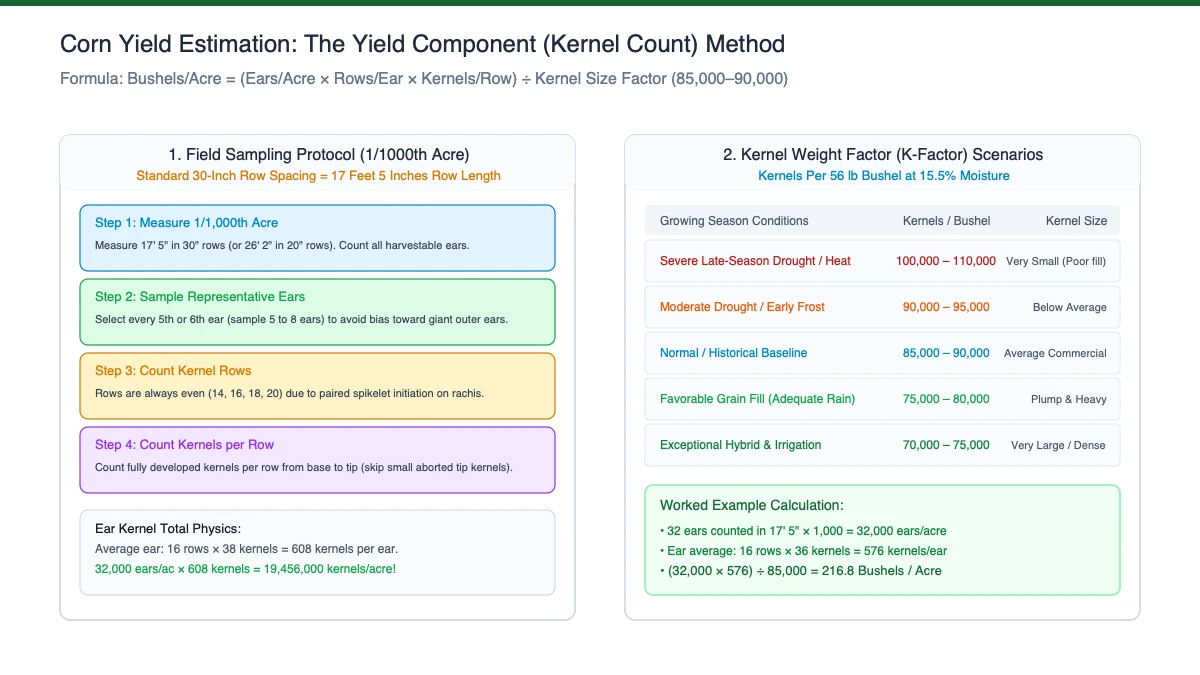
The yield-component method reduces a whole crop to three inputs you can gather with a notebook. Mark a strip measuring one thousandth of an acre, which is 435.6 square feet, and count every harvestable ear inside it before multiplying by a thousand for the per-acre figure. Kernels per ear comes from counting around the cob and then along two rows, a product that averages a few representative ears rather than the best one in the row. Both counts should be repeated across the zones of the field (the good ground, the end rows, the low corner) because a sample taken in one flattering patch carries its bias straight into the answer. Averaging several strips costs ten minutes and removes the most common source of error in the whole estimate. Decide beforehand what counts as harvestable, because tipped-back tips, barren plants and ears already dropped stay out of the tally: the combine will not recover them either. Pace off the strip rather than eyeballing it, since a strip that is actually 450 square feet instead of 435.6 inflates every count before the arithmetic begins.
What the fudge factor is hiding
Yield math counts kernels while the market weighs pounds, and the kernels-per-bushel factor bridges the two. Ninety thousand is the standard count in one 56 lb bushel of corn at 15.5% moisture, which makes it a statement about density as much as about arithmetic. Heavy, dense grain packs fewer kernels into the same volume, so the factor drops; light, wet or damaged grain crowds more kernels in, so it climbs, and the working range of about 65,000 to 110,000 covers most of what an elevator will see. That range matters because it puts an error bar on the estimate itself. A field that looks twenty bushels short may simply be carrying lighter grain than the standard assumed, so check test weight before deciding the crop underperformed. Kernel size varies with hybrid and season as well, so an identical ear count can imply different pounds in a drought year than in a full fill year. Moisture moves the same way, since grain weighed wetter than 15.5 percent shrinks as it dries and this estimate does not follow it down to the scale weight.
Diagnosing which lever moved
Each of the three inputs belongs to a different phase of the season, and that is what makes the estimate useful rather than merely hopeful. Ear count was largely settled at planting and through stand establishment, so a shortfall there points back to seed, soil temperature or planting depth. Kernels per ear are mostly a pollination and nitrogen story: heat at silking, a stressed plant, or missing fertility shows up here. The factor reflects grain quality at delivery rather than anything the plant did in June. Because the calculation multiplies, shortfalls stack instead of adding: losing ten percent of the ears and five percent of the kernels costs about fifteen percent of the yield, not five. Diagnose by moving one input at a time and watching which one restores the target. A quick sensitivity check shows the shape of the risk: cutting ears from 40,000 to 36,000 costs ten percent of the yield, while trimming kernels from 650 to 600 costs about eight. Diagnose in that order, starting with whichever input sits furthest from what you would expect for the field, and recheck the outlier rather than averaging everything together again.
What the estimate is not for
This is a standing-crop estimate built for decisions made before harvest: whether to harvest, how to price a standing crop, or which hybrid to order next year. It excludes harvest loss, tipped-back tips, dropped ears, storage shrink and moisture discounts at the elevator, and it speaks at standard 15.5% moisture whether or not your grain is there yet. Kernel counts also assume normal test weight, so dockage for light grain means fewer pounds behind the same bushel figure. When money changes hands, cross-check the number against a combine monitor or a weigh wagon and let those decide. Treat the component estimate as the early, cheap answer that tells you whether the harvest is going to confirm your expectations or embarrass them. The estimate is deliberately blind to harvest loss, tipped ears left in the field, storage shrink and moisture dockage, so treat it as the pre-harvest answer rather than the final one. When the standing figure and the combine monitor disagree by more than ten percent, the discrepancy itself is useful: it usually points at loss or test weight rather than at the arithmetic.
What your corn yield result means
Each term is a management lever you can still influence before harvest: ear count was set at planting and stand establishment, kernels per ear were largely decided by pollination and nitrogen, and the fudge factor reflects grain quality at delivery. Diagnosing a yield shortfall means knowing which of the three moved.
Because the calculation is multiplicative, small shortfalls stack: losing 10% of the ears and 5% of the kernels costs about 15% of the yield, not 5%.
How to read the output:| Result range | What it means | What to do next |
|---|---|---|
| 200 bu/ac and up | strong stand with good pollination | confirm with a monitor before contracting |
| well under target | one of the three numbers slipped | check ears first, then kernels |
| factor outside 80,000–100,000 | grain off the standard density | adjust for quality, not the stand |
| pounds and tonnes | weight for freight and rations | convert once the bushel figure settles |
Verify ear counts against calibrated harvest stand populations using our field crop plant population calculator.
Common mistakes with the corn yield
- Counting ears in one good patch: Sample several zones across the field and average them, because the estimate inherits every bias in where you chose to stand.
- Typing kernels around as the total: Multiply kernels around the cob by kernels on two rows, then spot-check a few representative ears rather than one standout.
- Leaving the factor at 90,000 for off-standard grain: Light, wet or damaged grain packs more kernels into a bushel, so raise the factor toward 100,000 or beyond and note the adjustment.
- Treating the estimate as a settlement figure: It ignores harvest loss, storage shrink and moisture dockage, so cross-check the combine monitor or a weigh wagon before signing anything.
Limits of the corn yield calculator
This estimates standing yield from a sample: the sample must actually represent the field, which is why counts are taken across several zones rather than one good patch. It does not account for harvest loss, tip-back or dropped ears, storage shrink, or moisture discounts at the elevator; the estimate is at standard 15.5% moisture. Kernel counts assume normal test weight. Dockage for light grain means fewer pounds behind the same bushel number.
Agronomy note from Dr. Dinesh A. Nagegowda, PhD: The classical yield component method for estimating pre-harvest corn yield calculates ears per 1/1,000th of an acre, kernel rows per ear, and kernels per row, divided by a kernel weight factor (standard 90,000 kernels/bushel). In our field evaluations, drought stress during grain fill can reduce test weight to 110,000 kernels/bushel, resulting in standard calculators overestimating actual harvest yield by 15% to 20%.
Sources
- South Dakota State University Extension: Estimating Corn Yield in the Field (used for: the yield-component method and the 90,000-kernel factor at 15.5% moisture)
- USDA Economic Research Service: Weights, Measures, and Conversion Factors for Agricultural Commodities (used for: the 56 lb corn bushel and the bushel-to-pound conversions)
- Iowa Department of Agriculture and Land Stewardship: How to Measure Your Grain (used for: how a bushel is measured and weighed in practice behind the standard weight)
Cite This Calculator
For laboratory course reports, academic papers, or institutional protocols (APA format):
Corn Yield: frequently asked questions
Why 90,000 kernels per bushel?
It is the standard count in one 56 lb bushel of corn at 15.5% moisture. Heavy test weight means fewer, denser kernels per bushel; light grain means more.
How do I count ears per acre?
Mark off a 1/1000-acre area (435.6 ft²), count the ears in it, and multiply by 1,000. Take several counts across the field and average them.
What if my fudge factor is different?
Adjust it for test weight or moisture: a light, wet crop might need 100,000+ kernels per bushel, dense grain 80,000 or fewer. The calculator flags anything outside 80,000–100,000.
Does harvest moisture change the estimate?
The estimate is stated at 15.5% standard moisture. Grain harvested wetter will weigh more wet but shrink as it dries. The elevator's moisture dockage, not this calculation, decides what you are paid.
Found a number that does not match its source? Report a mistake. Corrections are published in place and the page date is updated.
See a value here that won’t reconcile with its cited source? Report a mistake.

Dr. Dinesh A. Nagegowda, PhD: Plant & Molecular Biology Editor
Dinesh is a plant molecular biologist and Chief Scientist at CSIR-CIMAP whose research runs through functional genomics, transcriptomics, metabolomics, and biosynthetic pathways in plants. He writes and…