Free Dog tool
 Free Dog tool
Metacam Dosage Calculator for Dogs
The Metacam Dosage Calculator for Dogs determines canine meloxicam dosage (mg per dose and 1.5 mg/mL liquid volume) for initial loading and maintenance schedules. Meloxicam is a prescription NSAID used for osteoarthritis pain and post-operative inflammation in dogs. The approved regimen is a higher loading dose on day one (0.2 mg/kg) followed by a maintenance dose (0.1 mg/kg) once daily - figures that are easy to confuse with the feline schedule. This calculator converts your dog's weight into milligrams and millilitres for the concentration you hold, and marks the 0.05 mg/kg figure as off-label so nobody mistakes a cat schedule for a dog one.
Metacam Dosage Calculator for Dogs: result
Confirm with your vet before giving any medication: NSAIDs require a current exam, kidney and liver check in at-risk dogs, and a plan to stop other NSAIDs or corticosteroids. Watch for vomiting, dark or tarry stool, increased thirst/urination, or reduced appetite - stop the drug and call the clinic if any appear.
At a glance
- What it does: Converts the approved meloxicam regimen into millilitres for the bottle concentration you hold.
- Who it is for: For owners giving a prescribed NSAID for osteoarthritis pain or after an operation.
- Typical result: Returns day-one and maintenance volumes, and marks 0.05 mg/kg as the off-label feline figure.
How to use the metacam dosage calculator for dogs calculator
- Weigh your dog - NSAID dosing has little tolerance for a stale number, especially in small or elderly dogs. prefill →
- Enter the weight in pounds or kilograms; the calculator converts internally at 2.20462 lb per kg. prefill →
- Select the regimen: 0.2 mg/kg for the approved day-1 loading dose, 0.1 mg/kg for the approved once-daily maintenance dose.
- Choose the concentration printed on your bottle - 1.5 mg/mL for typical dog formulations, 0.5 mg/mL for the 0.5% suspension - because the same milligrams become very different millilitres.
- Read the volume in mL and give it with the graduated oral syringe supplied with the bottle; kitchen spoons do not measure 1.3 mL reliably.
- If you were handed a 0.05 mg/kg schedule, note the calculator's off-label flag and ask your veterinarian why that figure was chosen.
Metacam Dosage Calculator for Dogs: the formula & its source
Meloxicam dosing is weight-to-milligram then milligram-to-volume:
dose (mg) = mg/kg × weight (kg)
weight (kg) = weight (lb) ÷ 2.20462
volume (mL) = dose (mg) ÷ concentration (mg/mL)
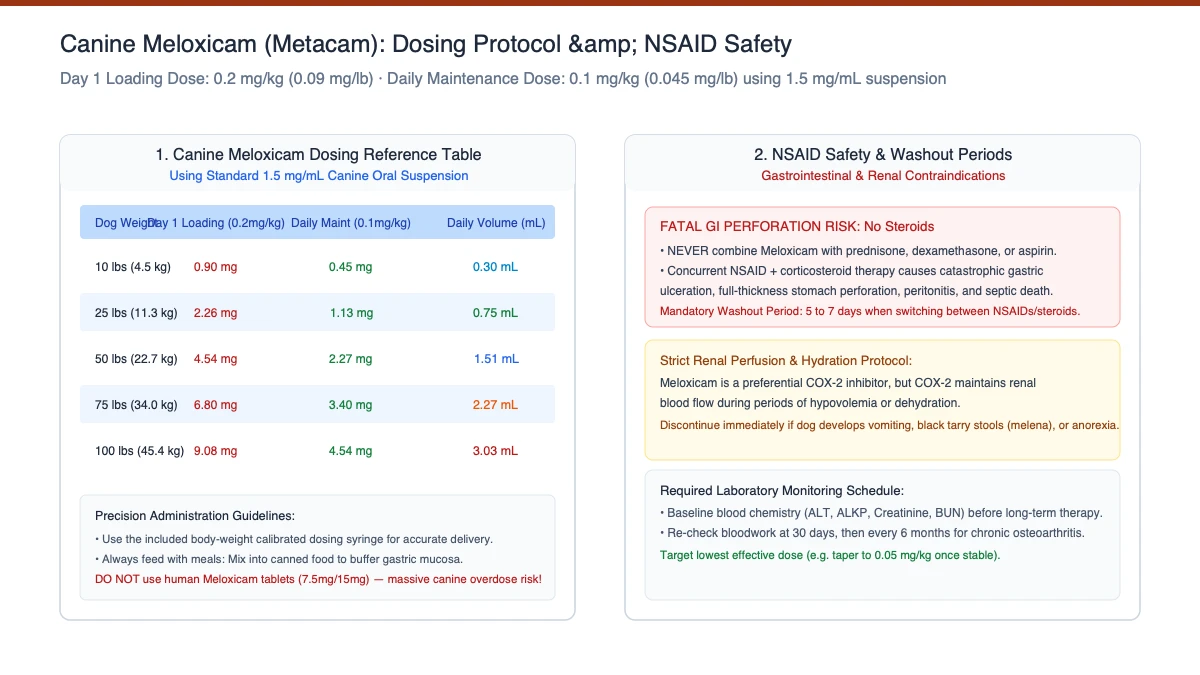
The approved canine regimen from the FDA label (METACAM NADA 141-213, MELoxidyl equivalent) is 0.2 mg/kg (0.09 mg/lb) orally once on day 1, then 0.1 mg/kg (0.045 mg/lb) once daily, with products available at 0.5 and 1.5 mg/mL and prescription-only status. The 0.05 mg/kg figure found in many search results is the feline maintenance dose - this calculator exposes it as an option only to flag it, not to endorse it.
For precise allometric metabolic scaling across divergent canine breeds, see our companion canine surface area (BSA) estimator.
| Symbol | Meaning | Unit | Typical range |
|---|---|---|---|
weight | current scale weight the regimen applies to | kg or lb | 1 to 60 |
regimen | rate selected: 0.2 on day one, 0.1 daily, 0.05 off-label | mg/kg | 0.05 to 0.2 |
conc | concentration printed on your own bottle | mg/mL | 0.5 or 1.5 |
volume | oral-syringe volume for a single dose | mL | 0.1 to 15 |
Metacam Dosage Calculator for Dogs: worked example
Worked example - 44 lb dog, 1.5 mg/mL bottle. 44 ÷ 2.20462 = 19.96 kg. Day 1 (loading): 19.96 × 0.2 = 3.99 mg, so 3.99 ÷ 1.5 = 2.66 mL once. Maintenance: 19.96 × 0.1 = 2.00 mg, so 2.00 ÷ 1.5 = 1.33 mL once daily. In a 0.5 mg/mL bottle the maintenance volume becomes 3.99 mL - the same milligrams, three times the liquid, which is exactly why the concentration field exists.
Example B: the same dose from a 0.5 mg/mL bottle
Example B: same milligrams, different bottle. Keep the 19.96 kg maintenance dose of 2.00 mg and switch the concentration to 0.5 mg/mL: the volume becomes 3.99 mL instead of 1.33 mL, three times the liquid for the same drug. Set the regimen to 0.05 while you are there and the page shows 1.00 mg, half the approved maintenance amount, flagged as the feline figure so a cat schedule is never mistaken for a dog one. Read the bottle label before every draw.
Formulation conversion
Meloxicam runs weight to milligrams, then milligrams to liquid, and both steps matter at home:
dose (mg) = rate (mg/kg) × weight (kg)
weight (kg) = weight (lb) ÷ 2.20462
volume (mL) = dose (mg) ÷ concentration (mg/mL)
The approved canine regimen from the FDA product label (METACAM NADA 141-213, and the equivalent MELoxidyl label) is 0.2 mg/kg, which is 0.09 mg/lb, once on day one, then 0.1 mg/kg, or 0.045 mg/lb, once daily. Products come at 0.5 and 1.5 mg/mL, and those two strengths turn the same milligrams into very different syringe readings.
The 0.05 mg/kg figure that search results pass around is the feline maintenance dose. The calculator lists it only so that it can be flagged, because a cat schedule applied to a dog delivers half the intended amount and teaches the wrong lesson about whether the drug works. Work one bottle through by hand: at 1.5 mg/mL a 2.00 mg dose is 1.33 mL, while a 0.5 mg/mL bottle needs 3.99 mL of exactly the same dose.
Contraindications and interactions
NSAIDs earn their caution list. Meloxicam can cause gastrointestinal ulceration and perforation, kidney toxicity including papillary necrosis, and liver damage, and the dogs most likely to run into trouble are those with suspected or confirmed kidney, liver or heart disease, those dehydrated or volume-depleted after fluid loss, and any dog with an active stomach ulcer.
Two combinations do the most damage at home. Stacking meloxicam with another NSAID, and meloxicam given alongside corticosteroids, are both common and serious overdose mechanisms rather than theoretical interactions, so every anti-inflammatory or steroid your dog already takes belongs in the conversation before the first dose. Use the lowest effective amount for the shortest time, and watch appetite, stool, thirst and urination throughout.
Breeding, pregnant and lactating dogs do not receive it. Older dogs tolerate the drug when monitoring is in place, but they are also the ones whose kidney values should be checked rather than assumed, which makes the pre-treatment bloodwork a conversation for the prescribing appointment rather than an optional extra.
Overdose signs and emergency action
The warning signs are specific enough to act on: vomiting, decreased appetite, dark or tarry stools, increased thirst or urination, yellowing of the gums or eyes, and lethargy that is new. Any of them means stop the drug and contact your veterinarian the same day, because NSAID adverse effects can escalate quickly rather than drift.
Accidental ingestion of a whole bottle is an emergency rather than a wait-and-see night, so keep the bottle capped and out of reach, and call your veterinarian or a poison-control line immediately if the cap is found chewed. An accidental double dose deserves the same call, with the bottle, the dog's weight and the time of the dose in hand.
Do not compensate by skipping days or alternating with another pain drug you have at home, and do not induce vomiting unless a veterinary professional tells you to. That decision belongs to the clinic, which can examine the dog and run bloodwork while the drug is on board. Resume only the schedule your veterinarian wrote down.
Never use if
Never start meloxicam without a prescription and a plan for monitoring. It is a veterinary drug with a narrow margin, and this calculator only converts numbers you have already been given rather than deciding whether the drug suits your dog.
Do not use it in a dog with suspected or documented kidney or liver disease, heart disease, dehydration or hypovolaemia, or active gastrointestinal ulceration. Do not combine it with another NSAID or with corticosteroids of any kind. Breeding, pregnant and lactating dogs stay off it, and a dog that has reacted to an NSAID before does not get a second trial.
Never give a dog formulation to a cat. Feline dosing and products differ, and dog-strength liquids have poisoned cats; the FDA boxed warning attached to feline meloxicam labels exists for exactly that reason. The same care runs in the other direction too, which is why 0.05 mg/kg carries a flag on this page instead of sitting quietly in the list.
What your metacam dosage calculator for dogs result means
The milligram row is the pharmacological dose; the millilitre row is what you actually draw up. Confusing bottle strengths is the most common home error with liquid NSAIDs - a 0.5 mg/mL bottle given at a 1.5 mg/mL volume delivers only a third of the intended dose, and the reverse delivers triple.
The loading-versus-maintenance distinction matters over days, not hours: day one reaches therapeutic levels faster, while 0.1 mg/kg daily keeps the COX-2 inhibition steady. Osteoarthritis benefit from meloxicam shows over one to two weeks of consistent dosing, so a 'didn't seem to help' verdict after two skipped days proves little.
How to read the output:| Result range | What it means | What to do next |
|---|---|---|
| 0.2 mg/kg | approved day-1 loading dose | Give once, then step down |
| 0.1 mg/kg | approved maintenance dose | The once-daily schedule that continues |
| 0.05 mg/kg | feline figure, off-label for dogs | Flagged so a cat schedule is not copied across |
| 1.5 vs 0.5 mg/mL | two bottle strengths | Read the label before every draw |
| Dark or tarry stool | a stop-and-call sign | Contact your veterinarian the same day |
Common mistakes with the metacam dosage calculator for dogs
- Copying 0.05 mg/kg from a search result: That is the feline maintenance rate; the canine label runs 0.2 mg/kg on day one and 0.1 mg/kg daily after it.
- Drawing from the wrong strength bottle: A 0.5 mg/mL bottle delivers three times the liquid of a 1.5 mg/mL bottle for identical milligrams, so confirm the label every time.
- Measuring tenths with a kitchen spoon: Use the graduated oral syringe that came with the bottle, because 1.3 mL and 4.0 mL look alike in a dim kitchen.
- Adding a second NSAID or a steroid: Combining meloxicam with another anti-inflammatory is a common and serious overdose mechanism; ask your veterinarian before any new medicine.
- Treating appetite loss as a minor effect: Vomiting, poor appetite, dark stools or new thirst are renal and gut warning signs: stop the drug and call immediately.
Limits of the metacam dosage calculator for dogs calculator
This tool provides a general estimate only. Always confirm dosing with your veterinarian before giving any medication.
Meloxicam can cause gastrointestinal ulceration and perforation, renal toxicity (including papillary necrosis), and hepatotoxicity. Do not use in dogs with suspected or documented renal, hepatic, or cardiac disease, hypovolaemia or dehydration, or active GI ulceration, and never together with other NSAIDs or corticosteroids - that combination is a common and serious overdose mechanism. Use the lowest effective dose for the shortest duration, and monitor appetite, stool, thirst, and urination throughout.
Do not use in breeding, pregnant, or lactating dogs. Never give dog meloxicam to a cat at dog concentrations - feline dosing and formulations are different and dogs' liquid strengths have poisoned cats. Keep the bottle capped and away from pets; accidental ingestion of a whole bottle is an emergency.
Clinical note from Dr. Chyrle Bonk, DVM: Meloxicam is our trusted first-line NSAID for canine osteoarthritis, surgical pain, and acute soft tissue trauma. However, patient safety requires strict adherence to body weight dosing and baseline organ assessment. We never prescribe meloxicam without prior serum chemistry screening for liver and kidney health, and we instruct owners to watch for gastrointestinal ulceration signs (vomiting, dark tarry stools, anorexia). Meloxicam must never be combined with corticosteroids like prednisone.
Sources
- FDA Freedom of Information summary and approved label for METACAM oral solution for dogs (used for: the approved 0.2 mg/kg day-one then 0.1 mg/kg daily regimen and the 0.5 and 1.5 mg/mL presentations)
- Merck Veterinary Manual, nonsteroidal anti-inflammatory drugs in animals (used for: NSAID contraindications covering ulceration, organ impairment and dehydration)
- FDA, boxed warning on meloxicam labels regarding safety risks in cats (used for: why dog and cat meloxicam products and schedules must never be swapped)
Cite This Calculator
For laboratory course reports, academic papers, or institutional protocols (APA format):
Metacam Dosage Calculator for Dogs: frequently asked questions
What is the normal Metacam dose for dogs?
The approved schedule is 0.2 mg/kg orally on day 1, then 0.1 mg/kg once daily thereafter, from the FDA canine label (0.09 mg/lb then 0.045 mg/lb). Use the calculator for your dog's exact mL figure - and only on your vet's prescription.
Why is the first dose higher?
Meloxicam accumulates with repeated dosing; the 0.2 mg/kg day-1 loading dose reaches therapeutic levels faster, after which 0.1 mg/kg maintains them. If the loading dose was missed, simply continue with the maintenance dose as directed.
How much is 0.1 mg/kg in mL?
It depends on the bottle: a 19.96 kg dog needs 2.00 mg, which is 1.33 mL of a 1.5 mg/mL solution or 3.99 mL of a 0.5 mg/mL suspension. Always match the concentration field to the label on your own bottle.
What are the warning signs to watch for?
Vomiting, decreased appetite, dark or tarry stools, increased thirst or urination, yellowing of the gums or eyes, or lethargy. Stop the medication and contact your veterinarian immediately if any appear - NSAID adverse effects can escalate quickly.
Found a number that does not match its source? Report a mistake. Corrections are published in place and the page date is updated.
The dose is straight from the FDA-approved canine label (0.2 mg/kg on day one, then 0.1 mg/kg daily), and the calculator calls out 0.05 mg/kg as the feline figure, because that mix-up turns up more often than it should.…

Dr. Chyrle Bonk, DVM: Veterinary Editor
Chyrle is a mixed-animal veterinarian in rural Idaho who has practised since 2010, with a particular emphasis on food-animal medicine and cattle alongside her companion-animal caseload. She reviews the…