Guide · Genetics
Dominant vs Recessive Traits: A Quick Reference
Mendelian trait expression analysis differentiates dominant alleles (which produce phenotypic effects in heterozygous states) from recessive alleles (which require homozygous configurations for expression). Understanding molecular protein dosage mechanisms clarifies why recessive conditions can remain phenotypically silent across multiple carrier generations.
Key takeaways
- Dominant means one copy shows the trait; recessive needs two copies to appear at all.
- The labels describe heterozygotes only: not strength, health, age or prevalence.
- Huntington's is dominant yet rare, while recessive cystic fibrosis affects more people.
- Two carriers of a recessive condition face a 25 percent affected pregnancy every time.
Interactive Calculator: Solve monohybrid and dihybrid cross ratios step-by-step with our interactive Punnett square calculator.
What the words really mean
Dominance is a statement about heterozygotes. An allele is called dominant when one copy of it is enough to produce the phenotype: the heterozygote looks like the homozygote carrying two copies. An allele is called recessive when its phenotype appears only with two copies, because one working copy already covers the job. Nothing in these definitions says dominant alleles are stronger, healthier, newer, or more frequent. They are labels for what happens in the middle of the genotype range, and they describe allele pairs within one gene, never one gene against another. Notation follows the same logic: a capital letter for the dominant allele, lowercase for the recessive one, so a heterozygote reads as one of each (Bb), and the phenotype question becomes a question about which symbol the individual carries twice.
Learn how chromosomal proximity alters Mendelian transmission ratios and calculate map units with our recombination frequency and linkage calculator.
The carrier arithmetic behind a recessive trait
Recessive conditions are the reason carrier math exists. Cystic fibrosis illustrates the numbers cleanly: population-based carrier screening data put its prevalence at 1 in 2,500 to 3,500 live births and its carrier frequency at about 1 in 25 people of Northern European ancestry (Ioannou and colleagues, Genetics in Medicine, 2014). Those two figures are the same fact seen from two sides. If disease prevalence is roughly 1 in 2,500, the recessive allele frequency is about 0.02, and twice that times its complement gives a carrier frequency near 0.04: one in twenty-five, exactly what screening programs measure.
Two carriers who conceive: each pregnancy carries a 25 percent affected risk, a 50 percent carrier risk, and a 25 percent chance of a non-carrier child. The recessive disease is uncommon in the population yet common in the carriers hiding inside it, which is precisely why carrier screening works and why recessive alleles can be far more frequent than the conditions they cause.
Codominance: both alleles get a say
Not every pair resolves to one visible allele. In the ABO blood group, the A and B alleles are codominant with each other and both dominant over O: the gene's OMIM entry (ABO, #110300) files it as the textbook example. A person genotype IA IB expresses both antigens; IA IO expresses A only; only IO IO expresses neither, giving type O. Run the cross IA IO × IB IO through a square and four genotypes appear in equal shares (IA IB, IA IO, IB IO, and IO IO), so two type A and type B parents can have a type O child without anything mysterious happening:
| IA | IO | |
|---|---|---|
| IB | IA IB | IB IO |
| IO | IA IO | IO IO |
Why dominant does not mean common
The commonest misconception in Mendelian genetics inverts the labels. Huntington's disease is autosomal dominant (one copy is enough), yet updated meta-analysis puts its pooled prevalence at 4.88 per 100,000 people with an incidence near 0.48 per 100,000 person-years (Medina and colleagues, Movement Disorders, 2022). Cystic fibrosis is recessive and, at roughly 1 case per 2,500 to 3,500 births, several times more common per person. Frequency follows mutation rates, drift, and selection across generations; dominance follows biochemistry within one cell. The two words never predicted each other.
Where the two-label shorthand breaks
Plenty of traits refuse the binary. In incomplete dominance the heterozygote sits between the two homozygotes instead of matching one; in codominance, as with ABO, both alleles register; and polygenic traits such as eye color spread across many loci, where a single dominant-recessive story covers only the largest effect: the HERC2/OCA2 variant that separates blue from brown, while other loci tilt the shade. The practical rule: dominance is a fact about one locus, a phenotype, and a contrast. The moment your question involves two genes, a population, or a continuum of appearance, you need a bigger model: a Punnett square for crosses, allele frequencies for populations, and honest uncertainty for blends. The shorthand still earns its place in classrooms. It just stops at the door of every question it was never built to answer, which is most of the interesting ones.
The molecular reason one copy is enough
The recessive definition already contains the mechanism: one working copy does the job. A gene's product is made in amounts, and a single intact allele usually supplies enough of it for the process to run normally, so nothing shows until both copies fail together. The dominant allele is simply the one whose single copy keeps the process above the point where the trait appears. Dominance describes that middle position in the genotype range; it says nothing about how hard the allele works or what it costs the person carrying it.
Two consequences follow. Carriers stay healthy because their working copy carries the full load, which is how a recessive disease stays uncommon in births while its allele remains common in the pool, hidden inside unaffected people for generations. And because the explanation runs through product rather than power, the label predicts nothing about how frequent, how old or how healthy an allele is: those are questions for the counts and the biology, not for the shorthand.
Two transmission patterns, side by side
The same square produces different family arithmetic depending on which label applies. A dominant condition is usually carried by a heterozygous parent who shows the trait, and each pregnancy receives that allele with 50 percent probability: one affected child in two, from one parent, with nothing required of the other. A recessive condition needs both parents to contribute a copy, so the affected child appears at 25 percent while the 50 percent carrier share and the 25 percent non-carrier share fill out the rest of the row.
Read the contrast as a question to ask first: which parent must carry what. For a dominant trait the visible phenotype runs through the family and each conception is a coin flip; for a recessive one, the question is who could be silently holding a copy, which is exactly the logic that makes carrier screening worth running on people who feel perfectly well. The arithmetic is identical in both cases, because a square is a square, and what changes is where the unknown sits.
Worked example: Dominant vs Recessive Traits: A Quick Reference
Two cystic fibrosis carriers, both perfectly healthy because one working copy does the job, run the same square at every conception: one box in four is affected, two are carriers, one is neither, so 25, 50 and 25 percent per pregnancy. The dominance labels explain only why neither parent shows a symptom while each passes the recessive copy to half their children; they change none of the odds. Run this cross in the calculator →
When traits involve codominant and recessive alleles simultaneously (such as ABO blood types), compute population equilibrium using our tri-allelic Hardy-Weinberg genetic model.
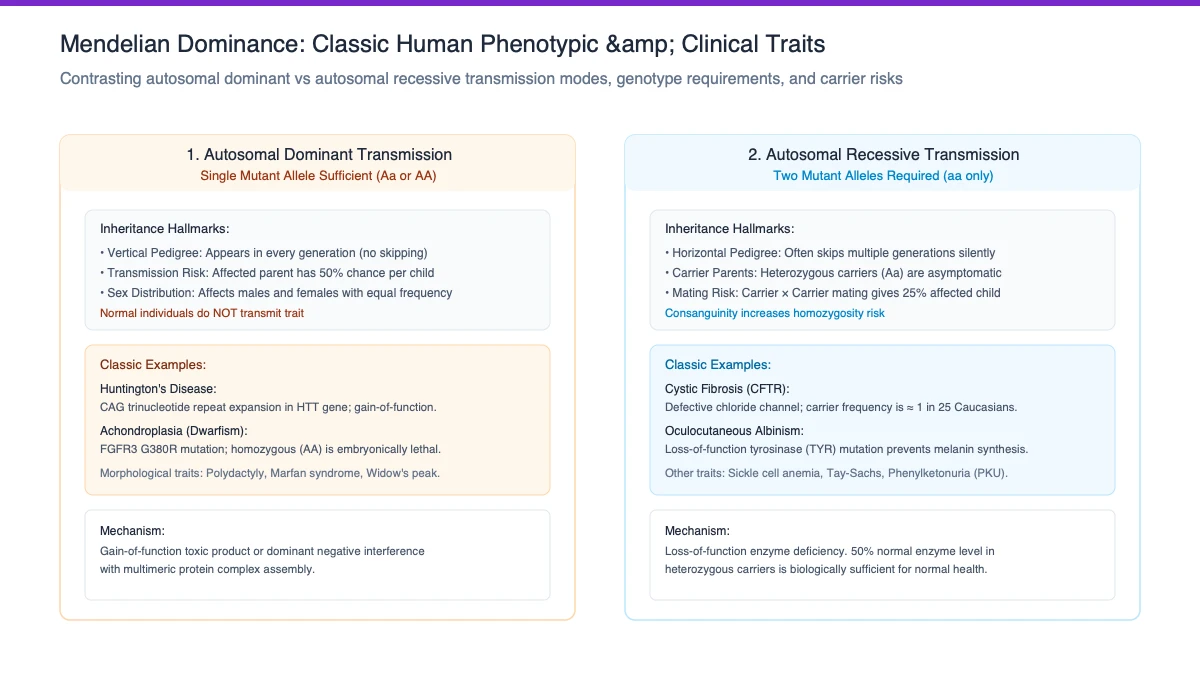
Common mistakes: Dominant vs Recessive Traits
- Reading dominant as common or strong, since the labels only describe how an allele behaves in a heterozygote, so check frequencies separately before claiming anything about prevalence.
- Expecting an affected parent to pass a dominant trait to every child, when the parent is usually heterozygous and the allele arrives with 50 percent probability per pregnancy.
- Applying one gene's labels to another gene or to a whole person, because dominance is a statement about one locus, one phenotype and one contrast at a time.
- Stopping at dominant and recessive for eye color or blood type, where codominance, incomplete dominance and blends across many loci each need their own model.
- Concluding that a recessive condition and its carriers are equally rare, when cystic fibrosis sits at 1 in 2,500 to 3,500 births against about 1 in 25 carriers.
Put it to work: Dominant vs Recessive Traits: A Quick Reference
The calculators below apply exactly what this guide explains: same formula, no mental arithmetic.
Dominant vs Recessive Traits: A Quick Reference: frequently asked questions
If a trait is dominant, does one affected parent guarantee affected children?
No. A dominant-trait carrier is usually heterozygous, and each pregnancy gets that allele with 50 percent probability, so an affected parent and an unaffected non-carrier partner expect one affected child in two, not all of them.
Is blood type O recessive?
Yes, as a phenotype. Type O people carry two copies of the IO allele; A and B express over it, so IO only shows when inherited from both parents.
Are blue eyes recessive to brown eyes?
At the main HERC2/OCA2 variant that separates blue from brown, yes (in the single-locus model). Eye color overall is polygenic, so the label is a useful simplification rather than the whole story.
Why do genetics problems always use letters?
Letters keep genotypes readable: one capital for the dominant allele, one lowercase for the recessive one, each gene its own letter. The letters are notation, not biology: the biology is which allele makes enough product to show.
Sources & further reading
Found a number that does not match its source? Report a mistake. Corrections are published in place and the page date is updated.

Dr. Dinesh A. Nagegowda, PhD: Plant & Molecular Biology Editor
Dinesh is a plant molecular biologist and Chief Scientist at CSIR-CIMAP whose research runs through functional genomics, transcriptomics, metabolomics, and biosynthetic pathways in plants. He writes and…