Free Gardening & Crops tool
 Free Gardening & Crops tool
Water Soluble Fertilizer Calculator
The Water Soluble Fertilizer Calculator determines fertilizer ounces per gallon and injector stock tank dilution ratios needed to achieve target nutrient PPM. Label rates for water-soluble fertilizers arrive in grams per gallon or ounces per gallon, while hydroponic recipes are written in parts per million and reservoir doses in grams. Enter the label rate and the bag's analysis to get ppm, N-P-K delivered per litre, the dose for your tank, and a liquid measure for stock solutions.
Water Soluble Fertilizer Calculator: result
Conversions: 1 ppm = 1 mg/L; 1 US gal = 3.78541 L, so 1 g/gal = 264.2 ppm and 1 oz/gal = 7,488 ppm. Elemental conversions: N = ppm × N%, P = ppm × P2O5% × 0.43, K = ppm × K2O% × 0.83.
At a glance
- What it does: Label rates in grams or ounces per gallon become ppm, N-P-K per litre and a tank dose.
- Who it is for: For hydroponic feeds, reservoir mixes and liquid fertilizer dosing from the bag analysis.
- Typical result: 2 g/gal of 20-10-20 is 528.3 ppm, 52.8 g into 100 L, and 105.7 mg/L of nitrogen.
How to use the water soluble fertilizer calculator
- Find the dose rate on the bag - grams per gallon, grams per litre, or ounces per gallon. prefill →
- Enter the N-P-K exactly as printed, in order, with dashes between the three numbers. prefill →
- Set your reservoir or watering-can volume in litres to get the dose for that tank.
- Take the N, P and K lines as what the plants actually receive - label numbers are oxide forms.
- For stock solutions, use the mL-per-litre line with your solution's density.
Water Soluble Fertilizer: the formula & its source
Label rates convert to parts per million through the US gallon, then split into elements by the guaranteed analysis:
mg/L = g per gal × 1,000 ÷ 3.78541 (= × 264.17)
1 oz/gal = 7,488 ppm · 1 g/L = 1,000 ppm
N = ppm × N% ÷ 100
P = ppm × P2O5% ÷ 100 × 0.43 · K = ppm × K2O% ÷ 100 × 0.83
dose (g) = g/L × reservoir L · mL/L = (g/L) ÷ density
The 0.43 and 0.83 factors convert phosphate and potash to the elemental phosphorus and potassium the plant actually takes up.
| Symbol | Meaning | Unit | Typical range |
|---|---|---|---|
R | rate exactly as printed on the bag | g/gal, g/L or oz/gal | 0.1–10 g/gal typical |
N-P-K | guaranteed analysis from the label | % | three numbers, e.g. 20-10-20 |
V | reservoir or watering-can volume | L | 1–5,000 L |
ρ | density when measuring a liquid | g/mL | 1.0 water, 1.1–1.3 stock |
f | oxide to element conversion factor | ratio | 0.43 for P, 0.83 for K |
Water Soluble Fertilizer: worked example
Worked example - 2 g/gal of 20-10-20 into a 100 L reservoir. Concentration = 2 × 1,000 ÷ 3.78541 = 528.3 mg/L (ppm) = 0.528 g/L. Elements: N = 528.3 × 0.20 = 105.7 mg/L; P = 528.3 × 0.10 × 0.43 = 22.7 mg/L; K = 528.3 × 0.20 × 0.83 = 87.7 mg/L. Dose = 0.528 × 100 = 52.8 g for the tank, or at 1.0 g/mL density, 0.528 mL/L as a liquid.
Example B: 1.5 g/L of 15-5-25 into a 200 L reservoir
Grams per litre skip the gallon step: 1.5 g/L is 1,500 ppm directly. Split by the analysis, that is 225.0 mg/L nitrogen, 32.3 mg/L phosphorus from the 5% phosphate times 0.43, and 311.3 mg/L potassium from 25% potash times 0.83. The 200 L reservoir takes 300.0 g, and measured as a liquid at 1.05 g/mL the same dose is 1.429 mL/L. Check conductivity after mixing.
Two languages for one bag
Fertilizer bags speak in grams per gallon or ounces per gallon because that is how the label has always read, while hydroponic recipes speak in parts per million because that is how dosing pumps and tissue tests are calibrated. One part per million is one milligram per litre, and a US gallon is 3.78541 litres, so a gram per gallon becomes 264.17 ppm and an ounce per gallon becomes 7,488 ppm.
The concentration line performs that crossing and prints both forms together, which is what makes a handwritten label rate comparable with a recipe from a supplier in another unit system. Grams per litre need no gallon at all: one gram per litre is already a thousand milligrams per litre, so that basis arrives as ppm directly and the second example leans on it.
The third basis, grams per litre, exists for the growing number of suppliers who dial their rates straight in metric. Selecting it skips the gallon entirely, and the worked example below uses it to show the same element split arriving through the shorter path.
The analysis is oxide forms, not elements
The three numbers on the bag are guaranteed percentages of nitrogen, phosphate expressed as P₂O₅, and potash expressed as K₂O. Plants never absorb an oxide; they take elemental phosphorus and potassium, and the conversion factors of 0.43 and 0.83 perform that translation. A 20-10-20 bag therefore delivers 105.7 mg/L of nitrogen, 22.7 of phosphorus and 87.7 of potassium at the worked concentration, not equal thirds of anything.
This matters whenever numbers are compared across sources. Tissue analysis and most published recipes are written in elemental units, while bag labels are written in oxide units, and reading one as the other roughly doubles the apparent phosphorus. The N, P and K lines here are already elemental, so they can be lined up against a crop target without a second conversion.
The dose line is what you weigh
Concentration describes the water; dose describes the work. Grams per litre multiplied by the reservoir volume gives the number that goes on the scale, and in the first example that is 52.8 g for a hundred-litre tank. It is also the line that separates growers who dose from the calculation from growers who dose by the scoop, and the scoop is the one that drifts.
Drift is rarely a measurement error. Evaporation between feeds concentrates what remains, a hot week raises uptake on some crops and not others, and a tank topped up with fresh water never quite matches the strength it started at. Re-run the calculation against the volume actually left, check electrical conductivity after mixing, and the dose line stays a control rather than a formality.
Stock solutions, density and the liquid line
Many systems dose liquids rather than powders, and the liquid measure line converts grams per litre into millilitres per litre using the density you supply. For water at 1.0 g/mL the two numbers are identical, which is why the first example reads 0.528 mL/L. A sugar-heavy or salt-heavy stock solution is denser, so the same mass occupies less volume and the density input keeps the pour honest.
Stock solutions also carry a handling rule that no arithmetic can enforce: never mix concentrates into one another before diluting. A calcium stock meeting phosphate or sulfate precipitates on contact, and the white flakes that form are nutrients the plants will never see. Dose each stock into the reservoir separately, with the pumps or stirring running, and the solution stays clear.
What a single-rate calculation leaves out
This is one rate mixed at one time, and a growing system is neither. Tap water arrives carrying calcium, magnesium and alkalinity that already occupy part of the target, growing media release nutrients of their own for the first weeks, and unused salts accumulate between feeds as plants drink water faster than they drink fertilizer. The label rate is therefore a starting floor rather than a finished recipe.
pH sits outside the arithmetic entirely, yet it decides whether the elements printed on the bag remain available once dissolved. Treat the outputs here as the mixing step of a loop that also includes a water test, a conductivity reading and a pH check, and the numbers stay tied to what the crop is actually receiving instead of what the bag promised.
Every one of those omissions is measurable, and none of them change the arithmetic shown here. The mixing step still has to be right first, because a dose calculated correctly against a reservoir you never measured is wrong by exactly the volume you guessed.
What your water soluble fertilizer result means
ppm is the language of hydroponic recipes and tissue balance; grams per gallon is the language of the bag. This calculator is the translation between them, and the N-P-K lines are the part most recipes get wrong - label percentages are oxide forms, not elements.
The reservoir dose is what you actually weigh out. Dosing by the scoop rather than by this line is how a 20-10-20 tank drifts into salt burn during a hot week when evaporation has already concentrated it.
How to read the output:| Result range | What it means | What to do next |
|---|---|---|
| 528.3 ppm | 2 g/gal restated as mg/L | the language hydroponic recipes speak |
| 105.7 mg/L | nitrogen delivered at 20% | compare it against the crop's N target |
| 52.8 g | dose for the 100 L reservoir | what goes on the scale, not the scoop |
| 0.528 mL/L | liquid measure at 1.0 g/mL | for stock solutions instead of powder |
| 7,488 ppm | the ounce-per-gallon convention | label rates written in oz/gal land here |
Prevent nutrient leaching in high-frequency fertigation systems by reading our cation retention and fertilizer leaching guide.
Common mistakes with the water soluble fertilizer
- Reading P and K as elemental from the label: The middle and third numbers are oxide forms; multiply by 0.43 and 0.83 or phosphorus and potassium appear roughly doubled against what the plant takes up.
- Dosing by scoop after a hot week: Evaporation concentrates the reservoir between feeds, so re-calculate from the volume actually left and check conductivity before adding a full label dose.
- Mixing concentrates before diluting: Calcium stock meeting phosphate or sulfate precipitates on contact, so dose each into the reservoir separately with stirring and never pour one stock into another.
- Ignoring what the tap water already carries: Municipal water contributes calcium, magnesium and alkalinity, so treat the label rate as a floor and trim it once a water test shows the baseline.
Limits of the water soluble fertilizer calculator
This mixes one rate at one time. It does not account for the nutrients already present in tap water or growing media, crop-specific recipes, pH drift, or the accumulation of unused salts between feeds.
Never mix concentrated stock solutions together before diluting - calcium and phosphate or sulfate will precipitate. Dose into the reservoir with stirring, and check EC afterwards.
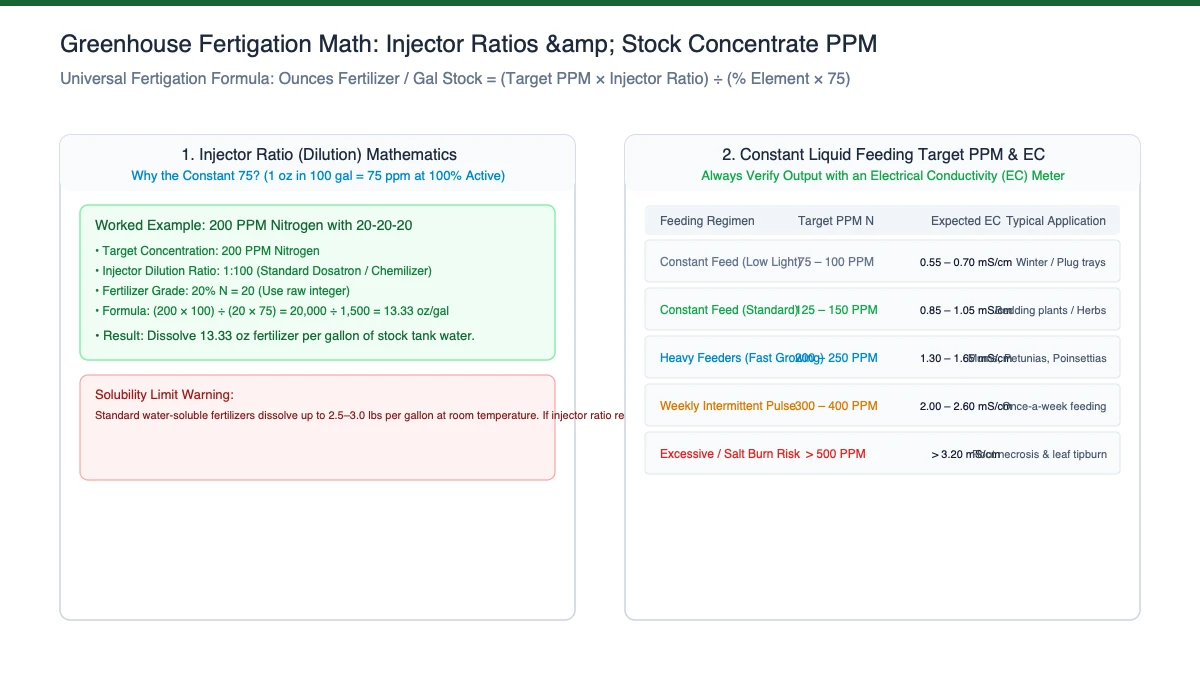
Agronomy note from Dr. Dinesh A. Nagegowda, PhD: Mixing water-soluble greenhouse fertilizers using proportioner injectors (e.g., 1:100 injector ratio) requires calculating concentrated stock tank recipes based on target parts per million (ppm) of elemental nitrogen. In our greenhouse research, verifying electrical conductivity (EC) of the emitter solution with a calibrated EC meter confirms that injector proportioners are operating accurately before fertigating sensitive plugs.
Calculate soil media volume for container nursery crops receiving liquid feeding with our soilless potting mix volume calculator.
Sources
- Penn State Extension, Hydroponics Systems: Calculating Nutrient Solution Concentrations Using the Two Basic Equations (used for: the ppm conversion from label rate through the US gallon behind the concentration line)
- University of New Hampshire Extension, mixing water-soluble fertilizer calculators (used for: grams-per-gallon and ounces-per-gallon label conventions the rate selector accepts)
- Penn State Extension, Soil Test Results: What's Next (guide for homeowners) (used for: reading the guaranteed analysis and matching a soluble rate to what the media already supplies)
Cite This Calculator
For laboratory course reports, academic papers, or institutional protocols (APA format):
Water Soluble Fertilizer: frequently asked questions
How do I convert grams per gallon to ppm?
Multiply by 264.17: 2 g/gal is 528.3 ppm, because 1 US gal = 3.78541 L and 1 ppm = 1 mg/L.
What does 20-10-20 mean on a soluble fertilizer?
20% nitrogen, 10% phosphate (P2O5) and 20% potash (K2O) by weight - converted to elements that is 20% N, 4.3% P and 16.6% K.
How much fertilizer do I add to a 100 L reservoir?
Whatever the label rate converts to: 2 g/gal works out to 0.528 g/L, so 52.8 g for 100 L.
How do I dose a liquid fertilizer instead of a powder?
Divide the grams per litre by the solution's density: at 1.0 g/mL that is the same number in millilitres - 0.528 mL/L here.
Found a number that does not match its source? Report a mistake. Corrections are published in place and the page date is updated.
Found a number on this page that doesn’t match its source? Email the correction →.

Dr. Dinesh A. Nagegowda, PhD: Plant & Molecular Biology Editor
Dinesh is a plant molecular biologist and Chief Scientist at CSIR-CIMAP whose research runs through functional genomics, transcriptomics, metabolomics, and biosynthetic pathways in plants. He writes and…