Free Gardening & Crops tool
 Free Gardening & Crops tool
Grass Seed Calculator
The Grass Seed Calculator determines required grass seed weight (pounds) for new lawn establishment and overseeding from square footage and turfgrass species. Seed is sold in pounds but recommended per thousand square feet, and most thin lawns come from seeding at half the rate, or twice it. Enter the lawn's dimensions, pick the grass and whether this is a new stand or an overseed, and get pounds of seed, an exact pound-and-ounce figure, and the bags to buy.
Grass Seed Calculator: result
Seed-to-soil contact decides germination: rake or roll after sowing, keep the top inch damp for two to three weeks, and never let a fresh seeding dry out. Slightly under the top of the rate range beats doubling it. Crowded seedlings disease out and thin later anyway. Check the bag’s own label rate too: it overrides everything if it differs.
At a glance
- What it does: Turns lawn dimensions and a grass type into pounds of seed, an exact pound-and-ounce figure and the bags to buy.
- Who it is for: Covers new lawns at full rate and overseeding at about half, with a custom rate for blends and coated seed.
- Typical result: Runs the sowing rate backwards so you can see which university table each answer came from.
How to use the grass seed calculator
- Measure the lawn in feet: for an irregular yard, break it into rectangles and add the areas. prefill →
- Pick the grass type: rates come from university establishment tables and apply to pure stands, not blends. prefill →
- Choose new lawn or overseeding. Overseed runs at about half the full rate because existing turf occupies part of the space.
- Read the pound-and-ounce figure for small jobs, or the bag count for a store run.
- Split the total across two passes in perpendicular directions for even coverage, and keep the seedbed damp until it germinates.
Grass Seed: the formula & its source
Seeding rates are quoted per thousand square feet, so scale the area first:
pounds = area (ft²) ÷ 1,000 × rate (lb/1,000 ft²)
Overseeding halves the rate because established turf already occupies part of the growing space:
overseed pounds = full-rate pounds ÷ 2
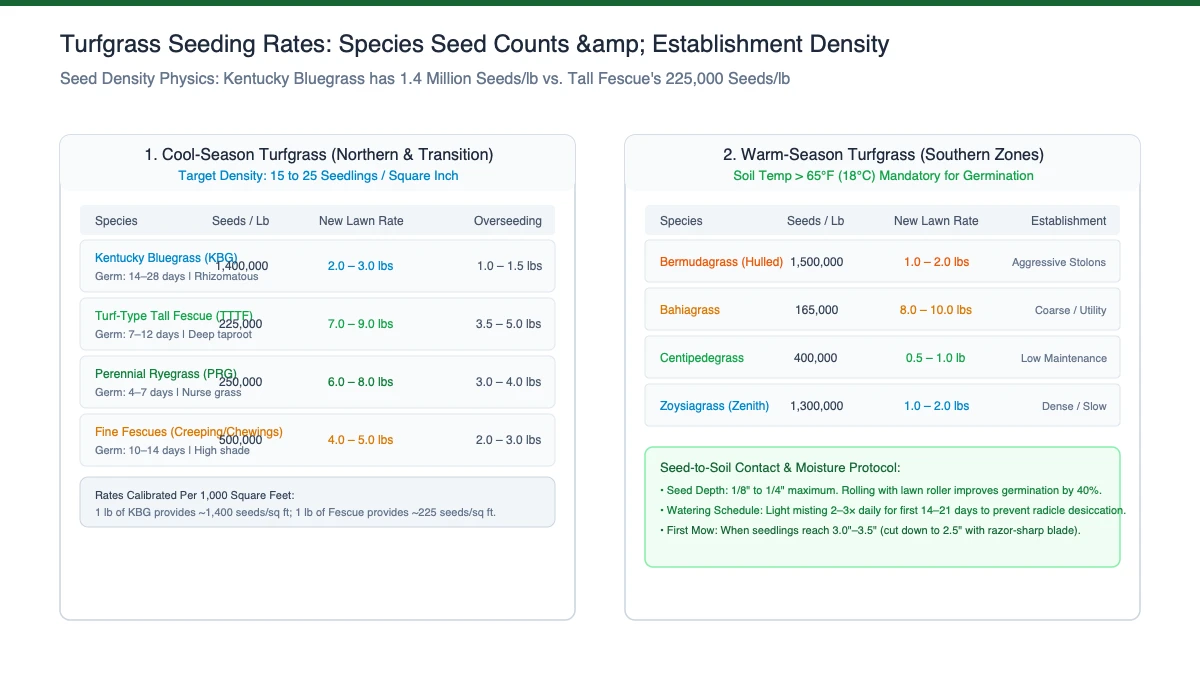
Typical extension rates: tall fescue 5–8 lb/1,000 ft² for a new lawn (3–4 overseeded), Kentucky bluegrass 1½–2, perennial ryegrass 4–6, hulled bermudagrass 1–2.
| Symbol | Meaning | Unit | Typical range |
|---|---|---|---|
len × wid | lawn length and width in feet | ft | 0.1–500 each |
area | length times width, in thousands of square feet | ft² | up to 250,000 |
type | selects the establishment rate table | option | fescue, kbg, rye, bermuda |
rate | pounds of seed per thousand square feet | lb/1,000 ft² | 0.1–20 |
mode | full rate or about half for overseeding | option | new, over |
bag | bag size for the store run | lb | 0 to skip bag math |
Grass Seed: worked example
Worked example: 50 × 50 ft lawn (2,500 ft²), tall fescue, new lawn, 10 lb bags. Rate 6.5 lb/1,000 ft² → 2,500 ÷ 1,000 × 6.5 = 16.25 lb (16 lb 4 oz). Bags: ⌈16.25 ÷ 10⌉ = 2 bags. Overseeding the same lawn instead: 16.25 ÷ 2 = 8.13 lb (8 lb 2 oz). Split each figure across two perpendicular passes for coverage that does not streak.
Example B: overseed on a custom rate
Example B: small overseed, custom rate. A 25 by 30 foot strip is 750 ft². At a custom 6.5 lb/1,000 ft² the full rate is 750 ÷ 1,000 × 6.5 = 4.875 lb, and overseeding halves that to 2.44 lb, written as 2 lb 7 oz for a job too small to weigh by the pound. With 3 lb bags the count is ⌈2.44 ÷ 3⌉ = 1 bag. The half applies before the bag math, not after, so buying on the un-halved figure leaves you a bag short of plan and a lawn over-seeded.
Where the rate comes from
Seeding recommendations are quoted per thousand square feet because that is the scale at which extension tables are written and at which seed is practically spread: rates under a pound per hundred square feet are impossible to distribute evenly by hand, and per-acre figures are beyond a homeowner's arithmetic. The tables themselves come from university establishment trials that sowed plots at several rates and measured how fast each reached a closed stand. What separates the grasses is mostly seed size and count, not opinion. Kentucky bluegrass is a small seed rated at 1½ to 2 pounds per thousand, tall fescue is coarse and runs 5 to 8 for a new lawn, perennial ryegrass sits around 4 to 6, and hulled bermudagrass needs only 1 to 2 because its seed is tiny and it spreads by runners once established. Trial plots also control for seed lot and season, which is why two universities can publish slightly different numbers for the same grass without either being wrong; stay inside the range and pick the middle when you have no local figure to follow.
Why overseeding runs at half
An established lawn already occupies most of the growing space, so seed sown into it competes for light, water and root room with plants that are years ahead. The half-rate convention reflects that reality: the new seedlings only need to fill the gaps the existing turf leaves, and broadcasting a full new-lawn rate among living grass wastes the excess as germination that thins out again by the following year. Most thin lawns come from seeding at half the recommended rate or at twice it, and the failure looks identical from the sidewalk either way. The thin lawn fills slowly with weeds holding the gaps; the crowded lawn germinates thickly, then dams off and collapses in patches. Follow the table, halve it for overseeding, and resist the urge to be generous. Rate also interacts with thinning and timing: a lawn that was power-raked or aerated before seeding has fresh gaps to fill and tolerates the upper end of the range, while seed scattered into thick, unopened turf should stay near the lower edge.
Bags, ounces and split passes
Seed is sold in bags of 5, 10 or 50 pounds while small jobs are measured in ounces, so the answer needs both faces. The pound-and-ounce figure tells you what to put in the spreader for a 750 square foot strip; the bag count tells you what to buy, rounded up because the store does not sell partial bags. Bag math belongs at the end of the calculation, after any overseeding halving, or you will price the wrong quantity. Distribution matters as much as the total: split the calculated amount across two passes in perpendicular directions, because a single pass at the full rate streaks and leaves the lawn visibly striped once it germinates. Set the spreader low, walk steadily, and check the coverage pattern on a hard surface before starting on the lawn itself. Calibrate the spreader before you start by spreading half the calculated amount over half the area and checking the coverage, then adjust the opening rather than discovering a bare strip after the seed is gone.
What the number assumes
The rates describe a pure stand of the named grass, and real seed is often a blend, which changes both the mixture and the physical volume in the bag. Coated and pelletized seed is the trap: the coating adds weight without adding seed, so the bag's own label rate, not a bare-seed table, is the legal and practical recommendation whenever the two differ. Nothing in the math compensates for preparation either. Seed scattered onto hard, dry, unworked soil or left to bake between waterings will fail at any rate, so seedbed contact and moisture through germination decide the outcome before the numbers do. Timing follows climate as well: cool-season grasses establish best in early fall, while bermudagrass wants late spring into summer, and a perfect rate in the wrong window still produces a poor stand. The output is a plan for the area you measured, so recheck it if the lawn changes: new beds, a patio or a fence line all alter the square footage, and last year's figure quietly over-seeds the smaller lawn you have now.
What your grass seed result means
The rate is a compromise between speed and health: seed too light and the lawn fills in slowly with weeds holding the gaps; seed too heavy and the seedlings crowd each other, damp off, and thin out the following year anyway. University rates are set at the point where establishment is quick without inviting disease.
Overshooting is the most common homeowner error because the bag looks affordable. But the extra seed is wasted germination, not extra lawn.
How to read the output:| Result range | What it means | What to do next |
|---|---|---|
| inside the type's range | rate matches the extension table | buy with confidence and split the passes |
| double the table | seedlings will crowd and damp off | halve the rate; thin stands still fill in |
| half the table | lawn fills slowly, weeds hold gaps | raise toward the table's midpoint |
| custom rate | blend, coated seed or special case | check the bag label before overriding |
Calculate starter phosphorus and nitrogen ratios for new turfgrass establishment on our turf starter fertilizer calculator.
Common mistakes with the grass seed
- Seeding at the full rate to overseed: Established turf already occupies part of the space, so halve the table rate; crowding invites disease and the extra seed is simply wasted germination.
- Reading coated seed like bare seed: Pelletized and coated seed weighs more per viable seed, so follow the bag's own label rate instead of the bare-seed table it does not match.
- Ordering from one edge measurement: Break an irregular yard into rectangles and add the areas, because a single length and width guessed across an L-shaped lawn skews every figure downstream.
- Sowing into a dry, unworked seedbed: No rate compensates for poor seed-to-soil contact or drying between waterings, so rake, sow thinly, and keep the bed damp until germination starts.
Limits of the grass seed calculator
Rates assume a pure stand of the named grass; blends and coatings (especially pelletized seed) change the physical volume in the bag, so read the label. Poor seed-to-soil contact, drying between waterings, or sowing into scorching weather will fail regardless of rate. These are establishment figures for lawns. Golf and pasture seeding use different targets, and the bag's own label rate is the legal recommendation wherever it differs.
Agronomy note from Dr. Dinesh A. Nagegowda, PhD: Turfgrass seeding rates vary dramatically between species based on seed count per pound. Fine-seeded Kentucky bluegrass contains roughly 2,000,000 seeds per pound, requiring only 2 to 3 lbs per 1,000 sq ft, whereas coarse-seeded Tall Fescue contains roughly 225,000 seeds per pound, requiring 8 to 10 lbs per 1,000 sq ft. Seeding too heavily causes excessive seedling competition and damping-off disease.
Determine topsoil cubic yard volumes for lawn leveling and aeration with our lawn topsoil dressing calculator.
Sources
- University of Georgia Extension: 2024 Bermudagrass Production Calendar (used for: hulled bermudagrass seed at 1–2 lb per 1,000 ft² and its warm-season establishment window)
- University of Tennessee Institute of Agriculture W160-B: turf establishment table (used for: Kentucky bluegrass at 1½–2 lb and perennial ryegrass at 4–6 lb per 1,000 ft²)
- North Carolina State Extension TurfFiles: Seeding Cool-Season Grasses in NC (used for: tall fescue establishment and overseeding rates for cool-season lawns)
Cite This Calculator
For laboratory course reports, academic papers, or institutional protocols (APA format):
Grass Seed: frequently asked questions
How much seed do I need for 2,500 square feet?
Tall fescue at 6.5 lb/1,000 ft²: 16.25 lb for a new lawn, about 8 lb to overseed. Bluegrass needs far less, around 4.4 lb for the same area new.
How much seed per 1,000 ft² for bermudagrass?
Hulled bermudagrass runs 1–2 lb per 1,000 ft² (University of Georgia); unhulled seed is often rated higher. It spreads aggressively, so light seeding fills in fast.
Can I overseed at the full new-lawn rate?
Not recommended: existing turf plus a full rate over-crowds the stand, inviting disease and wasted seed. Overseed at about half rate.
When is the best time to seed?
Cool-season grasses (fescue, bluegrass, ryegrass) establish best in early fall; warm-season bermudagrass wants late spring into summer. Match the seed to your climate's germination window.
Found a number that does not match its source? Report a mistake. Corrections are published in place and the page date is updated.
A value here that won’t reconcile with its reference? Report a mistake.

Dr. Dinesh A. Nagegowda, PhD: Plant & Molecular Biology Editor
Dinesh is a plant molecular biologist and Chief Scientist at CSIR-CIMAP whose research runs through functional genomics, transcriptomics, metabolomics, and biosynthetic pathways in plants. He writes and…