Guide · Dog
How Fast Do Dogs Really Age? The Truth About "Dog Years"
Canine epigenetic age modeling calculates biological aging trajectories using size-dependent allometric decay curves rather than the obsolete 7:1 human year rule. Large and giant breeds experience accelerated cellular senescence after age three, reaching senior life stages at six years compared to ten years for toy breeds.
Key takeaways
- Multiply-by-seven sells two averages as a conversion and fails hardest in the first year.
- The 15/9/5 rule buys 15 human years in year one, 9 in year two, then about 5 a year.
- The methylation clock fits human age = 16 × ln(dog age) + 31 from dog and human data.
- Size explains about 44 percent of the between-breed spread in lifespan: large breeds age faster.
Interactive Calculator: Calculate your dog's exact physiological age across toy, small, medium, and giant breeds with our epigenetic dog age calculator.
Where the seven-year myth came from
The 7:1 ratio predates any science behind it: it descends from a twentieth-century observation that the average person dies around 70 and the average dog around 10 - two averages sold as a conversion. It fails exactly where conversion matters most, the first year. A six-month-old puppy has its adult teeth, sexual maturity approaching and growth plates nearly closed; a six-month-old human has none of those. Multiplying puppy months by seven calls a four-month-old 'three years old' and a one-year-old 'seven', both of which understate how grown the dog already is. Keep the shortcut only as a reminder of how badly linear intuition serves a nonlinear process.
Method one: the 15/9/5 rule
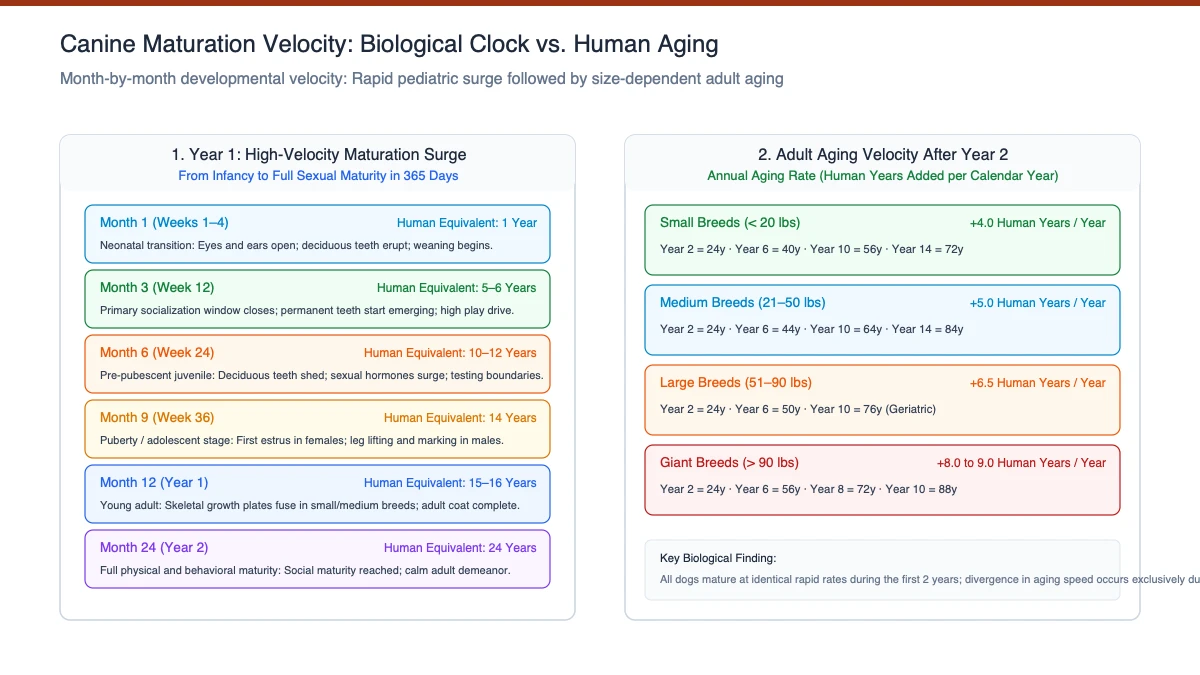
The rule the American Kennel Club and most veterinary clinics use weights the front of life: the first year buys about 15 human years, the second adds roughly 9 more, so a two-year-old sits near 24 human years. Every year after that adds about 5 for a medium dog - adjusted down to roughly 4.5 for small breeds and up to 6 or 7 for large and giant ones, because their clocks run faster. Work it through: a four-year-old medium dog is 24 + 2 x 5 = 34 human years, a ten-year-old is 24 + 8 x 5 = 64. The rule is deliberately coarse - it exists to place a dog on a human life-stage map, not to date a birth certificate - and its whole job is telling you when screening, dental checks and weight reviews become due.
Method two: the methylation clock
In 2020 Wang and colleagues published something better than a rule. They measured DNA methylation - the chemical marks that accumulate on DNA as mammals age - in 104 Labrador retrievers from puppyhood to sixteen years, compared the patterns against 320 humans, and fitted the relationship between the two species. The winning curve was logarithmic: human age = 16 x ln(dog age) + 31. It anchors development where the biology actually is - an eight-week-old puppy translates to about nine human months, the age both species cut deciduous teeth - and it lands a twelve-year-old Labrador, whose expected lifespan is twelve years, at about seventy human years, matching worldwide human life expectancy. The natural logarithm does the work the seven-year rule could not: violent change early, slow change later.
Why big dogs age faster
Across breeds the pattern is stark, and Kraus, Pavard and Promislow explained it in 2013 by modelling mortality for 74 breeds. Large dogs do not simply die younger by accident, nor do they start declining earlier - their rate of ageing is higher. On their data each extra two kilograms of adult body mass cost roughly a month of life expectancy, and body size explained about 44% of the between-breed spread in lifespan. Follow-up work found the same structure in purebreds against mixed breeds (mixed dogs averaged about 1.2 years longer at matched size), and a distinct IGF-1 variant shared by small breeds has since become a candidate mechanism: growth-hormone biology and ageing speed travel together. The practical translation is the senior line - roughly six or seven for a giant breed, closer to eleven or twelve for a toy.
Using either number honestly
Both outputs are population averages, and they disagree by design. The calculator shows them side by side and asks you to pick one scale and stay on it, because mixing a 15-year first year with a logarithmic later curve produces a number belonging to no dog. What the conversion is actually for is life stage: when screening bloodwork starts, when teeth get assessed, when weight creep starts to matter. A medium dog crossing seven should have baseline bloodwork and a dental check; a giant should have had them at five. The conversion is a communication tool for the waiting room - the schedule it points at is the part that changes outcomes.
Where the first fifteen human years come from
The 15/9/5 rule is not arbitrary weighting; it is a description of what a dog finishes in year one. By six months a puppy has its adult teeth, sexual maturity approaching and growth plates nearly closed, a checklist no human child comes near at the same age. Year two adds nine more because adolescence continues after the frame first looks done: behaviour settles and the body grows into itself. After two years the rule flattens to about five human years per calendar year for a medium dog, because nothing equivalent remains to compress. The animal is simply living. The logarithm in the methylation formula performs the same adjustment in one expression: ln climbs violently near zero and then flattens, which is why the clock places a one-year-old near 31 human years and then moves only a handful per dog year. Two shapes, one biology, fitted from different directions. Neither curve is a claim about your individual dog; both are populations averaged into a usable map, which is why the size classes in the calculator adjust the flat years after two while the logarithm handles the front of life for every dog at once.
Both formulas at the same ages
Running the two methods across a life puts the disagreement in view:
| Dog age | 15/9/5 rule | Methylation clock |
|---|---|---|
| 1 year | 15 | 31 |
| 2 years | 24 | 42 |
| 3 years | 29 | 49 |
| 8 years | 54 | 64 |
| 12 years | 74 | 71 |
The gap is widest in early adulthood, where the clock credits puppy tissue with work the rule leaves uncounted, and it closes in old age: by twelve both land within a few years of each other, near the three-score-and-ten of human life expectancy. The table also shows why mixing scales fails, because the spliced answer would belong to neither model. Choose the row that matches your purpose and keep every future conversion on that same row. The sizes sit in between as well: a small breed adds about 4.5 human years per year after the second, a giant about 7, so the flat part of the rule bends toward the animal in front of you.
Metabolic aging rates in dogs scale closely with physiological body mass and surface area; determine your dog's exact parameters using the canine body surface area calculator.
Worked example: How Fast Do Dogs Really Age? The Truth About "Dog Years"
A four-year-old medium dog converts two ways. On the 15/9/5 rule: 15 for the first year, 9 for the second, then 2 × 5, giving 34 human years. On the methylation clock: 16 × ln(4) + 31 = 16 × 1.386 + 31 ≈ 53. The gap is not an error; the two scales anchor different events in the dog's life. Pick one, stay with it, and use the number for what it is actually for: deciding when screening bloodwork, dental checks and weight reviews come due. Convert the same age both ways →
Common mistakes: How Fast Do Dogs Really Age? The Truth About "Dog Years"
- Splicing the two methods together: a 15-year first year bolted onto a logarithmic curve describes no actual dog, so pick one scale and stay on it.
- Applying seven years to puppy months: it calls a four-month-old three years old when the puppy already has adult teeth and near-closed growth plates.
- Using the medium-breed increment for a giant: after the second year add about 6 to 7 human years annually instead of 5.
- Treating the conversion as a diagnosis: both figures are population averages, and the life-stage schedule they point at is the part that changes outcomes.
Put it to work: How Fast Do Dogs Really Age? The Truth About "Dog Years"
The calculators below apply exactly what this guide explains: same formula, no mental arithmetic.
How Fast Do Dogs Really Age? The Truth About "Dog Years": frequently asked questions
Why do the two methods give such different numbers?
They anchor different events. The AKC rule starts the first year at 15 human years; the methylation curve starts every dog near 31 because puppy tissue changes far faster than a linear rule assumes. A 3-year-old reads 29 on the rule and about 49 on the clock. Pick one scale and stay on it.
Which method is right?
Neither is a diagnosis. Use the AKC rule for life-stage communication with your vet and the methylation formula when you want the research-grade comparison; both are population averages over very different individual dogs.
Do small dogs really live longer, or just look older?
Really longer, and they age more slowly getting there: body size explained about 44% of the variation in life expectancy across 74 breeds, driven mainly by a faster rate of ageing in large breeds rather than by bad luck as puppies.
How old is my 3-year-old dog?
On the AKC rule, 24 human years plus one medium-breed year of five: 29. On the epigenetic clock, 16 x ln(3) + 31, about 49. The calculator shows both so you can see where each scale places the same animal.
Sources & further reading
Found a number that does not match its source? Report a mistake. Corrections are published in place and the page date is updated.

Dr. Chyrle Bonk, DVM: Veterinary Editor
Chyrle is a mixed-animal veterinarian in rural Idaho who has practised since 2010, with a particular emphasis on food-animal medicine and cattle alongside her companion-animal caseload. She reviews the…