Guide · Cat
Cat Age Quiz (interactive)
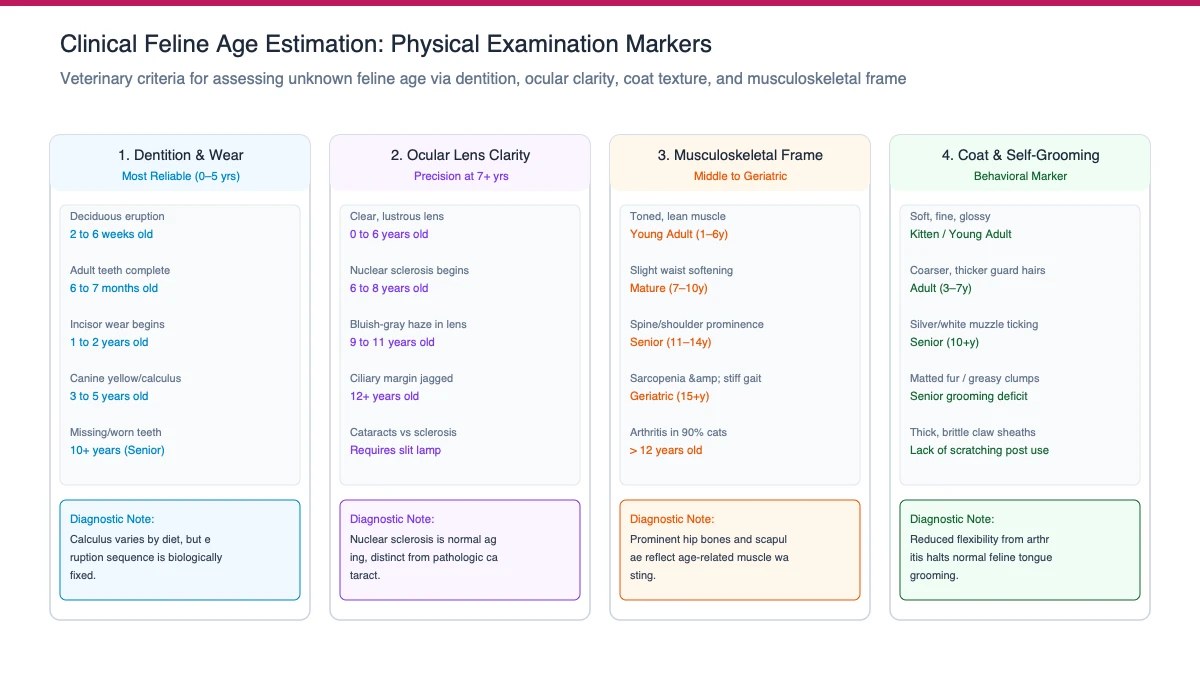
Feline age estimation assesses clinical physical indicators—including dental tartar accumulation, lenticular sclerosis, coat thinning, and joint mobility—to determine a cat's physiological life stage in human-equivalent years. Because rescue cats frequently lack documented birth records, evaluating biological markers provides the baseline for stage-appropriate feline veterinary care.
Interactive Calculator: Want the exact biological calculation? Use our cat age in human years calculator for life-stage and physiological age conversions.
Why a cat's age is an estimate
An unknown-age cat is aged by evidence, not by asking. Researchers compared nine ageing methods on 384 cats and reported the honest limits: tooth eruption dates a cat reliably only to about eight months - baby incisors erupt at two to three weeks, baby canines at three to four, permanent teeth begin replacing them around four months and the full adult set is in by six or seven - and canine root closure on a radiograph extends that to about twelve months. After that, in a living cat, no field method is reliable: wear, tartar and lens changes vary too much between individuals for better than a bracket. So this quiz delivers a life stage with a stated confidence, never a birthday.
What the four questions look at
- Teeth - the clock for the first eight months; after that, tartar load and wear move the estimate by years rather than months. Heavy calculus at the canines and any chipped or shortened tooth pull the reading older, while a clean, sharp adult set caps it below about three.
- Coat and grooming - kittens are fuzzy and still learning; young adults keep a glossy, immaculate coat; seniors often stop reaching the middle of the back, and mats or a dull, greasy coat over the loins are classic age signals. Winter coat and long hair both blur this one, so it works as a supporting vote rather than a deciding one.
- Activity - explosive play and fearless climbing mark the first year; a settled adult takes short play sessions; a senior chooses the floor and low perches, and stiffness on rising deserves a vet's look rather than a shrug.
- Muscle and condition - kittens are still filling out; young adults are firm under a thin cover; age-related muscle loss thins the spine and hips even when the scale weight looks unchanged, which is why this question asks you to feel rather than look.
How the vote is counted
Each answer carries one of four tags - kitten, young, adult or senior - and the tag appearing most often wins. Four questions means ties genuinely happen (two answers pointing one way, two another), and a tie resolves to the younger reading. Read the result as a band with a built-in reason to confirm it: mixed answers are exactly what boundary ages look like, and a dental exam plus bloodwork is what turns a bracket into a fact. If the answers split wildly rather than at the edges, re-check what you are observing - a shy cat hides its activity, a long coat hides its condition, and a cat that has just had a dental cleaning resets the teeth question entirely.
Turning the band into human years
The calculator's curve is the standard feline conversion: the first year counts as about 15 human years, the second adds 9 more (so a two-year-old is about 24), and each year after adds roughly 4. A six-month-old kitten is about half of fifteen - seven or eight human years - and a first birthday lands at 15; a young adult of two sits at 24; a four-year-old at 32; a seven-year-old at 44; a ten-year-old at 56; a fifteen-year-old at 76. The band gives you the inputs, the calculator gives the number and the life stage attached to it - and the stage is what sets the schedule, with veterinary visits moving to twice a year from about seven, when kidney and thyroid screening conventionally begins.
How old is your cat, really?
Four questions in the order a shelter examiner uses them - teeth first, then coat, activity and muscle. Pick what fits your cat today; the result gives a life stage and its human-year band.
Answer all 4 questions to see your result.
Put it to work: Cat Age Quiz (interactive)
The calculators below apply exactly what this guide explains: same formula, no mental arithmetic.
Cat Age Quiz (interactive): frequently asked questions
Can you really tell a cat's age from its teeth?
Reliably to about eight months, from the eruption sequence, with canine root closure adding a little to twelve months. Past that, tartar and wear give only a bracket of a year or two - documented as the practical limit in a study of 384 cats.
What human age is my cat?
Year one is about 15 human years, year two adds 9 (24 total), then about 4 a year: a 4-year-old is 32, a 7-year-old is 44, a 10-year-old is 56, a 15-year-old is 76. Put your cat's best age into the calculator for the exact figure.
When is a cat a senior?
Age seven is the accepted threshold for mature-adult screening, when visits move to twice a year; many frameworks call 11-plus senior and 15-plus geriatric. The calculator treats 10-plus as senior.
My answers split - is that bad?
No - boundary ages look exactly like that. The tie falls to the younger band, and the bracket gets settled at the next visit by dental exam plus bloodwork, which is how unknown-age rescues are aged in practice.
Sources & further reading
Found a number that does not match its source? Report a mistake. Corrections are published in place and the page date is updated.

Dr. Chyrle Bonk, DVM: Veterinary Editor
Chyrle is a mixed-animal veterinarian in rural Idaho who has practised since 2010, with a particular emphasis on food-animal medicine and cattle alongside her companion-animal caseload. She reviews the…