Free Animal Pregnancy tool
 Free Animal Pregnancy tool
Swine Gestation Calculator
The Swine Gestation Calculator calculates the sow farrowing date and farrowing crate transfer timeline based on the three-month, three-week, three-day rule (114 days). Sows carry 114 days (the familiar three months, three weeks and three days), with farrowing normally between day 111 and 117. Enter the breeding date for the farrowing date, gestational day, and the herd routine it sets: heat check at day 17–21, real-time ultrasound at days 21–35, and crate move around day 107–110.
Swine Gestation Calculator: result
At a glance
- What it does: Adds 114 days to a service date and prints the farrowing date, gestational day, and the 111–117 day window.
- Who it is for: Made for herd staff timing heat checks, ultrasound scans, crate moves, and the farrowing watch.
- Typical result: Returns the expected date, percent of term, and which diagnostic window is open on any given day.
How to use the swine gestation calculator
- Enter the service date. If she was heat-checked after weaning, the day-21 return check will already have told you whether she held. prefill →
- Leave the check date as today for her gestational day, or set any date to plan scanning and crate moves. prefill →
- Time the scan: days 21–35 for the first check, never days 38–50, and re-check anything doubtful from day 65 on.
- Move her to the farrowing crate about day 107–110 so she settles before farrowing rather than during it.
- Watch the red flags through the day 111–117 window and keep the induction conversation with your vet ready for day 114–116.
Swine Gestation: the formula & its source
Porcine gestation averages 114 days (the classic "three months, three weeks, three days" mnemonic), with a normal farrowing window of days 111–117. Modern herd genetics often run 115–116 days, so the single date sits in the middle of a real spread rather than on it.
Stages: days 0–20 (early embryonic, ending at the day-21 heat return), days 21–64 (the scanning window, with days 38–50 a trap), and days 65–114 (re-check, growth, crate move, nesting).
due date = breeding date + 114 days
gestational day = (check date − breeding date) in days
| Symbol | Meaning | Unit | Typical range |
|---|---|---|---|
breed_date | Date the sow was bred or artificially inseminated | date | any date within the last 125 days |
ref_date | Date her status is read for, left blank for today | date | the service date through day 117 |
D | Gestational day counted from the service date | days | 0 to 114 |
due | Expected farrowing date, computed as D plus 114 | date | 111 to 117 days after service |
Swine Gestation: worked example
Worked example: bred January 20. Farrowing date: January 20 + 114 = May 14. Window: May 11 – May 17, with the crate move on May 7 (day 107). Checking on March 1 puts her at day 40 of 114 (35% of term) with 74 days left. And note that day 40 sits inside the no-scan zone (days 38–50), so any scan today would be misleading even though she is comfortably pregnant.
Example B: scan inside the day 38–50 trap
Example B: a scan on day 42. Served on 10 January, she reaches day 42 on 21 February and looks comfortably pregnant, but she also sits inside the days 38 to 50 zone where skeletal calcification and bladder fill make readings unreliable. A scan that day can return a false open result and trigger a re-breeding decision on an animal carrying a full litter. Move the scan earlier, into days 21 to 35, or delay it past day 65, and the same equipment gives an answer worth acting on.
Average and range in days
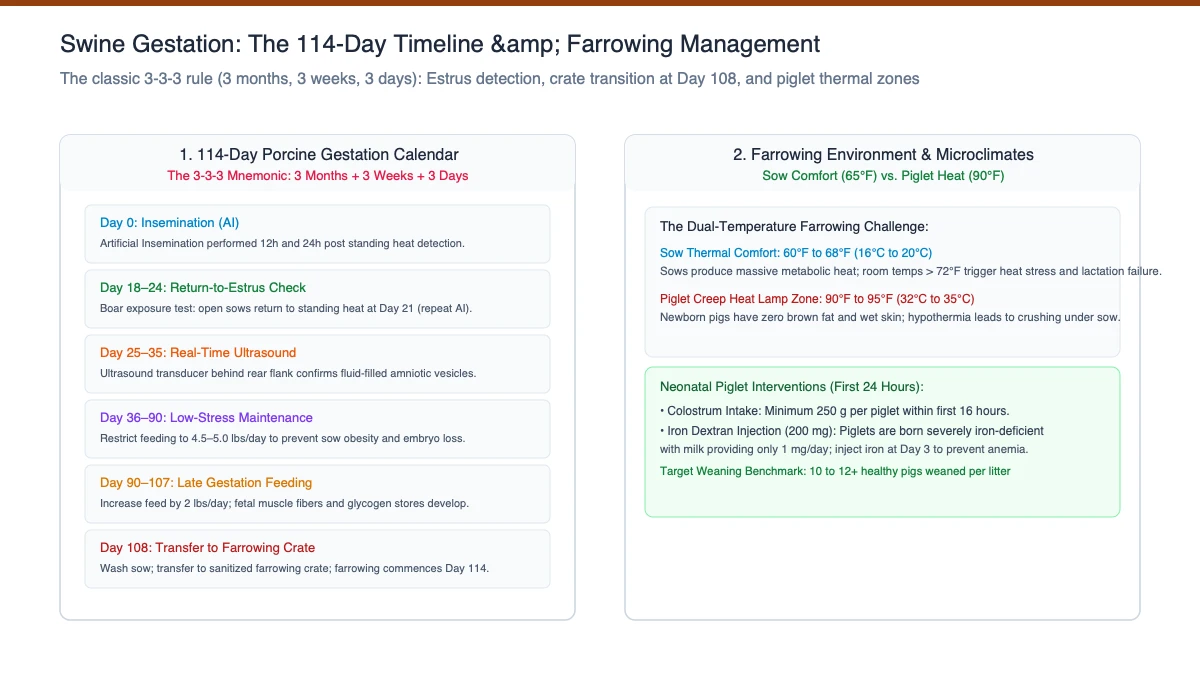
Porcine gestation averages 114 days, the familiar three months, three weeks and three days, with normal farrowing between day 111 and day 117. Modern herd genetics often run 115 to 116 days, so the single date printed by the calculator sits in the middle of a real spread rather than on top of it. Three days of variation either way is routine once the service date itself is right.
Service, ovulation and conception are not the same day. A sow served a day or two before she ovulated carries a due date later than her record suggests, and a sow bred across a prolonged or silent heat can be misdated by several days. Twin litters, which are common in swine, do not change the timeline. The band that matters for planning is therefore the whole 111 to 117 day window, with the crate move, the induction conversation and the farrowing watch all arranged inside it.
Early signs and timeline
Days 0 to 20 run quietly and end with the most useful sign the system gives for free: a sow that failed to hold returns to heat around day 21. Checking every sow at that point separates held from open animals before any equipment is unpacked, and it is the cheapest diagnostic step in the whole cycle.
Confirmation follows quickly. Real-time ultrasound between days 21 and 35 gives better than 93 percent accuracy even as early as days 21 to 23, with the best results around day 30. The following fortnight, days 38 to 50, is a trap in which false open readings are common, so no scan decisions should be taken then. Anything doubtful gets re-checked from day 65 onward. By day 107 to 110 she moves into the farrowing crate so she settles before delivery rather than during it, and nesting behaviour typically starts 12 to 24 hours ahead of farrowing.
The crate move deserves its own note. Moving at day 107 to 110 gives a sow several days to settle into the crate and begin nesting without relocation looming over farrowing itself, whereas moving on the due date adds stress to exactly the animals that need calm. Write the move date on the same card as the scan result, so whoever is on duty does not have to reconstruct the timeline from a service record at the end of a long day.
When to see a vet
Farrowing problems are recognised by the clock as much as by appearance. Contractions without progress, a sow that strains for an extended period without delivering, or one that delivers part of a litter and then stalls all need veterinary assistance. Keep the induction conversation with your veterinarian arranged for the day 114 to 116 period rather than raising it after she is already overdue.
Past day 117 with no sign of farrowing, the pregnancy is outside the normal window and the first question is whether the service date or the pregnancy itself is at fault. A sow scanned doubtful during the unreliable days 38 to 50 can easily be carrying a litter that a single poor reading declared absent, so confirm status before making re-breeding decisions. Off feed, fever, or abnormal discharge at any point in late gestation also belong with a veterinarian rather than with the herd record.
How accurate is the estimate
Accuracy is governed by the input date and by the scan you trust. Service dates that precede ovulation by a day or two shift the true due date slightly, and a silent heat can move it by more. Given a sound service record, three days of normal variation covers nearly every farrowing you will see, and modern lines running 115 to 116 days sit comfortably inside it.
Imaging is precise only at the right time. Ultrasound on days 21 to 35 answers the pregnancy question reliably, while days 38 to 50 produce false negatives that have ended viable pregnancies on paper. Re-checks from day 65 restore confidence in anything uncertain. The 3-3-3 mnemonic is a memory aid for 114 days and nothing more, which is why the window rather than the date should govern crate moves, induction timing, and the farrowing watch.
After farrowing, compare the real date with the computed one and adjust the record, since a herd whose sows consistently farrow two days early has learned something its service dates did not tell it.
What your swine gestation result means
In herd work the diagnostic dates matter more than the due date: day 21 tells you who held, days 21–35 tells you who is pregnant, days 38–50 tells you nothing at all, and day 107 tells you when to move crates.
The 3-3-3 rule is a memory aid for 114 days, not a precision tool. Modern lines run 115–116 days, which is exactly why the window, not the date, is what you should plan around.
How to read the output:| Result range | What it means | What to do next |
|---|---|---|
| Day 21 | return to heat marks a failed service | Identify open sows before scanning begins |
| Days 21–35 | reliable ultrasound confirmation window | Scan for status while accuracy is highest |
| Days 38–50 | unreliable readings, false open results common | Do not scan or make breeding decisions in this stretch |
| Day 65 onward | re-check window for doubtful animals | Confirm anything uncertain before acting on it |
| Days 107–110 | crate move ahead of farrowing | Move her so she settles before delivery begins |
| Days 111–117 | normal farrowing window around the computed date | Watch for nesting 12–24 hours before delivery |
Optimize gestating and lactating sow feed efficiency using our swine feed conversion ratio calculator.
Common mistakes with the swine gestation
- Scanning on day 40 because she looks settled: Avoid days 38 to 50 entirely, since calcification and bladder fill produce false open results that can end a valid pregnancy record.
- Treating the 3-3-3 rule as a precise date: Use the 111–117 day window for planning, because modern lines run 115–116 days and the mnemonic only remembers 114.
- Moving the sow to the crate on the due date: Move her at day 107 to 110, giving a week to settle before farrowing instead of arriving during it.
- Re-breeding from a doubtful scan: Re-check from day 65 onward, as a single poor reading in the unreliable zone has little bearing on her actual status.
Limits of the swine gestation calculator
Service dates can precede actual ovulation by a day or two, and a sow bred across a prolonged or silent heat may be dated wrong by several days. Twin litters are common in swine and do not change the timeline.
The scanning trap is the biggest practical hazard: skeletal calcification from about day 40 and bladder fill make days 38–50 unreliable, so a false 'open' reading there leads to needless re-breeding decisions. Confirm doubtful animals at day 65 rather than arguing with a bad scan.
Clinical note from Dr. Chyrle Bonk, DVM: Porcine gestation follows the classic, dependable rule: 3 months, 3 weeks, and 3 days (114 days, with normal delivery between days 112 and 116). In swine herd health management, sows are washed and moved into sanitized farrowing crates or pens on day 109 to 110. Maintaining ambient room temperature near 68°F (20°C) for the sow while providing supplemental heat pads or radiant lamps at 90°F (32°C) for newborn piglets is critical to reduce crushing and chilling mortality.
Sources
- Merck Veterinary Manual, Breeding management of pigs (used for: 111–117 day gestation with modern herds at 115–116 days)
- Merck Veterinary Manual, Common tests for detection of pregnancy in pigs (used for: ultrasound timing, accuracy by day, and the days 38–50 unreliable zone)
- Merck Veterinary Manual, Approximate gestation periods table (used for: pig gestation average used as the calculation baseline)
Cite This Calculator
For laboratory course reports, academic papers, or institutional protocols (APA format):
Swine Gestation: frequently asked questions
How long is a sow pregnant?
About 114 days (three months, three weeks, three days), with a normal farrowing window of 111–117 days. Modern herds often run 115–116.
When can you ultrasound a sow?
Days 21–35, with over 93% accuracy even at days 21–23 and the best results around day 30. Avoid scanning days 38–50. False 'open' readings are common.
When should she move to the farrowing crate?
Around day 107–110, about a week before the due date, so she settles before farrowing begins. Nesting behavior typically starts 12–24 hours before delivery.
Can a sow's due date be wrong?
Yes. Service date, ovulation, and conception are not identical, so ±3 days is normal. A return to heat at day 21 is the fastest proof of a failed service.
Found a number that does not match its source? Report a mistake. Corrections are published in place and the page date is updated.
Question a result, or spotted a number that doesn’t match its source? Email the correction →.

Dr. Chyrle Bonk, DVM: Veterinary Editor
Chyrle is a mixed-animal veterinarian in rural Idaho who has practised since 2010, with a particular emphasis on food-animal medicine and cattle alongside her companion-animal caseload. She reviews the…